
My first encounter with Thomas Pynchon was indirect, though the filter of a filmmaker whose latest movie felt suddenly weird, unfamiliar, a little ill at ease, perhaps even “off”, as if he’d come under a strange new influence, or was maybe just drunk. Paul Thomas Anderson’s Inherent Vice didn’t feel like any other Paul Thomas Anderson movie. When I first saw it, I was confused. What on earth had happened to this movie? Why was it so conspicuously and bizarrely different from his other movies, so unlike the Paul Thomas Anderson I remembered? What was this raucous audacity, this untidy shimmer as if it were shot through a distorted lens? What was this strange aftertaste, like some spice from a distant land surreptitiously stirred into the mix? What were these shifts in tone, these ludicrous outbursts, the slithering vulgar undercurrents of eroticism? Why the sensually indulgent voiceover from a fortune teller, invisible to most of the other characters, in an ethereal performance from a folk harpist named Joanna Newsom? Why does Martin Short abruptly show up, as ridiculously out of place as a talking dog? It wasn’t just detective fiction, it was detective fiction by way of something else.
Continue reading →
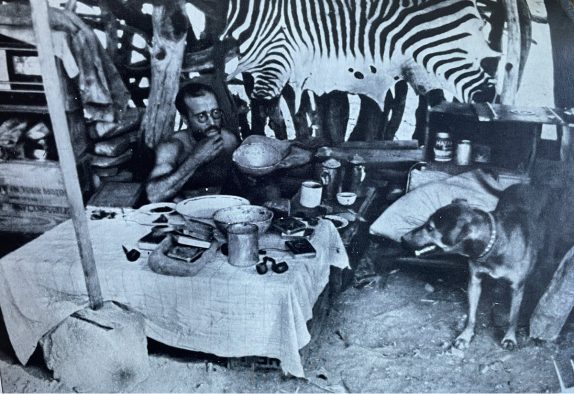
For the most part, The Sheltering Desert is a survival adventure about two men who take refuge in the Namib desert during World War II. But on a deeper and perhaps more fundamental level, it’s a story of transformation. Of what happens when your life is dictated by the demands and rhythms of a harsh wilderness. It’s the story of decivilization, or perhaps recivilization. Learning to live life by different rules.
Continue reading →

Django Wexler’s How to Become the Dark Lord and Die Trying didn’t teach me how to become the Dark Lord. But it did teach me other things, such as how fantasy worlds are uniquely demanding, how comedy is hard to do, how not to write a female character, how action scenes are usually a waste of word count, how some writers need vigorous editors, and how some people play too many videogames. Although many of the lessons I’d already learned elsewhere, so I guess it would be more accurate to say How to Become the Dark Lord reminded me rather than taught me.
Since I’m reviewing this at the behest of someone who enjoyed it and said he hoped I’d enjoy it, I feel bad confessing that no such thing happened. To elaborate feels pointless and even a little cruel. But I’ve been charged with a task — a quest, even! — and I intend to fulfill it. So I suppose maybe this book did teach me a little dark lordliness, in its own way.
Let the pointless cruelty commence!
Continue reading →

It’s 2005 and it’s been 20 years since Christoper Reeve’s final Superman movie, the astonishingly cheap made-for-TV-quality Quest for Peace. Reeves’ fall from a horse and eventual death from complications has cast a sad shadow over Superman in the wider world beyond comics. The Man of Steel lived his final years as a ghastly near-cadaver, having to blow into a tube to trundle onstage and show us his resolve. He was an inspiration to people with disabilities and his gradual recovery was a miracle of modern medicine, but it seems he inadvertently humanized Superman in the public consciousness. It turns out the Man of Steel was only ever a man of flesh, no more steel than any of us.
Continue reading →

Hyperion is not what you would expect if the only Dan Simmons you’ve read is The Terror, a slab of historical fiction with an uneven supernatural glaze. It’s overlong, tedious, confused, and ultimately flat. You’d never guess it was written by the same person who wrote Hyperion, a sparkling collection of multi-faceted science fiction, with carefully built characters, a lovingly detailed world, and a glaring problem that threatens to undermine it all.
But we’ll get to that later. The first thing that’s clear in Hyperion, which I don’t remember being a takeaway from The Terror, is that Simmons is an adroit writer. Maybe it helps if you’ve been reading someone who isn’t.
Continue reading →

You don’t read Deadhouse Gates to read Deadhouse Gates. You read it because you just read Gardens of the Moon and you’re about to read, uh…hold on, let me go look up the next book. Memories of Ice. You read it because you’re reading Steven Erikson’s bloated drawn-out Malazan series and this is the second book of, good lord, ten? There are ten of these?
Continue reading →

Most of Fup feels like a comedic short story. Like more profane Charles Portis or less absurd George Saunders. Maybe the sort of thing John Kennedy O’Toole might have written if he’d been alive to keep writing. But Fup stands apart for where Jim Dodge goes with his humor. He’s writing to amuse, to be sure. But he’s also writing to bring you someplace philosophical, perhaps even spiritual, but without any of the weight of philosophy or spirituality. It’s ultimately a tangle of homespun wisdom that lapses into folklore. The punchline isn’t really a punchline. It just might be a parable.
Continue reading →

You know how sometimes you think it would be cool to be back in school? Just learning about neat things, sampling a broad array of subjects, getting back to the classics of art, the fundamentals of science and mathematics, the greatest hits of history? Spending entire days just getting smarter? That would be cool, right?
But hold on a second. Continue reading →

In Lovecraft Country, being called a nigger, refused service at a restaurant, harassed by the police, or treated with contempt by an elite coven of warlocks is just another day. This cast of black characters living in Chicago in 1954 is accustomed to America. They have learned to navigate it. Literally. One of the main characters publishes a travel guide called The Safe Negro Travel Guide. It steers black people around — or, if necessary, through — the more virulent racism in America, especially where Jim Crow laws are still in effect. Which restaurants will serve black customers? Which highways should you not be on after dark? Which garages can you call if your car breaks down?
So the characters in Lovecraft Country don’t seem terribly surprised by the idea that maybe the universe is a vast and ancient expanse of indifference at best, outright hostility at worst. Why would someone go insane from learning what minorities know every day? If you look into the abyss long enough, you still have to ride in the back of the bus on your way to work. Continue reading →

For someone (i.e. me) who hasn’t read any of the Culture series, or even any Iain Banks, Player of Games is a real eye-opener. Banks is a deft and imaginative writer. This is a series I’m eager to explore further.
But as a commentary on games from thirty years ago, it doesn’t have much to offer. Continue reading →

Republican Congressman Mike Bost invoked something called “struggle sessions” last month. While talking to journalists, he explained why he wasn’t holding any town hall meetings, which have provided angry constituents a forum to make themselves heard by their Republican representatives. Bost felt holding such a meeting wasn’t a good use of his time. He compared it to “the cleansing that the Orientals used to do where you’d put one person out in front and 900 people yell at them.” That’s how I learned about “struggle sessions”, a form of public humiliation used in Communist Russia and China. Bost later apologized for using the word “Oriental”, but not for shirking his duty as a representative.
The Three-Body Problem, an award-winning “Oriental” science fiction novel, begins with a struggle session during China’s Cultural Revolution. It is the catalyst for everything that happens in the book, which might include the end of the world. It is also an example of the novel’s uniquely Chinese cultural identity.
You’d never know from its beginnings that despite this identity, The Three-Body Problem is literally universal. Continue reading →


