


My Imperial Struggle

Once upon a time, there was the perfect boardgame, and it was called Twilight Struggle. It came to us in 2005, otherwise known as the Dawn of the Age of Caylus, which was a threadbare—even penurious—era, a time when gameplay was as cold and austere as ye olde English lords who created it to keep the boardgaming peasantry groveling for scraps in an unending servitude to mechanics. The fact that it took a couple of breakaway designers across the Atlantic to set gaming in a new direction simply mirrored the arc of world events, and thus when Twilight Struggle rose to the very top of the Boardgamegeek rankings, it was as momentous as the time in 1992 that Francis Fukuyama dubbed “the end of History.” As the game itself was about that very period, it all threatened to wrap itself into an infinitely self-reflecting vortex, but games like Agricola soon arrived to carefully shepherd boardgamers away from geopolitical aspirations and towards portraying themselves as actual shepherds. And thus the peace was kept nigh many years.
Then in the Year 2020, a terrible virus engulfed the Earth, which was either a tragic misfortune, God’s revenge, an Oriental bioweapon, or a giant hoax that you should feel ashamed of believing in, all depending on your alignment and which part of the Astral Plane you hail from. Not at all coincidentally or any less importantly, it was the year that the designers of Twilight Struggle (again, two gentlemen hailing from the land of breakaway colonists) released Imperial Struggle, a game that was supposed to remind you that for far longer than there have been area control mechanics disguised as made-up rabbits and crows, England’s “hereditary enemy” was France. In a roughly hundred-year period between one time and some other time, these two empires fought for … stuff. Fish. Cotton. Prestige. Territory. In other, more academic terms: victory points.
Somehow, though, the game didn’t exactly catch on the same way Twilight Struggle did. If you want some kind of sourcing for that statement, I will refer you to my memory, and all the stuff I read about Twilight Struggle back then, and what I’ve read about Imperial Struggle since then, and how I feel about these things. But knowing how gamers demand absolutely objective evidence about everything, I can only say that right now, Twilight Struggle is #16 on Boardgamegeek’s strategy game rankings, and Imperial Struggle is #251. That’s as definitive as being caught standing over the dead body holding a smoking gun with expended cartridges in your pants.
I think that would have been it, and the passage of time would have eventually led to all this being buried under archeological layers of stinky clay and squirrel feces, had Brian Reynolds not come along and developed a version of Imperial Struggle for Rally the Troops. Dot com. Since you all know who Brian Reynolds is, I’m just going to move along from there. If you need a refresher course, sorry. The internet forgot. We only have this left.
Rally the Troops is a website that hosts a browser app for boardgames that enforces the rules. Yeah, exactly. It is the brainchild of a guy called Tor, who may or may not have also recorded one of my favorite electronic albums of all time. It hosts an eclectic collection of boardgames, ranging from the seminal Paths of Glory to the trivial and not worth your time [game name redacted]. It’s also open-source, so anyone can code their favorite game (with the appropriate publisher’s rights) and have it posted. And the fact that Qt3’s Clay Heaton is not spending all his time furiously converting the classics of boardgaming into Rally the Troops apps points to the profound misalignment of global incentives that is rapidly bringing our wasted civilizational time on this Earth to a welcome and long-ordained close.
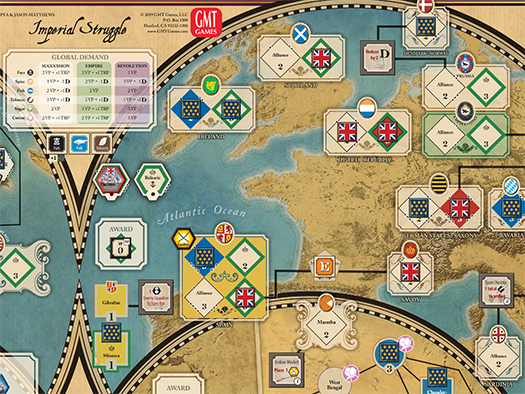
If I’m getting too philosophical for you, think about the distillation of motives that had to go into a game about multiple successive monarchies trying to satisfy innumerable competing interests across several continents, plus sex. Our nation’s inherited Puritan values prevent us from incorporating sex into games about hereditary dynasties—illogical as that is—but they surely don’t prevent us from including wholesome acts such as fighting. Imperial Struggle portrays the struggle across four continents, if you count the bottom half of America as an extra continent, which I do because if you don’t like it how are you going to stop me. The cockpit (which is a term that aeronautics is trying to abolish) of this fighting is Europe, the home of various hereditary monarchies such as all the spaces you see in the image below. This is a real problem I’ll get into later.
As you all know from your careful study of the role of the Angevin kings of England in the progression of world history, France and England competed across the salons of Europe, and the markets of America, the Caribbean islands, and India. Imperial Struggle envisages these efforts as discrete “investments” represented by investment tiles. There are nine of these each turn, and you’ll use eight. Just like you did historically.
When I say “you” I mean “the two of you” because nobody could use eight investment tiles at one time—that would surely take two people at least. Each tile has a major and a minor action specified, between economic, diplomatic, and military. These have been verified to be the three kinds of actions you can take as a monarchy so it all checks out. Each turn, over four action rounds (a term still awaiting a trademark infringement claim from the Mego Corporation), players choose whether to control markets, shift political spaces, build forts, or move fleets, all to fulfill certain conditions, such as having the most fishermen, or the most controlled spaces in the Caribbean, or the most prestige spaces in the courts of Europe. It’s a complicated dance, to be sure.
Event cards—drawn separately from investment tiles–give you the ability to do things “off menu,” like flip control or spend extra points or reduce your debt or make your opponent take more debt or build some squadrons of ships or pretty much anything you can think of that happened in those times and didn’t involve goblins. The ability to play events is dictated by whether or not a tile is available that enables events. Sometimes an event requires a tile to have a certain major action, which further restricts the number of tiles that will enable it. I think you can see where this is going. Furious calculation.
The reason for this is that in this area-control game of area-control games, there is one major (ha!) rules caveat, and that is that in order to remove your opponent’s control marker from a space, you must do it with a major action. This restricts the number of removals that can happen in a turn to the number of major actions of that type allowed by the investment tiles that have been drawn. So if there is only one tile available that turn that allows major diplomatic actions, the side that plays it will have an advantage because except under certain circumstances, that action will not be reversible.
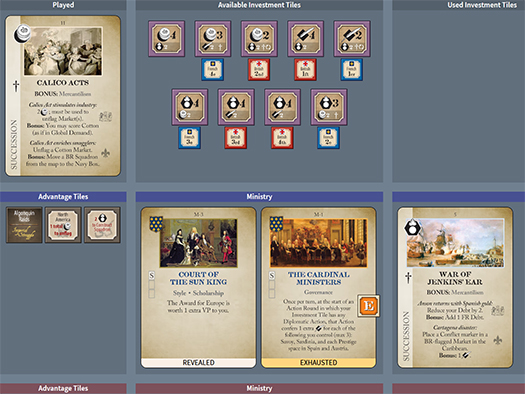
Which brings us back to events. Events can break the game, which is just like Slay the Spire except there it’s weird creatures who give you abilities, while here it’s ordained by History. You can get extra action points, or remove the other player’s control from certain spaces, or get money (in the form of reduced debt), or whatever you can imagine that happened in those times, again with the specific exclusion of goblins.
Because I’m a very bitter and angry person, I’m going to go ahead and vent about a game I just played, where I thought I was playing the last major diplomatic tile of the turn. I could see it: 4 major diplomatic, 2 minor something else. I chose it. I went and flipped a bunch of stuff I wanted, safe in the conviction that I couldn’t get re-flipped because there were no more tiles with diplomatic major actions available. But my opponent, who obviously is a bad person with no moral center, used a tile to play an event that gave him (or her, or it) a one-point diplomatic bonus. Which he then used as a major action (which is legal but not something I would approve of from a Constitutional perspective), backed up by a lot of debt, to reverse everything I had done previously and then some. And then he was like “hah u a jackass” and I was like “imma fite u” and he was like “im in china dude” and I was like “goddamn it.”
Tom Chick (of whom you may have heard somewhere) and I played a game of Twilight Struggle online, which consisted mostly of me kicking his a$$, and him whining about it. One of his complaints was that you really needed to know all the cards and their interactions to play the game effectively. And I was like uh do you think Dean Acheson complained about having to know things? That shut Tom up pretty quick, because Tom loves himself some Dean Acheson.
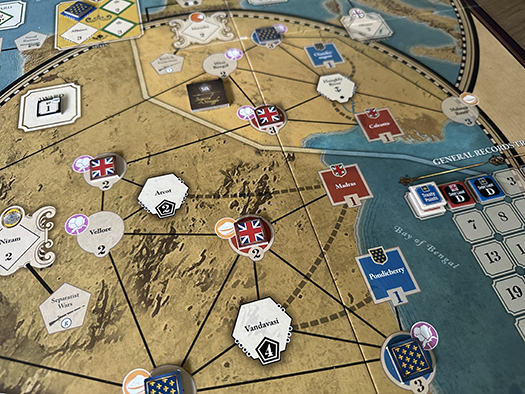
But the point remains: I shouldn’t have been so confident about my presumed invulnerability, because there were still tiles available that allowed for events to be played, and if I had prepared for that possibility, I would likely have waited and not taken that tile and my opponent would have taken it instead and screwed me even harder because like I said, there were no more tiles with major diplomatic actions on them. Life is barely tolerable even for the best of us, and for the others it’s just an unending Gehenna of pain unless you can generate some extra action points via the expenditure of debt.
Debt is Imperial Struggle’s most interesting construct, because from a historical perspective I think this is one of the most insightful mechanics in the game, since much of the day-to-day consideration of the French monarchy in particular was how they were going to pay for all this stuff. Can you believe they were allied with the Turks? What a bunch of religious traitors! So if you can get past that, which I honestly cannot, you get to the understanding money lets you do things, which I think is validated by everything you did today and yesterday, so don’t argue with me about it. Debt in Imperial Struggle is just extra action points, which can be the difference between controlling one more fish space in North America that gets you both the victory points for fish and those for North America. But how important is North America?
In Twilight Struggle, the most important continent in the game is Europe. The reason for this is that this is just how life is. If you don’t like it, you should move to one of those planets in those Larry Niven novels where it’s all round, or if you can’t do that you can just play it on Steam. But everyone else knows that the Soviets have to keep a lid on Poland because if the Good Guys flip it by electing Pope John Paul II, the consequences will be serious. This has been proven time and time again by historical differential equations. And you feel it viscerally.
In Imperial Struggle, the importance of a particular region is subject to the draw of certain chits, which determines the victory point allocation for that turn. On one turn, Europe may be pre-eminent. The next turn, it may be India. And then India again. It’s determined by randomness, which I’m sure wasn’t necessarily Odin’s intention. This can reward positions where you may not be positioned properly this turn, but next turn suddenly you have all the tobacco and that is what is in demand this turn. This is how the world works. Do you like life punching you in the face all the time? I don’t need a game for this purpose but accept that this is my lot in life.
The game has a definite geometry. It creeps up on you, like one of those courtiers you see in movies where they are kind of walking around in the background waiting, and all of a sudden tell the king that his son is dead or his mistress is pregnant or that Elric wants to see him, and suddenly you realize that the squares and circles on the map actually have a logic to them. Because at first, the map looks like a weird mishmash of map you find in a museum from some guy in the 1500s who made detailed drawings of the African coast but never actually left his house in Schleswig, plus Glorantha. Four kind-of-circular regions with land masses that look vaguely familiar, because of all the geographic shapes you might most easily recognize, two of them are probably Britain and Florida. But the weird portion of the Indian subcontinent on the map could be anything. If you told me there was a race of ducks that lived there and tilled the land, I’d believe you.
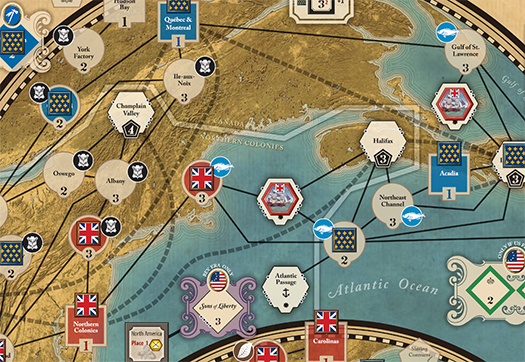
Slowly, you realize how the designers have crafted their own 17th-century Domino Theory out of trade, war, and diplomacy. All the trade spaces look the same, until you realize that if you protect them with forts or fleets, you can make them very hard for your opponent to wrest from your control. But only certain spaces are adjacent to potential forts, or sea areas, and thus positioning military strength furthers your commercial interests. But military strength costs money and opportunity that would otherwise be spent on trade. All the diplomatic spaces seem of little use unless they give you an alliance advantage in a war (more on that in a bit) but you soon discover that some of the most innocuous spaces confer advantages that can completely flummox your enemy, the way I was completely and totally flummoxed.
This is where the availability of a rules-enforcing digital referee that allows players to rapidly iterate game strategies can really speed up the meta. In the four or five games of Imperial Struggle I had played before putting it away for something else, I couldn’t figure out why anyone would use diplomatic points to take local alliance spaces, which didn’t seem to give you anything except the ability to place conflict markers. Which seemed like a waste of time since they go away after every war, and there is a war almost every turn. Who needs that? Until I played a guy who basically took all the local alliances, overran me with conflict markers in all my commerce spaces, and ran me out of the game by the third turn (there are six).
I wrote an article a long time ago about some game where giant ants came from the stars to build things. The counterargument from the late, and much missed, Alan Emrich, was human emperors have way, way more constraints on their actions than a bunch of intelligent space ants. Alan came up with the idea of Imperial Focus Points, which limited you to only being able to do certain things at certain times, like a more realistic space emperor. Then the whole thing got replaced by a spreadsheet because nobody likes abstraction in computer games.
In a way, Imperial Struggle is the philosophical successor to Master of Orion 3 before it got all messed up with studio notes. Each turn’s investment tiles are very clearly opportunities available to the respective monarchies: on one turn, you may have a bunch of economic and diplomatic tiles available, but only one war tile. Or none. That’s just the way the world has worked out during those decades. Monarchies in the Age of Enlightenment operated within the constraints of the European monarchical system, where there might not always be a chance to make outright military advances, or there might not be commercial opportunities worth pursuing, or you may have really offended the sensibilities of European salons with your extraordinarily pungent farty pants and now no one will answer your letters. Btw, remember letters?
Want to start an all-out war in India? Tough. The limitations of finances and diplomacy prevent it. Right now. Since you’ll eventually cycle through all of the investment tiles, you’ll get the chance to warfight all the fightwars. But not on your schedule.
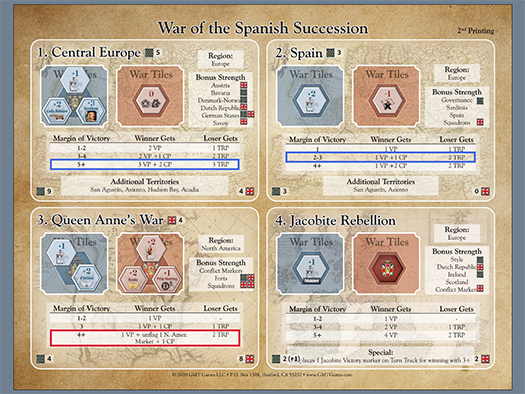
What this does, though, is to dictate play in which you never want to be winning anything by anything but the smallest margin because anything else may handicap you later. If you’ve put a lot of investment into sugar, and then it doesn’t come up as a demand good for the next three turns, you’ve wasted a lot of action rounds. Which, again, may be exactly what the now-deceased members of the House of Bourbon would tell you if you had asked them before you threw out the Ouija board you had as a kid that got trashed when your parents cleared out the attic: we spent too much on the fur market. Because when you look at the history being represented, and the value placed on markets over territory, you see that you’re really the French of British monarchies desperately trying to fund their lifestyles and ambitions. Want Pondicherry? Have it. It’s 2 VP. But give me my sugar and tobacco.
This is emphasized by the importance of debt. If you are at your debt limit and incur debt from an enemy tile, you lose a victory point. Which is a huge deal, much worse than losing a fort in some godforsaken colonial hellhole. It truly is about European monarchic solvency.
This is smart and insightful historical design. My question is whether it is good game design. And the answer is …
I’m not sure.
One problem I have with the random value chits is that they imply a world that is unpredictable and changing, with no guarantee that this turn’s bonanza in sugar and tobacco in the Caribbean will last. Maybe it will. Or maybe next turn it will be all cotton and spices, meaning India. Or fish and furs from North America. But then the game locks you into four very pre-determined global wars, as though you are some sort of Calvinist. The Succession Wars (Spanish and Austrian), Seven Years War, and American Revolution all happen on schedule, as though none of them were affected by anything else happening in the random part of the game. Queen Anne’s War is followed by King George’s War is followed by the French and Indian War. With apologies to Beavis and Butthead, I can only ask: why no Beaver Wars??
Sorry. Far be it from me to fight History. But I can’t shake the feeling that I’m participating in a combination of episodic attempts at controlling things that have no connection to each other. And none of them feel like anything other than some comparison of integers.
I am so profoundly conflicted about this that I have now played over 30 games of Imperial Struggle on Rally the Troops, and am still waiting for that revelation that this is the game for me. On the other hand, I keep playing.
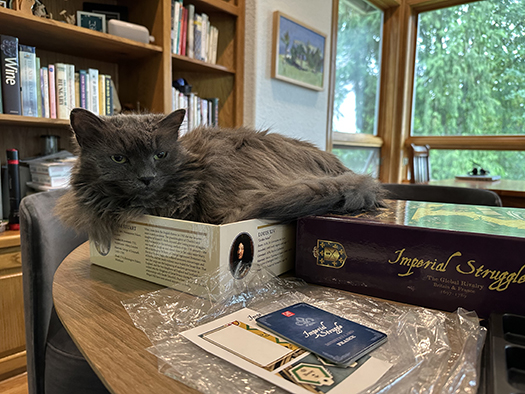
In some games I play, there is a geographical and military confluence of understanding that leads to a better understanding of our planet and the events that have taken place on it. In the other, there are some spaces that are round, and some that are square. None are hexagons. This is a profound historical revelation. The flames of Gehenna await you.

Imperial Struggle
Rating:
Boardgame
Find out who would win in a fight between England and France!
