


All-Star Superman: now more than ever?
It’s 2005 and it’s been 20 years since Christoper Reeve’s final Superman movie, the astonishingly cheap made-for-TV-quality Quest for Peace. Reeves’ fall from a horse and eventual death from complications has cast a sad shadow over Superman in the wider world beyond comics. The Man of Steel lived his final years as a ghastly near-cadaver, having to blow into a tube to trundle onstage and show us his resolve. He was an inspiration to people with disabilities and his gradual recovery was a miracle of modern medicine, but it seems he inadvertently humanized Superman in the public consciousness. It turns out the Man of Steel was only ever a man of flesh, no more steel than any of us.

But for most of those years, things in the world had been going swimmingly and we didn’t need an all-powerful godlike superhero to save us anymore. In those days, we were indulging in our darker side, ironically, Tim Burton style, with the Batman movies. Just goofing around mostly. Until 2001. Until 9/11. Perhaps because of 9/11, Bryan Singer roused Superman from a long absence. Say what you will about Singer’s Superman Returns, but it made Superman super-cinematic again, and Kevin Spacey’s Lex Luthor is now as creepy as a Lex Luthor will ever be. It’s just like that bastard real world to bring low our superheroes and elevate our villains.
Origin story: the All-Star imprint
This is the cultural context in which DC Comics published a 12-issue run of standalone Superman comics, under the new brand of “All-Star”. This branding was used for a short-lived “imprint” which gave writers and artists full freedom to do what they wanted with the company’s characters. Select well-known creators, chosen for their critical and popular appeal, would have full access to the entire catalogue of characters without having to worry about any of the messy continuity issues that applied to the ongoing comics. All-Star comics were basically prestige one-offs, little pocket dimensions free from the ongoing rules and limitations that would normally apply. A trust exercise, if you will. “Hey, you guys have done such a great job, we give you special dispensation to go your own way, do your own thing, with all our assets at your disposal. We trust you. Go forth and create your own run.”
In other words, the “stars” weren’t just the heroes and villains that would appear in the comics, but also the creators of the comics itself.
“The title All-Star Superman was DC co-publisher Dan DiDio’s idea,” recalls a writer named Grant Morrison, who notes the name was a callback. “All-Star Comics was published by DC in 1940…Dan revived the All-Star trademark for a play-on-words imprint, established as a playground for “big name” comic book creators to cut loose on non-continuity, [by writing] “definitive” and personal visions of DC’s top characters.”
Morrison was hired to write All-Star Superman, which began in November of 2005 and wrapped up, 12 issues later, in October of 2008. There was also an All-Star Batman, by Frank Miller. It would sputter and stumble and fall apart, basically killing the All-Star concept (ten years later, DC would try again with Batman, resulting in an eventual All-Star Batman by another writer). You might call the whole thing a failed experiment, but only if you judge it by what it didn’t produce. We never got an All-Star Wonder Woman, an All-Star Flash, an All-Star Green Lantern, or an All-Star Joker. But it’s hard for me to consider a failure something that produced Grant Morrison’s All-Star Superman, a richly written, warmly drawn, and affectionate paean to an American icon. It was nothing short of an epiphany for me.
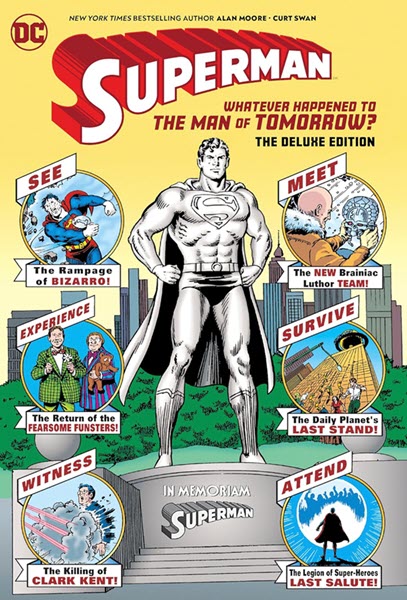
(Previously, in 1985, DC did something similar as they were transitioning Superman from one editor to another. For the final two issues of the outgoing editor’s tenure, he hired Watchmen author and deconstructionist Alan Moore to wrap up the Superman storyline. He gave Moore full creative freedom to imagine whatever he wanted, knowing everything was about to be rebooted with the next editor. The two-part “Whatever Happened to the Man of Tomorrow?” was a nasty little bow on the Superman mythology, tied by someone who didn’t even seem to like Superman. I hated it, but it’s an intriguing counterpart to All-Star Superman, subjecting the Man of Steel to all sorts of indignity, cruelty, and misery as befits Moore’s gloomy English misanthropy. Moore would write a few more issues, including a wacky Superman/Swamp thing crossover, all collected in this volume. I don’t recommend it unless you hate Superman, too.)
Our villain: the comics cynic
As someone not at all hip to comics, the significance of acclaimed creators is mostly lost on me. I wouldn’t know a Grant Morrison from a Van Morrison. And I furthermore wouldn’t have cared. I’ve spent my adult life dismissing comic books for various reasons, some of them rational. Comic books are silly power fantasies, made for kids. Comic books are crassly episodic, like TV at its worst. Comic books are inherently inconsistent, where nothing ever matters because someone else will write another issue next month. Comic books split the reader’s attention between poorly coordinated text by some writer and drawings by some drawer and someone else entirely coloring inside the lines and even someone doing weird things with the fonts like randomly bold-facing certain words. And don’t get me started on superheros, the original Mary Sues before Mary Sues even had a name.
Sometimes these observations about comic books are true, and perhaps even widely true. But sometimes they aren’t. Sometimes they’re short-sighted, uninformed, kneejerk reactions from someone who simply doesn’t have the patience or curiosity to take a closer look. And when you’re wrong, you’re wrong.
I don’t just mean that last sentence as a reprimand, because in some cases, it’s also and more importantly a revelation. And one I’m delighted to experience, even if it’s late in life. Heck, especially if it’s late in life, when you might feel you’ve seen it all and there’s nothing new under the sun. When you feel that from here on out, it’s just the things you’ve already liked and the best you can hope for is to re-appreciate the trappings of your childhood. So imagine my surprise to discover, at nearly sixty years old, not just a whole new medium, but a new perspective on an American icon who I had dismissed as naive, pointless, and just plain goofy.
For instance, one thing I’ve come to appreciate in comic books as a visual narrative medium, distinct from movies, is that they don’t have soundtracks telling me how to feel. A good soundtrack is, of course, an invaluable asset for a movie. But more often than not, it’s a cudgel, whapping me on the head with some emotional imperative: be sad, be triumphant, be wistful, be excited. So many soundtracks are clumsy and overt: here comes the action, here comes something dangerous, here’s the scary part, here’s the heartbreak, and now the long-awaited climax. Music dribbled so heavily over everything like syrup or motor oil, obvious and thick. Comic books have no such tool at their disposal and are better for it.
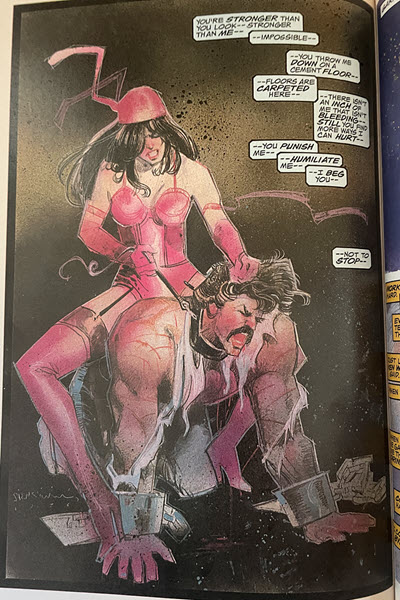
And not only can I really like comic books, some of them speak to me as full-throatedly as any novel, movie, or symphony. Which I never would have admitted a few years ago, even though I knew of at least one exception. Elektra: Assassin, largely due to artist Bill Sienkiewicz’s uncanny ability to channel Frank Miller’s juvenile fantasies into a psychologically violent work of almost overbearing expressionism in which America is subverted by an inviolable goddess. It’s the stuff of Greek mythology applied to the Cold War, seen through a stark Freudian lens. Basically, Athena come down from Olympus to spank Frank Miller — and America in general — for being such a dumbass. You might think it’s a stretch if you haven’t read Elektra: Assassin. But for many years I have owned, routinely re-read, and pondered a single-volume collection of its self-contained run. Yet I was unwilling to admit that maybe other comics could be just as relevant and just as powerful?
Meanwhile: in the land of Marvel
So All-Star Superman isn’t the first comic book I’ve read. In fact, I’m happy to say I’ve got a full shelf of comics that I’m delighted — proud, even! — to own. It all began when Kelly Wand, with whom I co-hosted years of movie podcasts, sent me hardcover omnibuses of Doctor Strange and Thor for some of the movies we’d be discussing on the podcast. Kelly routinely recommended real books, and sometimes to overcome my reluctance, he would send me a copy. He knew I couldn’t resist cracking the cover if a book were dropped into my lap. So I took the Doctor Strange and Thor volumes almost as a practical joke, as him punking me into reading goofy comic books. But reading the Thor comics by Jason Aaron changed how I experienced Taika Waititi’s second Thor movie, and for the better. I laid “groundwork” for Waititi’s riffs on various bits from Aaron’s run. I “got” the jokes! And that created a sort of feedback loop where I could go back and peruse the Thor comics and better appreciate Aaron’s stories.
Shortly thereafter, and as a result of me reading and not hating Doctor Strange and Thor, I was talking with a close friend named Chris Marquardson, who grew up reading comics and therefore had none of my cynicism or prejudice, and who could still appreciate them with a child-like — but not childish — enthusiasm. He told me how the Thanos storyline in the Marvel movies, a fascinating set-up with a facile pay-off, differed from the source material in Marvel’s comics. And he did something astonishingly generous and entirely in character: he sent me his copies of the original Infinity Gauntlet run!
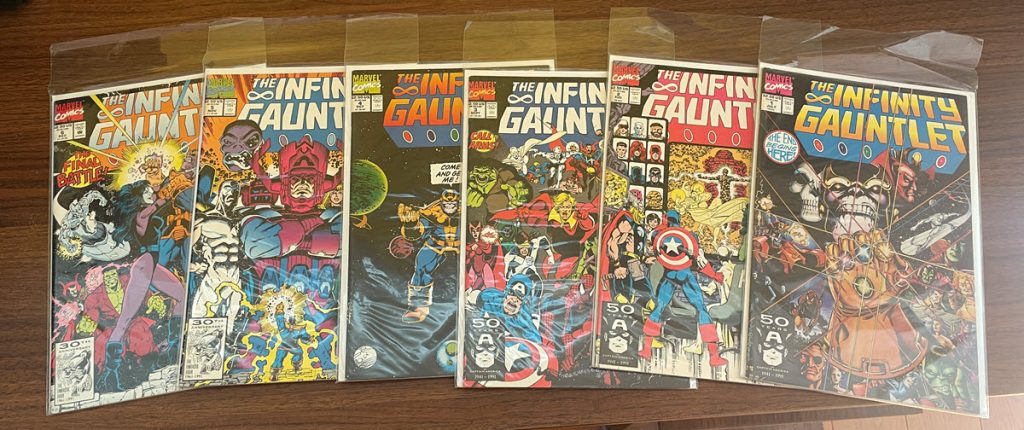
But he didn’t just dump them in my lap by way of daring me to crack the cover. He prepared a kind of syllabus and then provided the reading material for a fuller appreciation of the subject, tracing the storyline back through the Silver Surfer, an integral character — arguably its soul — who was omitted from the movies. He basically created for me an Infinity Gauntlet 101 class, illustrating the difference between watching movies in 2008 and reading comics in 1990. By sharing his childhood with me, by literally giving me a piece of it, Marquardson taught me the difference between a tentpole movie property and an arc in comics. He showed me, from soup to nuts, the modern process of creating, processing, packaging, licensing, repurposing, and reselling mythology.
The comics themselves were startling, funny, exciting, different, and at times deliciously weird. They were artifacts of another time, visitors from another world. And I’m pretty sure they’re valuable, being as old and first edition as they are. They arrived in plastic protectors, designed for comic books, with cardboard panels in the back to keep them from being bent. Once I would have snorted derisively at these protectors, the way I do now at people who use card sleeves in their boardgames. But I’d be uneasy handling them without these covers, and when I read them, I remove them carefully and handle them gingerly.
They occupy a very precious place for me, and even more precious is Chris’ handwritten letter detailing the issues and the order in which to read them. This is where I learned to read comic books one at a time, not to binge, to take my time to savor the “next issue” teasers. Even to enjoy the awful ads from another time, interspersed among the pages, squatting on the back covers. I would force myself to read only a single issue every morning, to stop and let it linger for at least a day. This is how comics were written, how they were published and therefore read. Pacing matters. It was part of the experience. Let it happen as it was intended.
And although Chris never presented them in these terms, I think of his six Infinity Gauntlet issues the way a museum might think of paintings from a private collection: they’re on loan and I’m grateful to host them, but I wouldn’t dream of claiming they’re mine. They live for now on my comics shelf, but they belong to a close friend. It’s a temporary privilege to be able to take them down and re-read them, or simply admire them, whenever I want.
My comics shelf has grown since then, mostly from the generosity of my friends. Knowing my history with Elektra: Assassin, Chris has provided me with everything Elektra, which was a wide and varied net to cast. He saw to it I appreciated not only Sienkiewicz’s remarkable contributions, but also the lengths to which Frank Miller and even his wife Lynn Varney took Elektra: sometimes exciting, sometimes absurd, often involving Daredevil. I was gobsmacked, and not always in a good way.
Since then, Kelly has sent me Alan Moore’s series of Swamp Things, which I’m currently working through slowly and which are nothing like the other comics I’ve read. They’re ponderous, weird, and meditative. Following Swamp Thing I have queued up a massive tome of Hellblazer, which I didn’t realize at first was Constantine, who I only know from the stylish and smart movie with Keanu Reeves. I was a bit confused at first why he’d want me to follow up Swamp Thing with Constantine, but it becomes clear as I read through these stories about Earth’s “elemental protector” and his constantly tormented girlfriend Abby.
Back in Metropolis: introducing Superman
So as melodramatic as it may sound, this has been a real journey for me, with no small amount of discovery. Not just about comic books, but about myself and how I respond. And in the last year or so, as I’ve dealt with debilitating and frightening health problems, a significant part of that journey was discovering the richly warm glow of All-Star Superman, written by Grant Morrison and drawn by Frank Quitely, sent to me by Chris Marquardson, discovered slowly over the course of a week or so, and revisited when things got really bad.
When Chris sent me All-Star Superman, I was a bit taken aback? Superman? Really? These days? Representing truth, justice, and the American way, unironically? A god-like boy scout in an absurd and colorful costume? Cape, tights, bright boots, and a carefully cultivated curl on his forehead? Wouldn’t a Batman comic be more my speed, something grittier, more timely, with whom I’ve played variously videogames and even scoured maps for collectibles and therefore know the ancillary characters?
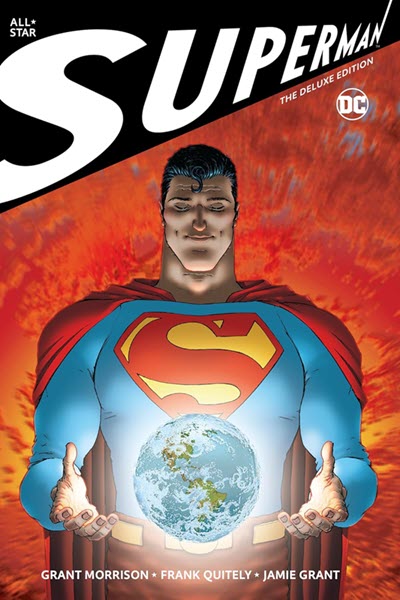
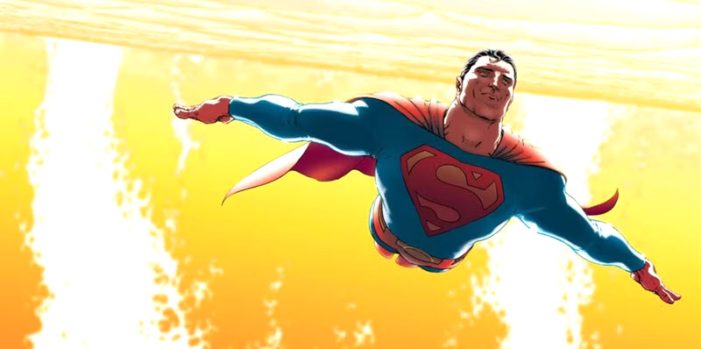
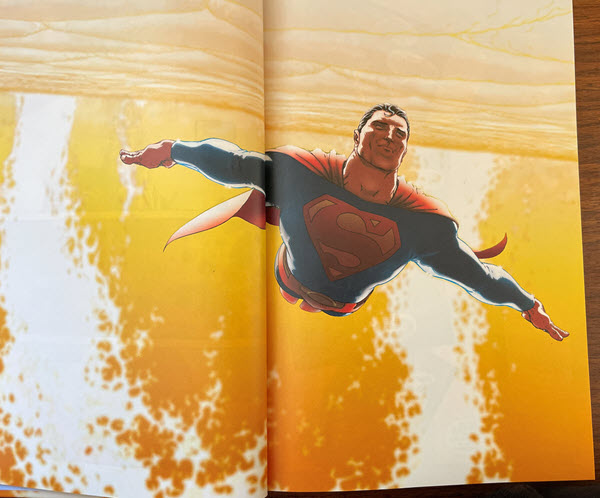
But I trust my friend. And there was something about a couple of the covers. Not the main cover, which has Superman holding the world in miniature and looking a bit smug about it. But the cover underneath the dust jacket. I always look underneath the dust jacket. There I found a full-spread expanse of the sun’s bright yellow, with Superman backlit so his garish reds and blues are muted. He’s flying, but with his arms stretched out to his sides, in a T-pose rather than the classic “fists forward” flying. Like a little kid pretending to fly instead of the classic Steve Reeves pose that all the movie Supermen seem to have adopted. And there’s something about the expression on his face. Unconcerned, relaxed, unhurried. Knowing.
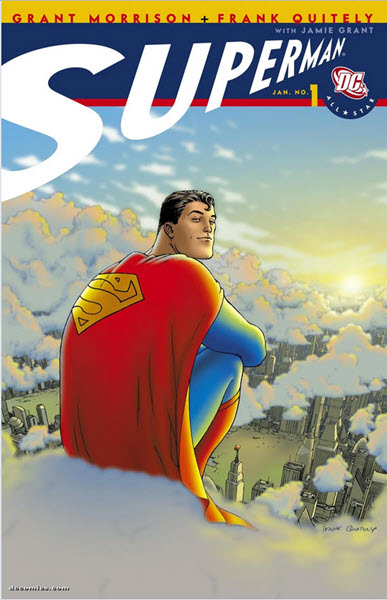
Then there’s the cover of the first issue. Superman is sitting on a cloud. Sitting on a cloud? He can do that? He’s glancing over his shoulder at the camera, at the artist, at the reader, at me. It’s as if a photographer has shouted, “Hey, Superman, over here!” But what’s with that expression? Why does he look so, well…content? Shouldn’t Superman be grimly determined to save the world instead of relaxing, Buddha-like, with a nearly Mona Lisa inscrutable smile, defying physics in a wholly new way by sitting on a cloud?
And then, in the very first pages, that full-spread image from beneath the dust jacket: Superman gliding along the sun’s brilliant photosphere, the bright yellow light pouring around him, his arms flung out, childish and blissful. Who is this guy?
So I read All-Star Superman like I would read any other comic. Slowly, one issue every morning, poring over the artwork, sometimes reading an issue twice. In this case, almost always reading an issue twice. Grant Morrison and Frank Quitely’s work isn’t dense, but it is rich. It breathes. It invites you in and makes room for you.
One of the first things I responded to was how it’s all self-contained. It had a beginning, a middle, and an end. Although it was part of a story larger than itself, it didn’t reference earlier issues or tease later issues. It did discreetly foreshadow and smartly call back, but only within the confines of what I held in my hands; instead of a fragment from hundreds of issues, it was a complete work of 12 issues. It furthermore had a voice, and that voice was nothing like the Superman I knew from movies. It was warm and graceful and intelligent, relatable but still otherworldly. After reading it, I understood that smile, that blissed out expression, why Superman’s arms were flung out like a little kid pretending to fly instead of thrust forward like a missile.
Chris has described the warmth of Quitely’s artwork as a friend draping his arm around your shoulder, saying “I got you”. We were talking about how I couldn’t even focus on reading comics when I was sick, and just flipping through many of them just felt overbusy (Stan Lee and Jack Kirby’s Fantastic Four from the 1960s was my prep work for the recent movie) or overbearing (Elektra: Assassin), or just unfamiliar and alien (revisiting Silver Surfer). But I did end up flipping through All-Star Superman, and it was perfect for when I was too sick for anything else. “I got you,” Quitely said, his arm around my skinny shoulders while I slumped on the couch and idly flipped though the warm orange panels, sipping at its stories of strength and perseverance.
All-Star Superman: issue by issue
So let me finally talk in detail about All-Star Superman itself. What follows might be construed as spoilers, so if you’re unfamiliar with this series, if you want to discover it yourself, you might want to skip to the next header. Because I want to describe in broad strokes exactly what Morrison and Quitely have done, issue by issue, and as a whole, which will necessarily discuss some specifics. I want to explain how they washed away my skepticism and showed me an American icon I’d previously failed to appreciate.
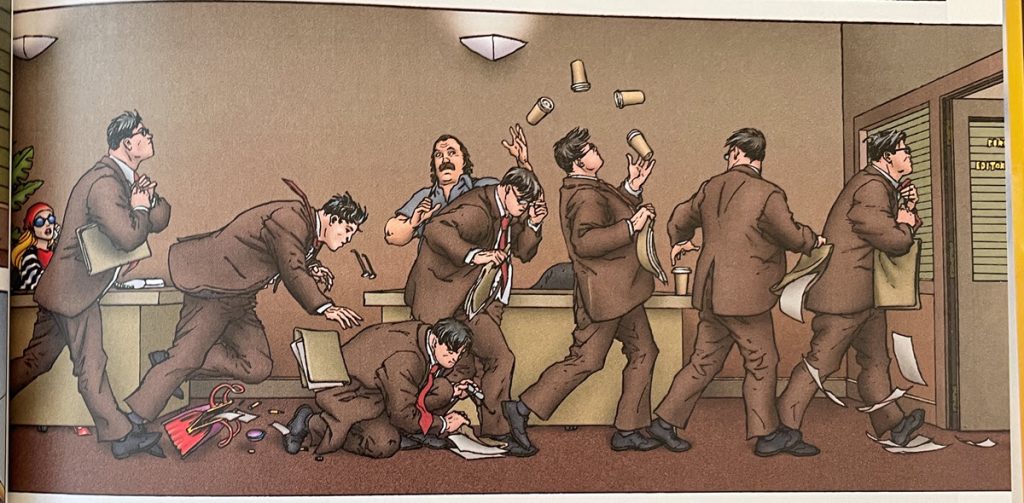
The first issue, “Faster”, introduces the cast and lays some promising groundwork. Superman gets a terminal “cancer” diagnosis, the result of Lex Luthor scheming, which will cast a pall over the entire 12-issue run. We visit the Daily Planet and meet its cast of characters. In this very first issue, Clark Kent reveals his identity to Lois Lane, fast-forwarding past any drawn-out will-they-or-won’t-they suspense. By the way, check out how Quitely can make a static panel a kinetic character study:
“Faster” also introduces a literally colorful and benevolent supergenius named Leo Quintum who’s reinventing humanity from a remote moon base, engineering nitrogen-blooded giants for deep space exploration and “nanonauts” for a subatomic dimension called the yactosphere. Heady stuff, worthy of any prestige comic, and it will all play a role in later issues. And it all begins with an opening set piece that’s a naked homage to Ray Bradbury’s Golden Apples of the Sun.
(Speaking of American icons, I then re-read the Bradbury short story for the first time since I was a kid. The few short pages of Golden Apples of the Sun are full of heart-breakingly beautiful prose. Bradbury’s description of an icicle: “a dripping of white wine, the blood of cool but warming April fell from that clear crystal blade.” The sun itself: “the flesh of God, the blood of the universe, the blazing thought, the blinding philosophy that set out and mothered a galaxy.” The first mate freezing to death inside the refrigerated ship: “irony of the coolest sort…a man afraid of fire and killed by frost.” Similarly, in “Faster,” Lex Luthor’s genetically engineered suicide bomber explodes in a puff of frost from Superman’s breath, also inside the sun.)
In issue 2, “Superman’s Forbidden Room”, we see not just a vast world outside the Superman mythology, even into the far future, but we also see what a kind and thoughtful boyfriend he is by way of celebrating Lois’ birthday with her. He picks flowers, he’s learned to sew, he cooks, he crafts a unique present that she nearly spoils by being an investigative reporter and basically opening her present before she’s supposed to. Frank Quitely darkens the frames into a blood red-hue as Lois’ suspicions deepen and she approaches the forbidden room.
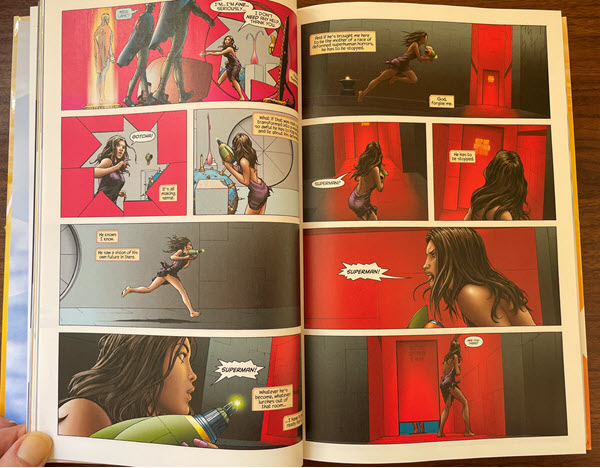
He even playfully renders a few panels in black-and-white as Lois considers their relationship in starker terms.
The third issue, “Sweet Dreams, Superwoman”, introduces Biblical, Greek, and Egyptian superheros. Atlas enters with a throwaway complaint about his back hurting. Samson, a real pussy hound, suggests he and Lois hop into his chronomobile to get drinks at the crucifixion. And the Ultrasphinx, Atom-Hotep, can place victims in a state of “quantum uncertainty”, neither alive nor dead. Slyly funny stuff, Grant Morrison! Then Superman upstages them all by resolving the paradox of an unstoppable force meeting an immoveable object, and I didn’t even hate this answer. Turns out the Man of Steel has brains, too. But the issue is all about Lois Lane’s birthday and it’s something I wouldn’t have expected from a Superman comic: dreamy and romantic.
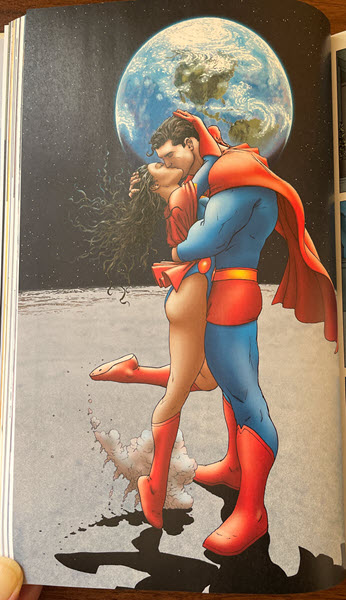
The fourth issue feels like filler, squandering the “evil Superman” trope on the slapstick shenanigans of Jimmy Olsen — who? — bookended by Jimmy’s travails with his girlfriend Lucy — who? Let’s move on. The fifth issue gets back to Lex Luthor, now in prison, where Clark Kent interviews him. “The Gospel According to Lex Luthor” reveals to the world that Superman is dying, and ends with this wonderful panel and its unconventional composition of Kent being ferried out of hell by, uh, some random dominatix named Nasty?
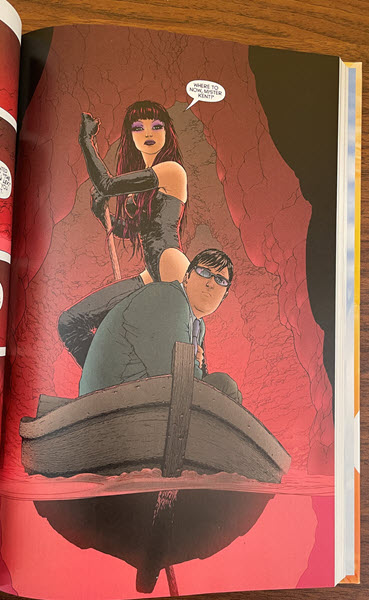
We’ll learn more later, for for now, I have to wonder who draws a man in a boat like that? Frank Quitely, that’s who.
In issue six, at the halfway point through the run, the somberly titled “Funeral in Smallville” gets really wacky, introducing characters I never thought I’d see in a Superman. And not just Krypto, Superman’s dog.
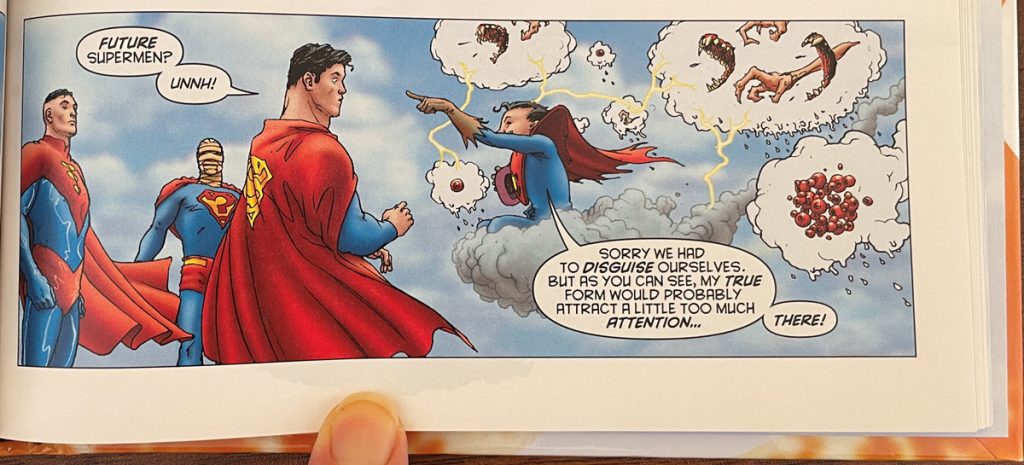
This is where Grant Morrison really takes the story off the usual rails and lets it veer into a very strange place indeed, connecting them all to a seminal moment in the Superman mythology. This is the kind of revisionism I can really get behind, and it even comes with a cool twist. “Funeral in Smallville” might be my favorite issue.
The next two issues, #7 and #8, are a two-parter that plays with the concept of the Bizarro, the “opposite Superman”. Titled “Being Bizarro” and “Us Do Opposite”, respectively, they playfully fold the Bizarro concept in on itself. And although “Us Do Opposite” is literally difficult to read, it’s a deconstruction that directly invokes experimental poetry, with nonsensical Joycean prose and a climactic burlesque of the Star-Spangled Banner.
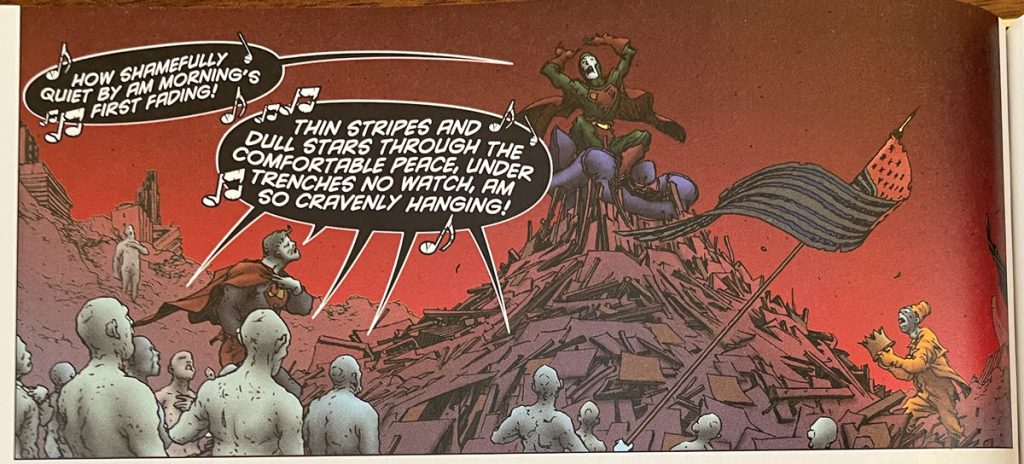
It may not be entirely successful, but it’s certainly ambitious and shows Grant Morrison’s willingness to take a big unconventional swing at Americana.
Once Superman escapes Bizarro world and returns to earth, he discovers “The Curse of the Replacement Supermen” in issue #9, which imagines something perfectly sensible: what if Krypton had sent out astronauts before it blew up? Might they also find their way to Earth eventually, like Superman did when he was a baby? So Superman discovers a couple of Kryptonian astronauts have filled in as Earth’s champions while he was gone. It’s a fresher take on the General Zod silliness where Kryptonian criminals from the Phantom Zone find their way to earth. Instead, it’s Krypton’s equivalent of the heroic Apollo 11 crew, with their own distinct set of ideals.
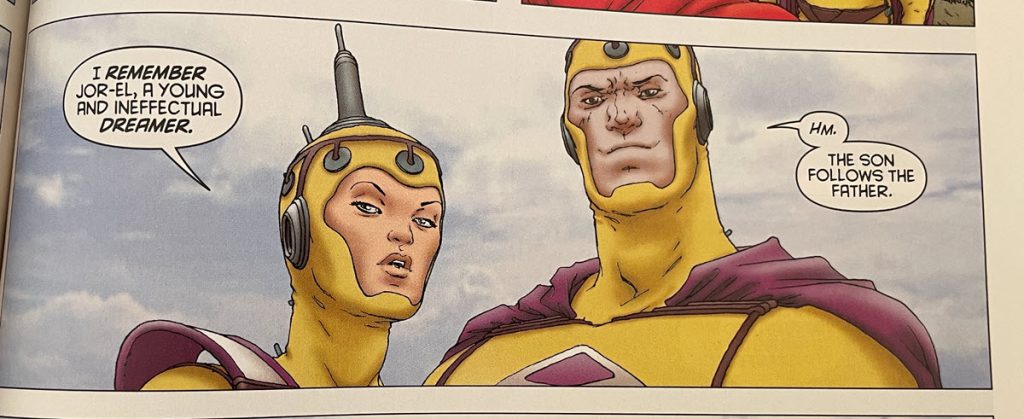
It’s the one issue where it feels like Morrison wrote himself into a corner, and he cheats his way out with a single panel of incomprehensible technobabble. But it ends up with a lovely resolution.
Issue #10, “Neverending”, is where Grant Morrison truly shines. This poignant meditation on mortality, humanity, and legacy is unlike anything I’d ever have expected from stories about an invulnerable superhero, or any superhero. It’s the emotional peak of All-Star Superman, told in a deliberately shuffled narrative that spans time, planets, and the whole cosmos.
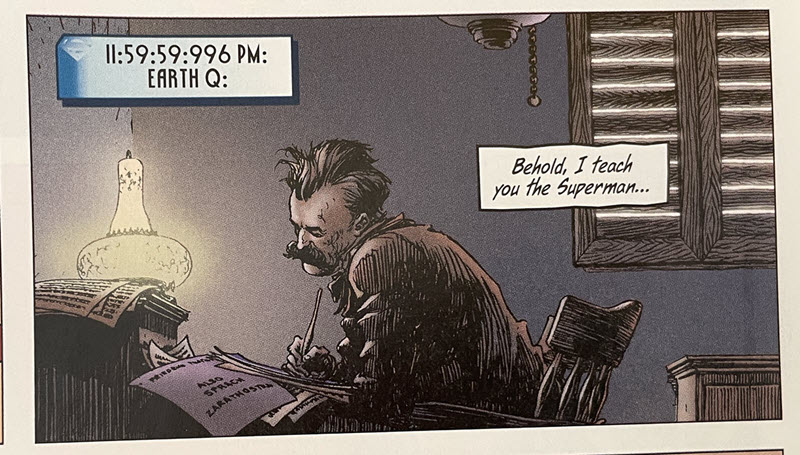
The old me never would have dreamed of something so profoundly thoughtful from a comic book. Even the Nietzsche Uberman reference fits neatly.
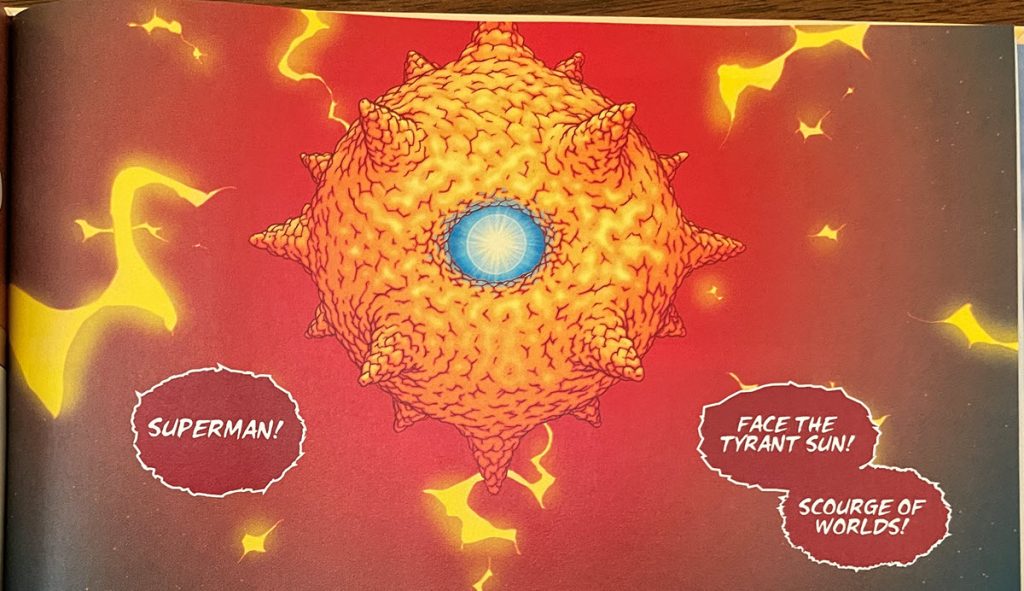
And then “Red Sun Day”, the penultimate issue, transitions into over-the-top superhero and supervillain and cosmic monster action, all of which has been carefully set up in previous issues. Morrison pays off earlier references as he ties up loose ends, showing the value of a self-contained story arc over long and drawn-out continuity tangles hashed out among various authors. This is where Grant Morrison’s All-Star Superman comes together as a whole, shrewdly plotted and now resolved with short and vividly sharp action sequences. This is where DC’s All-Star strategy proves itself a winning formula.
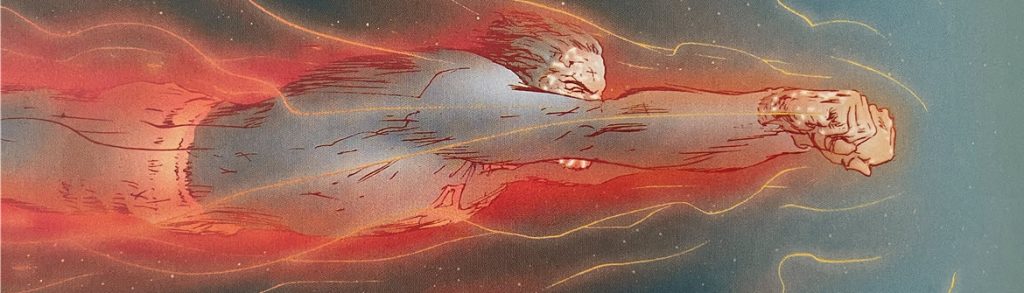
In fact, issue #11 is so strong that the finale issue, “Superman in Excelsius”, feels a bit underwhelming, an epilogue instead of a climax. Superman literally flies off into the sunset, leaving humanity to stand on its own, inspired by his example and his feats. But the All-Star Superman hardback omnibus published in 2022 — technically All-Star Superman: The Deluxe Edition — isn’t over. The final 15 pages are Morrison’s detailed commentary, full of specific references and concept art.
Beyond All-Star: Superman here and now
Where and how does all this fit into 2025? For me, it’s been a feast of comfort food when it sometimes feels like the world is collapsing, like America is no longer the country I once loved, like the future is uncertain and dim, when it seems I’m so sick I’ll never get better, when things have changed for me and left me uncertain and flailing. For instance, I used to be an intensely political creature, daily sending tendrils of curiosity out into the world. But that’s changed dramatically as I wait out Trump’s Presidential term and hope for the least worst outcome, opting to remove myself from political news, commentary, outrage, and stress. Similarly, my social life has changed, contracting into smaller spaces, often indirect and virtual. My experience with movies and videogames has shifted as I’ve opted instead for books, boardgames, and — weirdly enough — episodic television for my entertainment. It’s as if nothing now is what it was. It can be frightening. I long for sources of stability, safety, reassurance. I crave escapism that will put its arm around my shoulder and tell me, “I got you.”
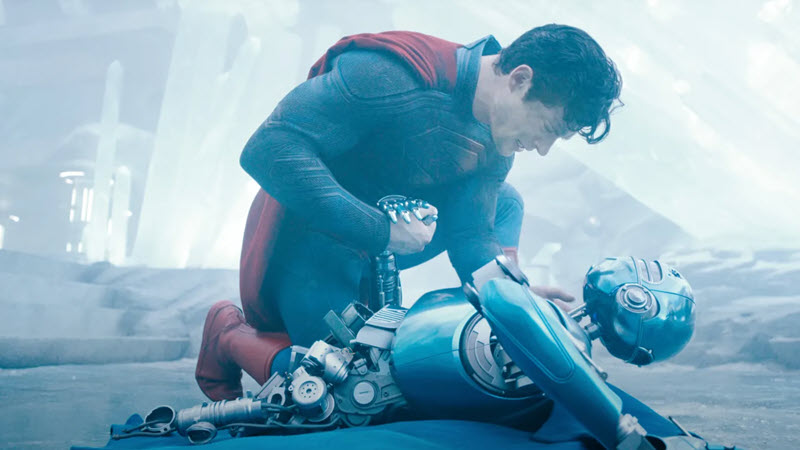
I rewatched the most recent Superman movies for this article, and was surprised at how little they moved me, at how utterly irrelevant they felt after reading All-Star Superman. I appreciated how elements of All-Star Superman found their way into James Gunn’s recent movie. I especially enjoyed David Corenswet’s interpretation of Superman as a grimly determined and charming boy scout, very much channeling Christopher Reeve. But I also chafed against Superman having to resolve a Kosovo-style conflict and especially the nasty ret-conning of his origins story and his intended relationship with Earth.
(As a brief and perhaps gross analogy, imagine in the 9/11 terrorists were blind sleeper cells who never got their final instructions thanks to some fluke in communications. So they went on to become skilled pilots who spent their lives dutifully getting people where they needed to go. And then one day they find the activation code from Osama bin Laden that had been sent decades ago, telling them why they were really taking flying lessons in Florida. Oops!)
Superheroes, and especially Superman, don’t live in those morally grey zones. They don’t even share the same universe. Superman simply doesn’t do moral calculus. But I also accept James Gunn was making a movie for audiences who live in the year 2025, where moral calculus is an imperative. But it betrays Superman as an escape, as a place we go to shrug off the cares of the real world and to be cradled in a morally absolute world of black hats and a red cape, benevolent, omnipresent, omnipowerful, monotheistic. God is dead, but we’ll always have Superman. How could James Gunn have glossed over such a fundamental part of the mythology? How could have compromised it so dramatically, ripped it so violently from its context?
Can I confess something that might rightly invite ridicule? Although I recognize the cultural and nostalgic significance of Richard Donner and Christopher Reeves’ Superman, and especially the bar-raising action — for the time — of Superman II, those movies are too dated, and too sadly burdened with the tragedy of what happened to Reeves, for me to enjoy. Appreciate, sure. Enjoy, not so much. And Bryan Singer’s Superman Returns is just too awkward and clunky.
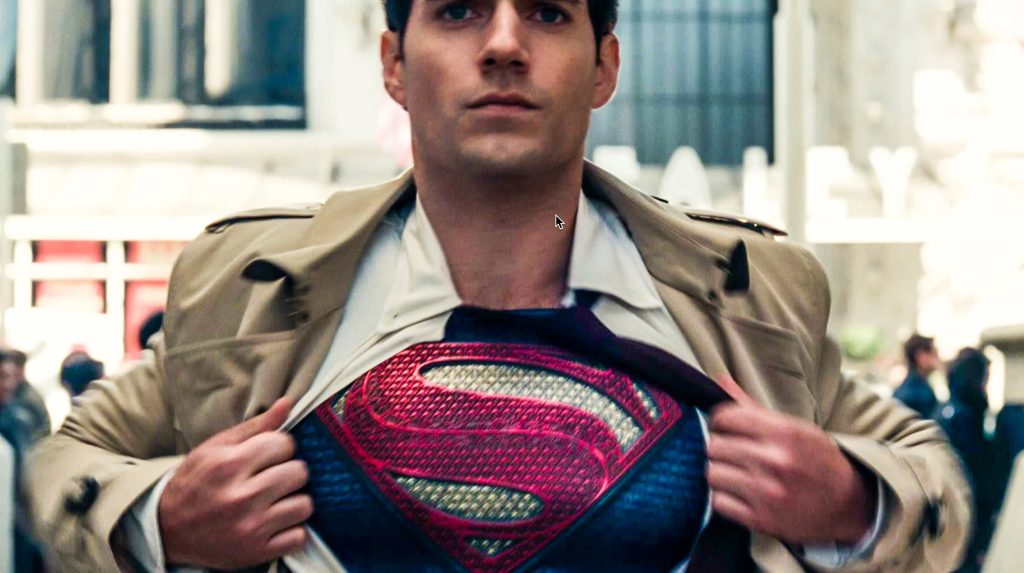
So by process of elimination, my Superman movie of choice is Zack Snyder’s Man of Steel. Snyder’s a flashy filmmaker with all the sophistication and heart of a 14-year-old boy breathlessly recounting his D&D campaign. But in 2013 he had the cachet to throw big budget spectacle onscreen, and to enlist a range of capable actors talented enough to pretend to take his nonsense seriously, with nary a smirk (including a very good friend of mine from Arkansas named Coby Goss who has a small part as a priest!). Furthermore, who among us hasn’t become a Cavill fan by now? There’s nothing particularly special about his Superman/Clark Kent performance, but he’s obviously having the time of his life. And all of this without even a Lex Luthor (although Michael Shannon’s Zod, his silly sidekicks, and their edgy spaceships are plenty goofy to make up for the Lex Luthor we’ll eventually get with Jesse Eisenberg).
So when Snyder appropriates the Superman mythology and does his own stuff with it, when he makes it his own D&D campaign, I can’t help but admire his enthusiasm and the resources he brings to bear. This will, of course, all fall apart in Superman v. Batman, but again, that’s part of why I can enjoy Man of Steel more than the other Superman movies: this was Snyder before his fall, when he was still just the guy who wrangled Watchmen into a standalone movie, when those of us who enjoyed the silliness of Sucker Punch hadn’t broken up with him yet. So, sure, I freely admit my favorite Superman movie is Man of Steel, for all its faults. You can laugh now. I won’t mind. Just please keep in mind the caveat that I don’t much care for any of the Superman movies, and Snyder’s just happens to be the one I don’t care for the least.
All of this cinematic guff is very different from All-Star Superman. The big-budget spectacle, the grim determination or our Supermen’s Boy Scout performances, the compression of the mythology into a two-hour experience. These have none of All-Star Superman’s warmth, color, room to breathe, and especially breadth. All-Star Superman, which came to me at a very specific time in my life, when I was newly open to comic books and eager to explore them on their own terms, isn’t just a lovely paean to an American icon; it’s a celebration, a collection, an example of a niche medium at its best. I can’t think of a better time than 2025 to read it.
(Why am I reviewing comic books on Quarter to Three? Because it won the Patreon review request drawing! If you’d like to participate in the monthly drawing that determines what I’ll review next — it can be anything, from videogames to comic books to local attactions in Los Angeles! — please have a look at my Patreon campaign here. Anyone who pledges $10 or more will be able to participate in the monthly drawings.)

All-Star Superman
Rating:
Grant Morrison and Frank Quitely celebrate an American icon with remarkable warmth, affection, and breadth, and you only have to buy one book! (You can click on the little image to the left to buy your own copy of All-Star Superman from Amazon to support Qt3.)
