


Is Dispatch disappointing episodic TV or a superficial videogame? Why not both?
I wouldn’t normally play a game like Dispatch. I’ve had very little experience with the Telltale games (well, “games”) that set the stage, mostly because I have very little patience for games that don’t actually have much game. But then I fell in love with a lighthouse. After my reaction to Double Fine’s Keeper, whose lighthouse lumbers amiably between walking simulator and adventure game, I’ve nurtured a newfound curiosity to try adventure games. Just how much have my changing predilections changed? After a brief thrill, Dispatch offers a sobering answer.
One of the main obstacles for my enjoyment of traditional adventure games — videogames of all sorts, in fact — is videogame dialogue. I have no patience for tabbing through paragraphs of exposition dump. I’m a voracious reader, but also a demanding reader. As such, I simply can’t abide the usual structure of videogame dialogue, much less the exasperating pointlessness of most of the choices that interrupt it. So while my predilections might be changing, and while I’ve been eager to sample various adventure game puzzle structures, I have bounced decisively and even violently off the games that expect me to endure videogame dialogue. I want them to get off my lawn and I’m not above shaking my fist and yelling.
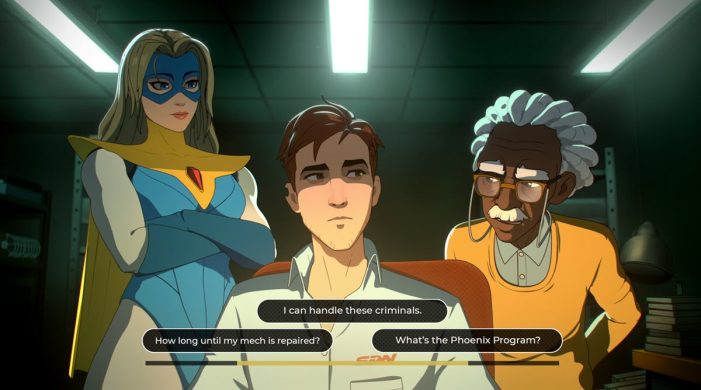
So imagine my surprise to boot up Dispatch and discover how adroitly it dances around the issue of videogame dialogue and dialogue choices. Like the Altman-esque Oxenfree before it, here is a new — to me! — way to do videogame dialogue. Dispatch presents its three options while the characters are still talking, with a canny appreciation for the pacing of how people interact. I never have to sit and wait. I never have to tab through menus to exhaust the topics on a list. I never have to work my way down to the inevitable “That’s all for now” dialogue choice. Because it’s basically an animated movie, a sort of latter-day Dragon’s Lair by way of Adult Swim, Dispatch flows. It moves in a way that other videogames don’t, can’t, or won’t.
And this carried me through its first few episodes just fine, which is also a part of how Dispatch flows. It introduces itself in a handful of discrete half-hour packages (basically a half hour of animated film with a half hour of superficial — and superfluous — gameplay). Early on, it really captures the appeal of episodic TV: the easy introductions, the promise of more to come, the teasing, the tantalizing, the anticipation, the gallery of narrative doors left ajar, the ample water-cooler fodder.
But episodic TV will invariably break your heart by either ending while it’s still good, or turning bad before it ends. Dispatch falls into the latter category. In fact, after the initial promise, it’s not so much that it turns bad as that it never bothers to take off. As a superhero yarn, Dispatch can’t even be bothered with origin stories, much less taking flight, or even finding its superpower. It’s certainly not a power fantasy, and it pales as a deconstruction in the long tradition of Watchmen to Mystery Men to Boys. Instead, it’s a collection of prosaic post-Whedon palavering among office workers for whom casual dress and cosplay are the same thing. Dispatch is written about, for, and by people whose life experience seems to consist of going to a job and then cajoling co-workers to go out and party somewhere afterwards. Its superpowers are feeble irony, rote sarcasm, and embarrassingly earnest wisdom about learning to be true to yourself and whatnot.
Furthermore, nothing happens. The conspicuous absence of a villain for most of the story is partly why Dispatch spends so much time in narrative doldrums. The bad guy is basically a bookend, and by the time the climax rolls around, it arrives so suddenly that you’re liable to have forgotten there were ever even bad guys in this world. In fact, as far as villainy goes, Dispatch can’t even live up to its premise of being about villains. The idea is that the protagonist is charged with herding a group of reformed villains, but there’s nothing in the game to suggest their villainy. Instead, these are all just warmed-over heroes, doing the usual heroic stuff. Dispatch wants to be subversive, but it never rises above the moral complexity of a D&D campaign where everyone in the party is good and maybe one of them is chaotic good. Even the villain has to distinguish himself as evil by — gasp! –threatening someone’s pet. He’s so bad he’d choose the option to kick the puppy instead of pet the puppy. That’s the worst Dispatch can imagine.
As a choice-and-consequences narrative, the forks in the road apparently boil down to who commits an obligatory betrayal. At least that’s the best I can tell after one playthrough. There’s an obligatory noble sacrifice/death, entirely scripted it seems, followed by the obligatory grief porn episode. I suppose the ending thinks it’s got an obligatory twist, but is it really a twist if I’ve long since stopped caring who does what to whom?
Along those lines, there is the usual ham-handed videogame romance, where you decide who you’re going to take to the prom. This feels particularly ham-handed given that the choice is between one of your subordinates and your boss. Isn’t that kind of thing frowned upon these days? I intended to steer my way to “neither of the above”, but accidently romanced my boss because I wasn’t reading the responses closely enough. Oops. The heart wants what the dialogue tree dictates, as they say.
I did enjoy Aaron Paul’s voice acting during the early parts of the game. The star of Need for Speed and Westworld is perfectly cast as the lead character when he’s a hapless slacker recruited to dispatch superheroes. Which somehow also involves managing them. As the game progresses, Paul seems to get increasingly bored as the dialogue segues into jejune life lessons from a middle management life coach. I can’t blame him.
As for the superficial gameplay, I expected as much going in, so it’s hard to fault Dispatch for not being a better game. But what is there is about as much fun as sending out my assassins in Assassin’s Creed 3. Remember that? No? No one? It’s just me? Okay, fair enough. I’m sure you can relate the dispatching to some other game you enjoyed. I think a Dragon Age had something like this. It’s mostly a way to level up some characters, and Dispatch leverages it nicely as an opportunity for interparty banter. But it squanders the opportunity for any sort of worldbuilding or character development; instead, it’s just time management and character progression, entirely firewalled from the animated movie you’re watching between gameplay. A level 1 character without any of his special abilities and an intelligence of 1 is no different during the animated movie than a level 12 character with all his special abilities unlocked and his intelligence maxxed out at 10. If there’s one way to make pointless gameplay even more pointless, it’s to ignore it entirely in the narrative. Dispatch doesn’t even try to care about its gameplay, so why should I?
Even the quick-time events are pointless. You can turn them off or ignore them completely, as I did for the interminable last episode. I whiffed every punch, sweep, laser blast, and missile strike. It made no difference. I’m pretty sure that’s the case with the eponymous dispatching that makes for most of the gameplay. There’s also a hacking minigame that involves a lot of using your arrow keys to move a ball around a grid and “hack” nodes, which relates even less to the story. Our protagonist is a hacker? Who knew.
In the end, Dispatch was little different from any TV series I watched that seemed promising at first, and gradually turned disappointing. Does the outcome invalidate the early promise? For me, yes. Absolutely. But I admit there’s something to be said for the comfort-food aspect of spooning up the episodes as they’re ladled out, for the filler of the ongoing storyline, for the frisson of anticipating what might happen next. At the very least, it’s nice to see that videogames can harness the flow of animated movies to break out of the usual menu dialogue. If a game is going to disappoint me as much as Dispatch, I’m at least grateful that it knows how to move.
Dispatch
Rating:
PC
A videogame that cannily captures the heartbreak of episodic TV
