


Oh, the places you’ll go with Keeper’s lighthouse at the end of the world
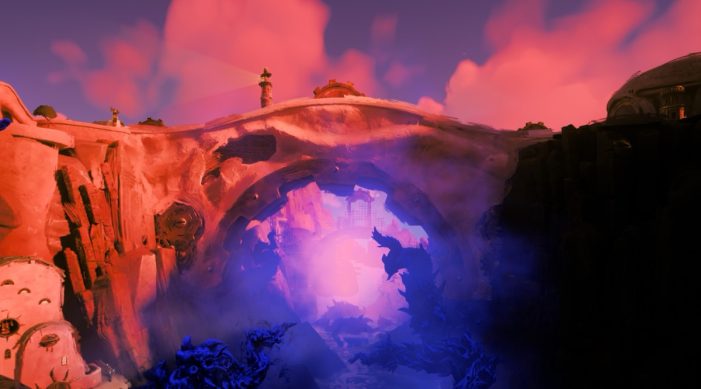
Oceans not being what they once were, neither are lighthouses. The lighthouse has become, to modern audiences, a place of loneliness, isolation, and even madness and monsters. Imagine being cooped up on some rocky promontory far from civilization, cut off for months, even years at a time.
Yet imagine you’re protecting the brave men who ply the vast uncaring oceans, stitching the world together across their impossible expanse. This is the lighthouse of the aptly named Keeper. This is the sagging stone edifice that somehow revives itself and walks precariously on crab legs made from roots. This is the faithful companion for our dragon gull thing that opens the story. This is the entry point for Double Fine’s latest creation, a mere “adventure” game, but also a staggeringly weird and imaginative journey through a place you’ve never been.
Keeper is a game about looking at things, literally shining a light on them to peer more closely. As such, the camera, controlled always and only by Double Fine, might feel restrictive at first, a source of frustration and thwarted intent. “But I want to look over there,” you might peevishly complain. But what I came to realize, accept, and eventually embrace is that the camera is a thing of beauty, a gentle tool in Double Fine’s hands. It’s how they tell you where to look and especially where to go. It’s very much a trust exercise, and once you trust the camera, Keeper can soar in new ways, freeing you from having to pilot your own perspective like some invisible drone, and freeing Keeper from other world-breaking contrivances like glowing waypoints or GPS paths or maps.
I don’t generally play adventure games, and although I’m working on it, I find I have little patience for puzzles. Which is precisely why I don’t generally play adventure games. I was worried Keeper was going to be a bunch of bullshit dream logic puzzles and I’m happy to say that’s absolutely not the case. The puzzles aren’t really challenging in any meaningful sense, at least not to anyone who’s assayed an adventure game, or even played a Resident Evil. The mechanics are familiar, if not the trappings. I can safely say I never once had to figure out how to turn on a goddamn generator. Like the rest of Keeper, any puzzles are mostly about looking at things and wondering what they do, and sure enough, yeah, that’s how it works. I was frustrated a couple of times because I’d turned off the control prompts that remind you what you can do and tell you where you can do it.
One puzzle really put a burr under my saddle. I was all, like, “Fuck Keeper, fuck Double Fine, fuck Lee Perry,” but it was because I’d turned off the control prompts. I’d forgotten you could use the d-pad to change your interaction point. If I hadn’t switched the prompts back on, this would have been a very different review: an unwritten one. Where I was constantly frustrated was playing on a middling laptop, pumping Keeper onto my big-ass TV screen in superhigh resolution. I kept having to duck into settings to mess with things to get a decent frame rate so I could enjoy the experience rather than wait for it. Ah, the irony! I should have just dialed down the resolution a notch and set everything to medium, or resigned myself to playing on my desktop’s monitor. Let this be a reminder that trust exercises can work both ways.
But as a “mere adventure game”, know that Keeper is kind and welcoming and not here to frustrate you, but to surprise and delight you. During an early bit, I figured I had to avoid creatures that were going to throw something at me. I assumed such a strange world was necessarily a hostile world and there would necessarily be antagonists. Instead, it turns out I was meant to help them, which is how nearly every puzzle works here.
Long ago, I had the good fortune to sit down and talk with Paul Reiche and Fred Ford, the co-founders of Toys for Bob. Ford said something that always stuck with me because it was so simple and obvious, so much a part of what drives many of the games I love. He said their games — at the time Star Control and Unholy War, but eventually Skylanders as well — were about “weird things beating each other up”. Now Double Fine flips the script into weird things helping each other. Keeper is called what it is for a reason.
Before I played, I’d unfortunately been told by a couple of people, “There’s no dialogue.” Which isn’t really that remarkable given that there aren’t things in here that talk. But unlike last year’s animated masterpiece Flow, another magical story that has no dialogue because it’s about familiar creatures not talking, this is about things that could very well have talked in any other game. I can imagine another studio, one less confident than Double Fine, adding chatter and jokes and pop culture references, finding something to do for the staff writers to earn their salaries. So while this might be no Triplets of Belleville in its “no dialogue” bullet point, it’s still laudable.
And I suppose marketable. But here’s another important element of Keeper. I finished Keeper in four sittings, not just because it’s short (albeit exactly as long as it needs to be), but because it’s so compelling. Given its brevity, given its imaginative world and undiscovered delights, any marketing will compromise some of your experience. Any screenshots or trailers or IGN talking heads or verbose hipster reviewers will leach some of the magic. This is a story to be told by its creators, where the only exposition are the brief snippets of text describing the achievements. Which aren’t even achievements in the usual sense, but tiny lore bubbles, barely a tickle like the fizz in champagne. This is a story you should get from project lead Lee Perry, and his remarkable artists, and David Earl’s deft score, and no one else. You’ll only get to discover it once.
(If you enjoyed this review, please consider supporting me on Patreon or making a PayPal donation. I could really use your help and if you join Patreon at the $10 tier, you can pariticpate in monthly drawings to determine what I review next. And please share this review with others, which is also a great help.)

Keeper
Rating:
PC
A game about looking at things, about weird things helping each other, and about what it means to be a lighthouse.
