


I Was a Teenage Exocolonist asks, “Are you there, God? It’s me, space Margaret.”
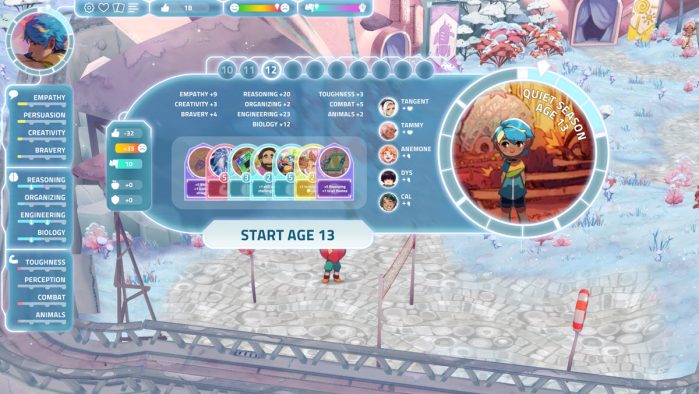
“Welcome to puberty, Tom,” chirps I Was a Teenage Exocolonist about fifty years too late.
I’ve just turned 13 ingame, and I’m more confused than when I was actually 13. What is going on here? Who is this game for? People who play deck-builders? Visual novel readers in search of arbitrary branching? Actual 13-year-olds? Is this twee bildungsroman what passes for young adult fiction these days? Is its pastel-colored space colony appealing or even remotely interesting to sci-fi fans? Is this how Northway Games follows Rebuild, their ruthless zombie apocalypse resource management games? And now that I’ve reached puberty, how much worse are the rest of my teens going to be? At least when I was actually 13, they separated the boys from the girls and marched us into the gym to watch an awkward instructional film. Here, now, I have no such guidance. I have only a haphazard deck of cards.
There are basically three ways to consider I Was a Teenage Exocolonist, and frankly, I don’t see how any of them does it any favors. As a visual novel with a branching plot, as a deck-builder, or as a visual novel with a branching plot combined with a deck-builder.
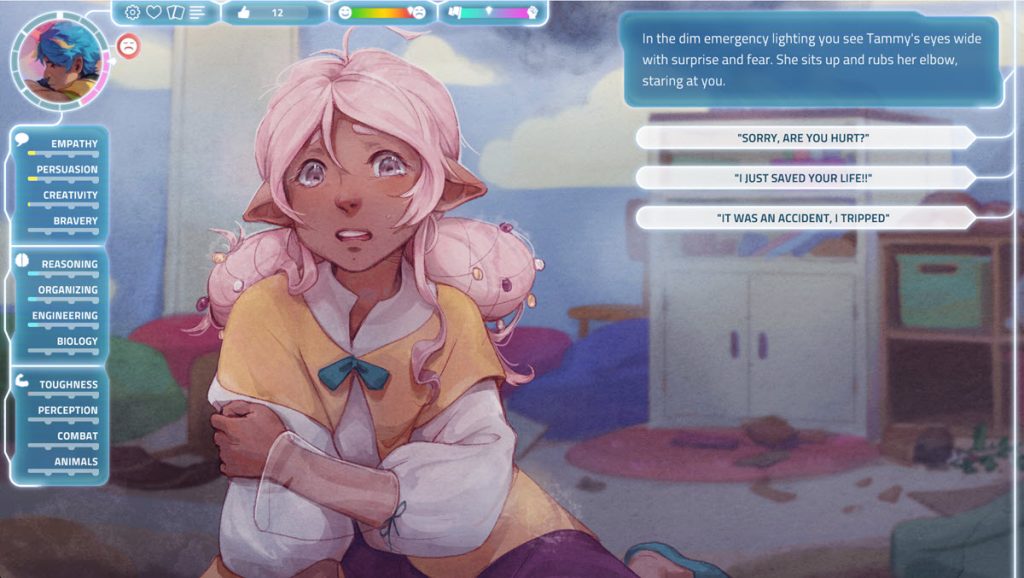
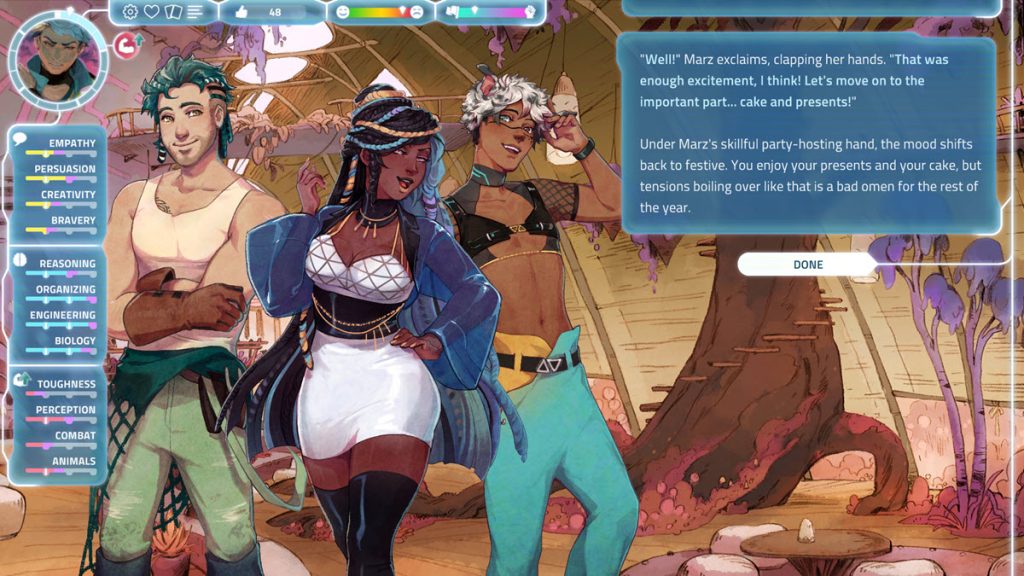
As a visual novel, it’s a cloying trough of young adult fiction: glib, chipper, clumsily manipulative, predictable, scattered and desultory, crammed with filler, entirely forgettable. Your ten-year-old turns into a twenty-year-old, paragraph by paragraph, one year at a time, while your space colony undergoes alien attacks, political upheaval, and outbreaks of puberty. A few adults loiter around the perimeter, but it’s mostly teenager-on-teenager action. Some space colony stuff happens, almost entirely to and because of the teenagers. If you read for ten years — the fail-forward gameplay doesn’t seem inclined to get in your way — you’ll unlock an ending, at which point a time travel gimmick loops you around to start again from the first page. Read it 33 times and maybe you can unlock all 33 endings.
To be fair, passing judgment on a young adult visual novel is outside my purview. I haven’t been a young adult for quite some time, so I don’t really need youthful uplift narratives encouraging me to be all I can be, and reassuring me that erections, hormones, menstrual cycles, nocturnal emission, uncertain sexuality, teenage pregnancy, and even parenthood are all realities of growing up and they’re perfectly healthy so they’re nothing to be ashamed of, because you live in a multicultural utopia on a pastel-colored planet where the only colonists who don’t respect nature are the bad guy militants who arrive to teach you that sometimes you have to rebel against authority. In other words, I’m not the target audience.
But regardless of its target audience, the writing is trite and unremarkable, all the more so for hewing so closely to the tenets of young adult fiction. This stuff is nothing if not formulaic, because it’s intended as a formula: the recipe by which children are baked into adults. These tenets are the scaffolding for good people, for the building blocks of pluralistic progressive societies. They don’t afford a lot of wiggle room. Like most formulas, they’re predictable, familiar, eventually even tedious. Since you’ll only ever be a young adult for a limited period of time, their shelf life is limited. You eventually move on to the more edifying and less didactic stuff, right? Presumably, you’ve outgrown the need to be told “you matter” and “the world is fundamentally good” and “everything will be all right”.
But something happens when you spackle young adult fiction into a choose-your-own-adventure structure, and especially one built on “engaging” the player with repeated playthroughs. Now you’re stressing a specific theme in the formula: you can be whatever you want to be. In other words, do whatever you want. You have complete freedom, without any obligation to anyone or anything, with no moral value higher than the ending you want.
But one of the most important lessons a child should learn, that which separates a responsible adult from a child, regardless of the cultural context, is that he or she is not the center of the universe. You have obligations to others, wider responsibilities, and ideally even a sense of morality. Yet this Copernican shift is almost entirely absent in a narrative structure where the ultimate goal is the ultimate goal, where the whole point is to unlock more of the 33 endings. The ends literally justify the means.
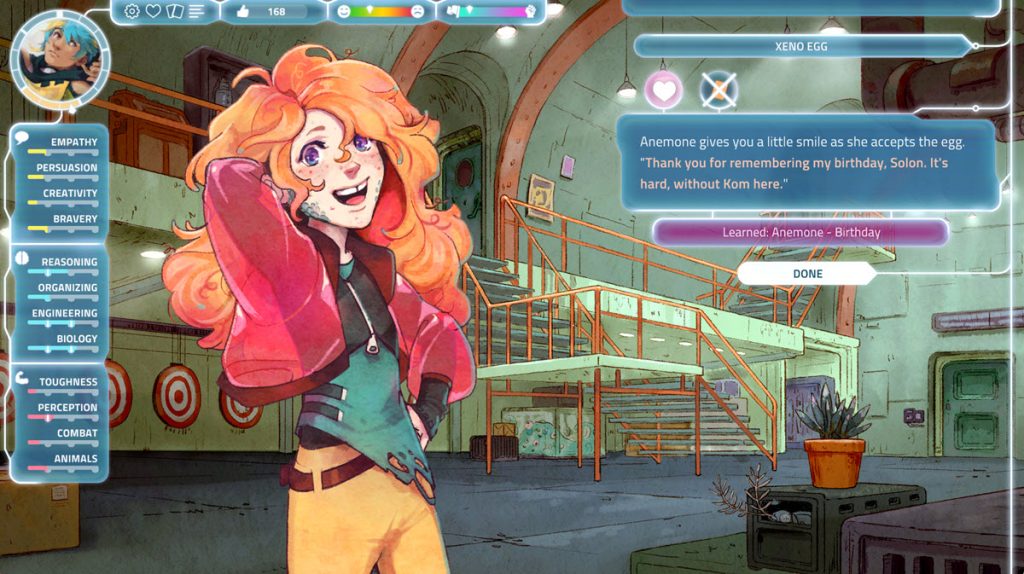
Furthermore, by gamifying social relationships, relationships are merely transactional. Specifically, romance becomes transactional. What gift earns me the most hearts on the heart scale? If I want to pursue a relationship with a character, I must figure out what she wants and then get as many of those as I can find. At which point the heart meter fills up and I’m done. Sure, there might be narrative beats, but even these are transactional. Can I allocate the necessary resources, can I pay the opportunity cost, can I guess the solution to the “puzzle” dilemmas? How can I navigate the if/then conditionals to meet the romance threshold? It’s sadly superficial, and it does nothing to impart to relationships the necessary elements of empathy, respect, and trust. Love is a meter instead of a form of social responsibility. And when it comes to chemistry, passion, and emotional reciprocity, well, we’ll talk when videogames and visual novels grow up. It’s one thing for adults to spend time chasing down whatever D&D sex scene Larian wrote for you and Shadowheart; it’s something else entirely to tell young adults that they just need to collect red xeno eggs to have a romantic relationship with Anemone.
Maybe I’m reading too much into this game’s role for young adults. As someone who’s never had the privilege or responsibility of raising a child, maybe I just need to shut up and get on with the deck-building.
As a deck-builder, I Was a Teenage Exocolonist is hardly that. The first problem is that the “building” is mostly a matter of being dragged along whatever story current you’re swimming. Cards you don’t want will be routinely dropped into your deck, with only the flimsiest of narrative justifications. You might be working on a red combat deck, but oops, you just got an event that’s going to jam a low-value social card into the mix. You can and presumably should game the available actions to build your deck up. You can occasionally buy and cull specific cards by spending your spacebucks, but not with any statistically meaningful regularity. Spacebucks are too hard to come by and the costs are too great to make up for the random junk your deck accumulates as the whims of the storyline build a deck for you. Maybe the chaos is the point. Maybe it’s meant to reflect the unpredictability of teenage life on a space colony. Maybe this is a deck-happener instead of a deck-builder.
Interestingly, when you rest to replenish your stamina — a meter that gradually drains so you’ll occasionally have to take a turn to rest — you can remove a card from your deck! Great idea! Except that you don’t get to choose the card you can remove. Instead, two random cards are drawn. Would you like to get rid of one of them? Early in the game, this works fine. You’ll cull those lousy zero-value cards. But as the game progresses, you’re more liable to draw two valuable cards, neither of which you want to cull. You’ve effectively wasted a turn that might have otherwise tuned your deck.
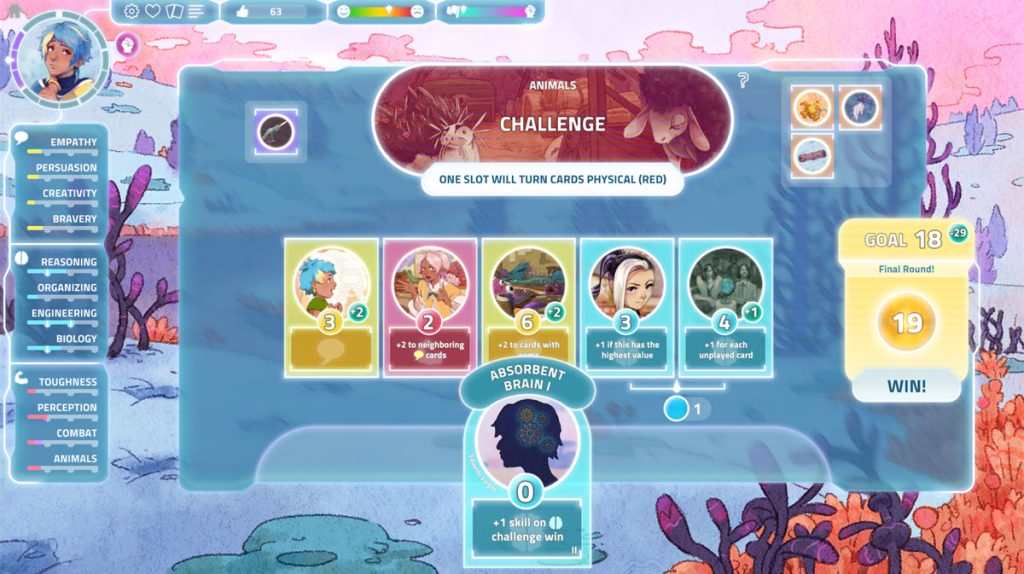
The cards are divided into three “suits”: red physical cards, blue mental cards, and yellow social cards. Each card is a number from zero to five, with occasional powerful cards going up to eight. Any given challenge is a matter of drawing a hand of five cards and then totaling their point value. Did you meet the goal of the challenge? If so, you win an extra point of that challenge’s reward! If you didn’t meet the goal, no extra point for you and you only earn the base reward. Better luck failing forward next time.
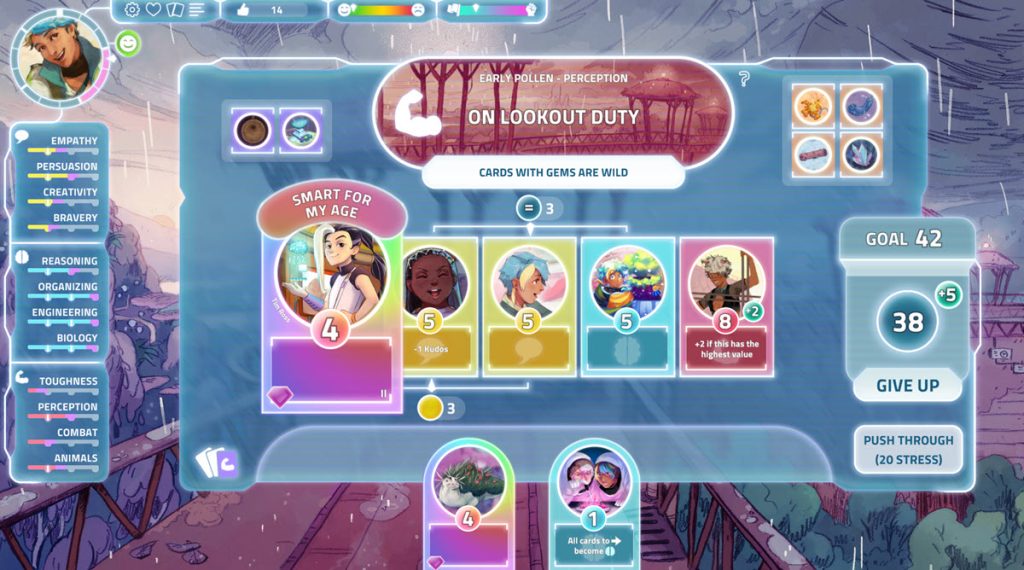
Of course, there’s a bit more to it because you can arrange the order of your cards. You earn bonus points for numerical straights and flushes of the same suit. Eventually, some cards have special abilities, such as boosting adjacent cards, or wild suits, or bonuses if you can play them to specific slots. Some challenges have special conditions, such as blocking certain slots, or changing the value of suits. As you raise your character’s stats, you’ll change some of the parameters, like your hand size, or your predilection for certain suits, or the amount of gear you can equip for persistent bonuses. There are even consumable inventory items that change card suits, add points to a card’s value, or even redraw your hand.
The whole thing is shot through with a surprising lack of thematic consistency, or even consideration. Why are the names of the cards — the actual theming — so downplayed that you can’t even see them unless you click the card? What do gems on cards represent? What do adjacency modifiers represent? Why does a card for babysitting give you 5 social but gossiping gives you 8 social and sharing only gives you 1 social? Why did you get a 3 combat card for playing in the snow? Why does curing a disease only give you 1 mental but winning your school’s science fair gives you 5 mental? I Was a Teenage Exocolonist is uninterested in answering these questions. It’s just throwing out arbitrary values, modifiers, and abilities. It’s just slapping names and numbers on cards. You figure it out. I Was a Teenage Exocolonist can’t be bothered. Its gameplay never manages to lift itself above the level of haphazard math puzzles.
Because the deck building is so passive, because the card play is so limited, and because the theme is so sloppily amorphous, I Was a Teenage Exocolonist is bottom-of-the-barrel stuff when it comes to the deck-builders. I suppose I should be thankful for this option in the settings screen?
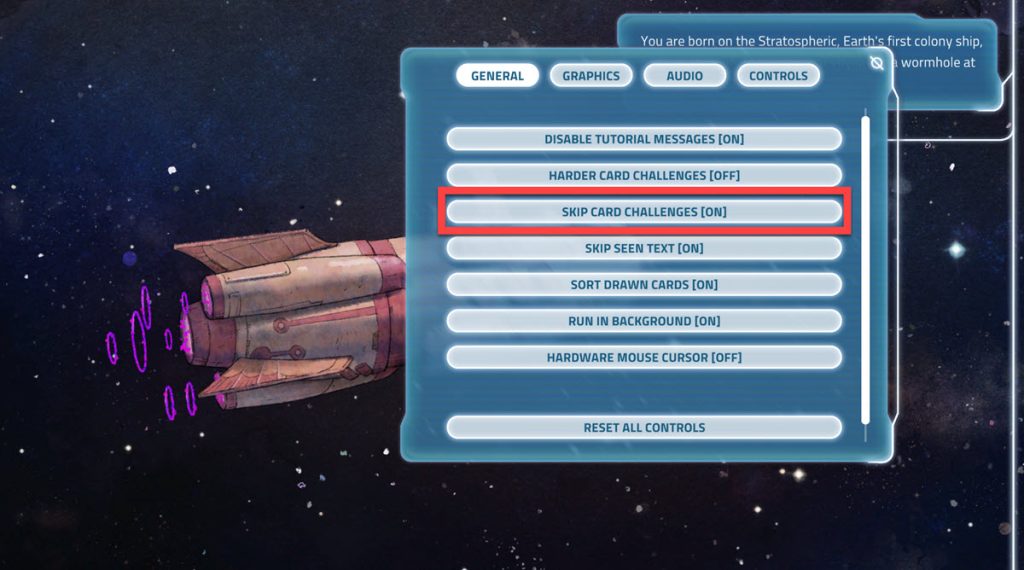
You can completely turn off the challenges in which you use your deck of cards. Instead, you just win them all automatically. It’s not enough that you could have failed forward! With this option, you can win forward. What does it say about Northway’s confidence in the game portion of I Was a Teenage Exocolonist that they give players the option to opt out entirely?
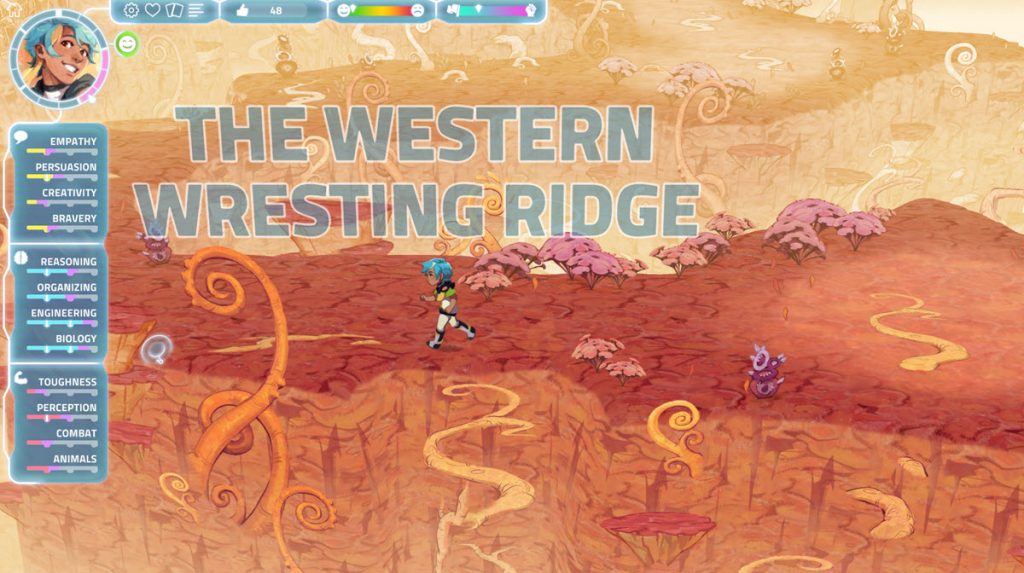
Which brings me to the third way to consider this game: as a visual novel with a branching plot combined with a deck-builder.
Each year of your character’s young adulthood is broken into 13 months. Your allotted time span is ten years. So that’s a total of 130 turns to get to whatever ending you get to. Each turn, you can walk your avatar around a space colony to talk to other characters and choose among different challenges in different buildings. Each challenge will raise some of your character’s stats, with more points earned if you beat the challenge. Some challenges are gated by your stats. For instance, you can’t defend the walls from aliens until your combat reaches a certain level. You can’t repair robots until your engineering reaches a certain level. And as your stats reach various levels, you unlock abilities, which is the main reason to raise your stats. Along the way, sometimes cards are dumped into your deck whether you want them or not. You may not be deck-building, but your deck is being built.
There are attempts to break out into heftier gameplay, but I can’t say they’re successful. The planet is divided into four biomes. Each is a dungeon, really. A more-or-less linear maze interrupted by challenges. Presumably there’s a special ending if you finish the four mazes. The intent is to model exploration of a mysterious planet, but that’s hardly expressed in these strings of challenges. Frankly, I have more of a sense of exploration walking around the pointless space colony trying to find Anemone so I can give her a red xeno egg.
I suppose I might have enjoyed I Was a Teenage Exocolonist if the visual novel hadn’t been so doggedly young adult. Or if the deck-builder hadn’t been so subpar at a time when there are so many good deck-builders. But taken together, this whole feels even less than the sum of its parts and it’s clearly not for me. I guess you could say I Was an Adult Who Stayed on Earth.
(Why is a grown-ass man like me who’s got unreasonably high expectations for fiction and exacting standards for deck-builders reviewing I Was a Teenage Exocolonist? Because it won the Patreon review request drawing! If you’d like me to review something, anything, for any age group, of any genre, support me for $10 or more on Patreon. You’ll get a PM every month asking what you’d like me to review, and your choice will take its place in the bracket competition.)

I Was a Teenage Exocolonist
Rating:
PC
This is what would happen if you shot Judy Blume into space
