


10 hours of Clair Obcur: watching weird things closely
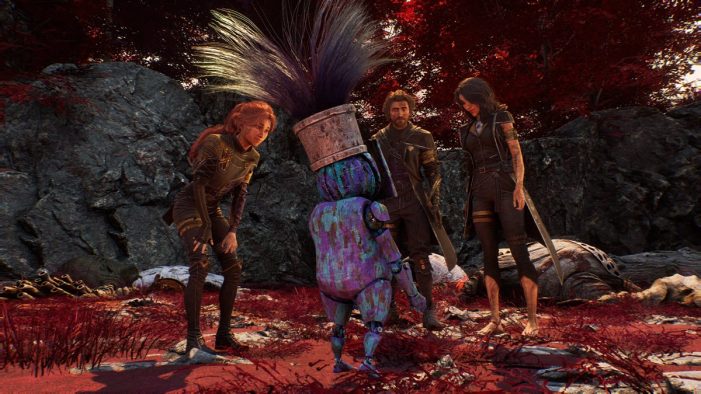
I expect a JRPG to take its time getting underway. They tend to open slowly, as they amble casually through their opening hours. They meander among bouts of worldbuilding, new systems tutorials, and character introductions. You’re not really playing a JRPG until you’ve paid several hours of game tax. Even then, there might be several more yet to come. JRPGs are not for the impatient.
But I don’t think I’ve ever played a less eventful first ten hours than the first ten hours of Clair Obscur. I am utterly nonplussed. I simply don’t get it. I don’t understand the lack of worldbuilding, systems, or characters. And what is there seems underdeveloped. The worldbulding is inscrutable and arbitrary, the systems are simple and few, and the characters are glib videogame puppets with luxurious hair and meager motivations. This is the critically acclaimed Clair Obscur: Expedition 33? This is what won our forums’ yearly awards?
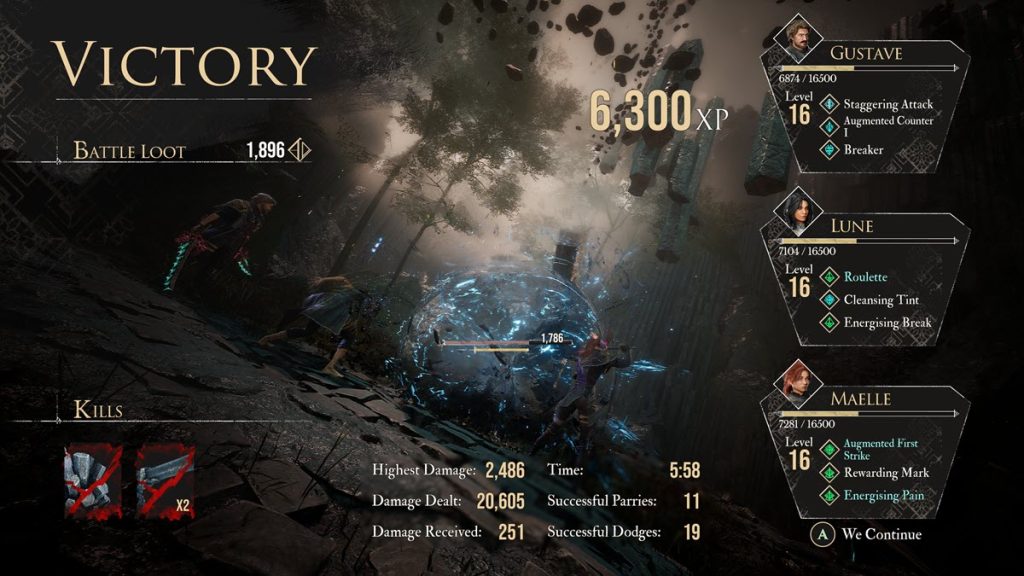
With a little over ten hours on my saved game, I’ve just hit the Act II title card. And I’m still pretty confused about the actual premise. Let me see if I have this right. An evil Paintress who has her hair in front of her face, Samara-style, keeps rebooting the world? And this makes everyone vanish, like in the Marvel movies when Thanos snaps his fingers, except not the people going on an expedition to stop the evil Paintress? And this whole thing is called a “Gommage”, which I can’t hear without my brain telling me that might be the French word for “cheese”? And whenever an expedition launches, a helpful timer on the horizon counts down from 100? And I’m playing expedition 33, which would technically be the 67th expedition? Actually, the 68th, since I believe there will be — or was? — an expedition zero? And when my expedition arrives at Paintress Island, we get wiped out during a contested amphibous landing, like Normandy beach but instead of Nazis the enemy is a single old man? Yep, this is definitely a JRPG!
I’m not sure how much of that I have correct, or even whether I’m supposed to fully understand any of it yet (a lot of the story seems contingent on the characters knowing more than the player). But now that a mess of new Act II plot points are being introduced, I get the feeling Clair Obscur is running ahead without me. Which I might not mind, since being inscrutable can be a fundmental part of a JRPG. But the first step for me caring about these characters is understanding them, and that’s hard to do when I barely understand what they’re doing, why they’re doing it, and what the stakes are. Is getting Gommaged permanent? And why do they speak English but cuss in French?
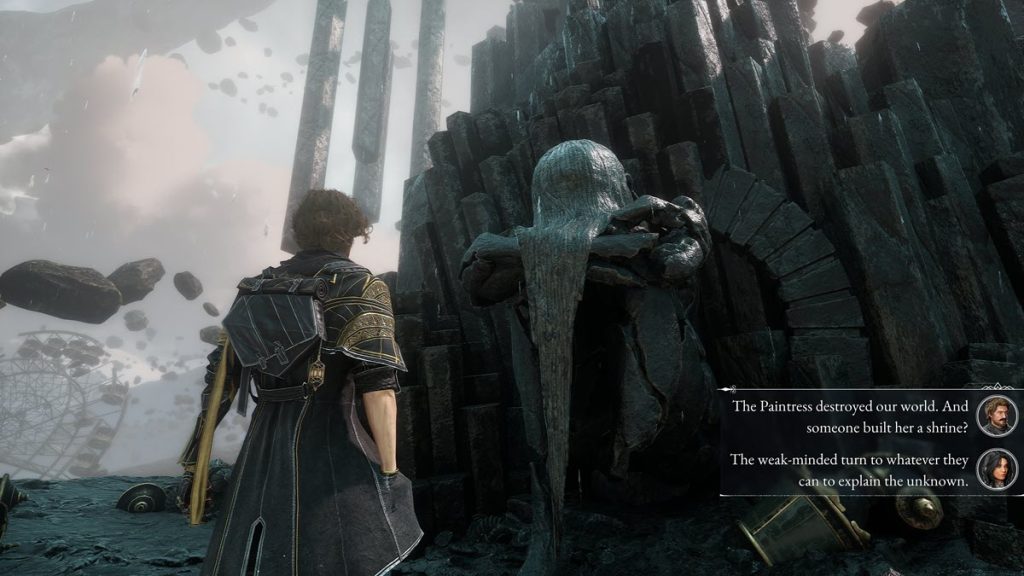
I don’t even understand where they are, other than “inside Unreal engine levels”. Everything is frayed, gaudy, multi-hued, half floating in the air, like Facing Worlds but confused and confusing. The levels are comprised of shredded surrealism, busily nonsensical and utterly noninteractive. It’s absurd, in the Frenchest possible sense of the word! Nothing matters. Nothing does anything. Noplace is different from any other place. I am in a maze of twisty little passages, all alike.
Without a map, they can be hard to navigate. Have I been here? Have I been over there? They’re tragically dull since there’s nothing to do beyond “get to the other side”. The handful of puzzle chests I’ve found — they’re called “paint cages” — seem to just contain cosmetic options for my characters. There are collectible audio diaries, which is the worst kind of collectible. Since this is a mostly lootless game, the only treasure has been potion upgrades of questionable value and stashes of “chroma”, a currency of even more questionable value. When there’s nothing worth spending it on, how much does money matter?
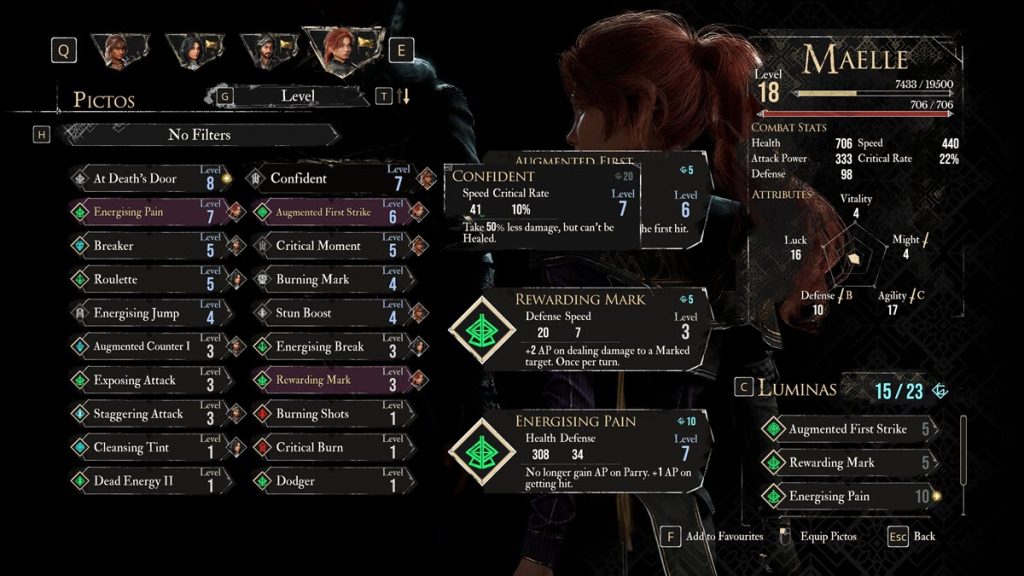
Character development seems oddly restricted in Clair Obsure. Weapons, “pictos” (equippable stat boosts), and “luminas” (unlocked passive bonuses) are the building blocks for character advancement, along with skill trees. And yet, so much of what I’ve found and unlocked seems useless. I keep finding new pictos that will unlock new luminas and thinking, “No thanks, I’m fine with that I’ve currently got slotted!” The skills seems awfully slow to unlock, but I couldn’t care less since I see no incentive to vary which skills I use. In fact, the limit on six equipped skills would normally be annoying potential micromanagement, since you can swap them out between battles. But so far, I haven’t needed most the skills I’ve unlocked.
The main problem with the character build system is that if feels very “fire and forget”: I’ve settled on a fixed strategy that I apply to every battle. I’ve got a pretty reliable “burn-then-break” routine going, and I see no reason to vary it, even if I happen to be dealing with burn-resistant monsters. The weapon upgrade system encourages settling on one specific weapon, and tailoring a character’s stats accordingly is the narrow path for leveling up (in fact, the consumable item that lets you reset character stats seems like it’s intended to gate how frequently you can change a character’s weapon). You bring three of the four characters into combat, and each of the available characters plays differently, so they’ve got that going for them. But given the inflexibility of combat, I see no reason to vary which three characters step up to fight. Part way through the first act, I added a fourth character, but had no interest in learning her Tarot card powers. They were just going to mess up my “burn-then-break” routine.
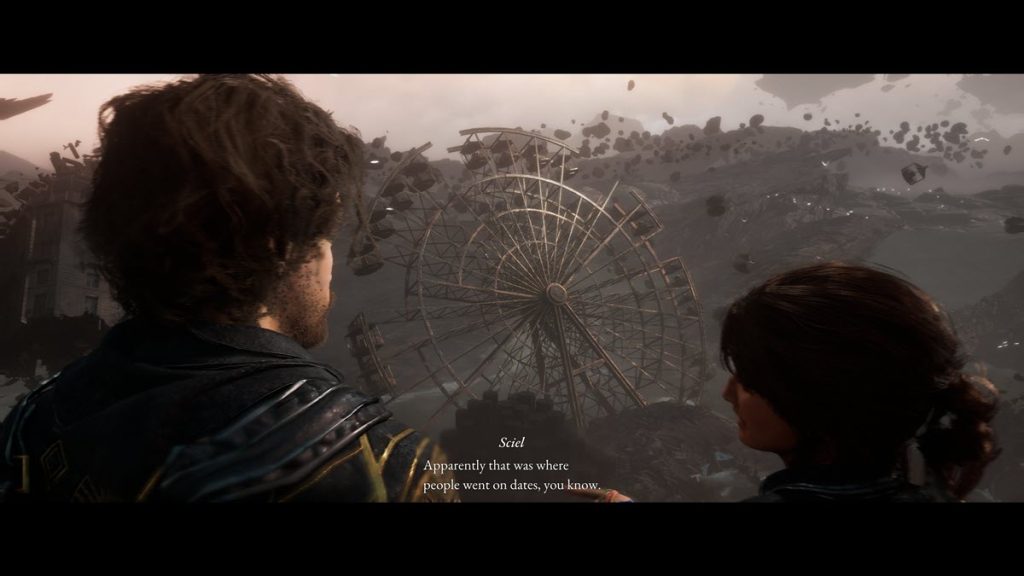
These characters seem to be Clair Obscur’s alternative to gameplay systems, because there’s precious little else to do in the game other than fight weird monsters. No dialogue system, no factions, no base building, no resourse management, no loot, no gear, no overland abilities. Late in Act I, you can cross a new type of terrain, so that happens. Clair Obscur trundles along its simplistic gameplay loop: push through indeterminate mazes to get to the other side, then wait out the glumly plodding cutscenes that are more interested in hair technology than meaningful dialogue, effective drama, or any sort of pacing. Repeat until Act II title card.
I couldn’t care less about the characters, and not just because I don’t understand what they’re even doing. When Act II introduces a supposedly dramatic twist — “quelle surprise!” Clair Obscur would have me exclaim — my main concern was that I’m going to have to learn how Tarot card girl works after all. It speaks volumes when the only disruption to the fire-and-forget is a scripted beat after ten hours.
And as for the combat system, it’s certainly different. It is based almost entirely on learning the timing for the various attack animations for each of the monsters. This will determine how well I can dodge their attacks and therefore avoid taking damage. My survivability is amost solely determined by reacting to these animations. Once I’ve learned dodging, I can risk a parry instead to apply counter damage. Basically, parrying will kill them more quickly so I won’t have to dodge them as much. But I found it was far safer to just dodge and let my “burn-then-break” routine do the killing. In fact, all my fine battlecraft — the weapon development, the slotted lumina, the choice of pictos, my potions and unlocked healing abilities — are secondary to dodging. Clair Obscur is a game about watching animations, learning them, and then reacting to them to get through combat.
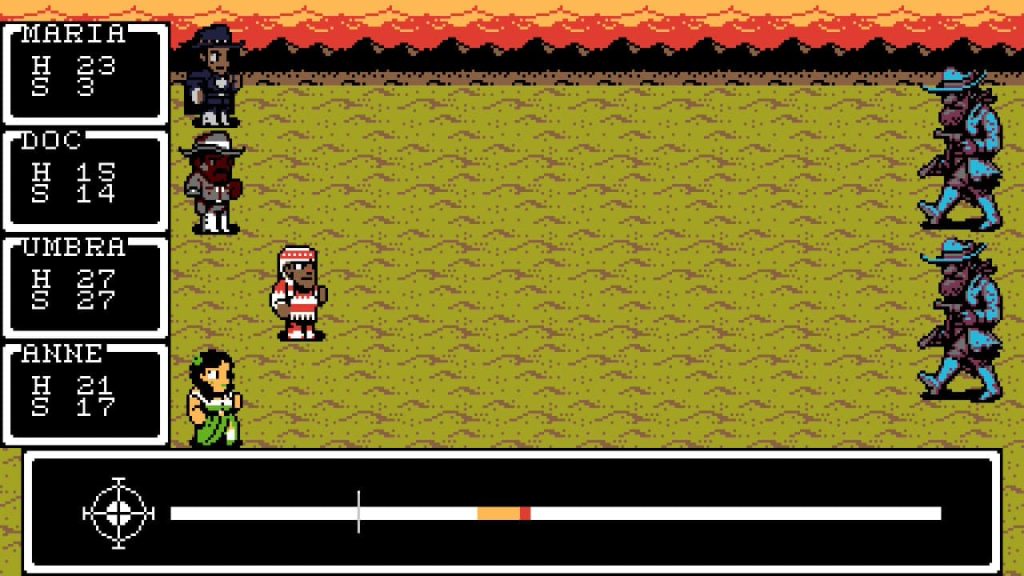
Which is an interesting premise. I appreciate how it makes a JRPG’s traditional menu-based battles feel more interactive, how it gives them the allure of skill-based combat by asking me to learn timing and sometimes even rhythm (I’ve enjoyed the same system in another JRPG called Grimstone (pictured)). But as the premise for an entire combat system? As the almost only meaningful detail about an enemy? As a way to subvert character builds, and loot, and even healing? As the singular sine qua non of gameplay?
Here’s where the lack of worldbuilding really comes home to roost, because it takes a fair bit of investment to learn these animations. I don’t understand these monters, yet I have to study them anyway. Carefully. With the possible exception of the constructs built by the “Italian” puppet people, I don’t get any sense of ecology, context, or even creativity. The enemies seem weird for weird’s sake, and not even weird enough to pull it off. They feel like random things invented by a team of artists working to justify their salaries, none of whom have talked to each other, or anyone else on the development team. Pointless and strange can part of a classic JRPG, I realize, but nearly the entirety? Never before have I been expected to watch them so closely, to learn them individually, to tune my reflexes to their undulations, jerks, and jitters. I am a slave to these graceless animations in this drawn-out and pointless exercise in watching weird things closely.
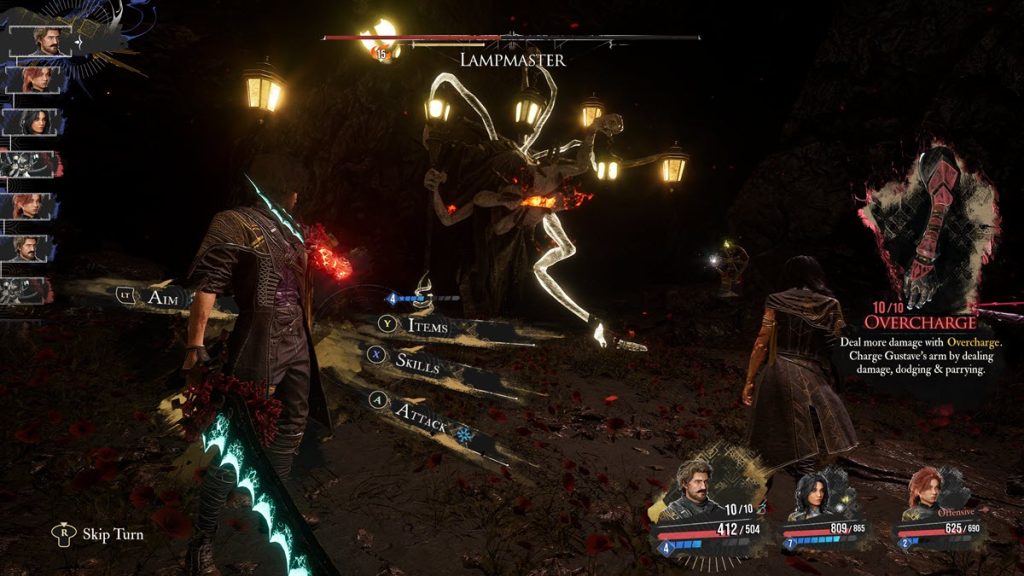
But maybe that’s just the first ten hours. “Onwards to Act II,” he says, with the same enthusiasm as someone on a day-long march who’s just checked his watch to see it’s not even noon yet.
Clair Obscur (first 10 hours)
Rating:
PC
A game about replaying battles until you've memorized the animations
