


Best thing you’ll see all fiscal year: I Love Boosters
I went into Boot Riley’s I Love Boosters with some trepidation. Sorry to Bother You, Riley’s previous and first movie, felt so distinctive. So subversive, so slyly goofy, so warmly funny instead of resentful. It felt so much like one person’s voice, one person’s bottled-up inside joke finally escaping. How could Boots Riley possibly capture that same grinning lightning-in-a-bottle quality a second time? Surely he’d written and directed his masterpiece and from there on out, it would be iterations or sophomore efforts all the way? What could possibly top LaKeith Stanfield’s rap performance for Armi Hammer, which has aged in such wonderfully uncomfortable ways since 2018?
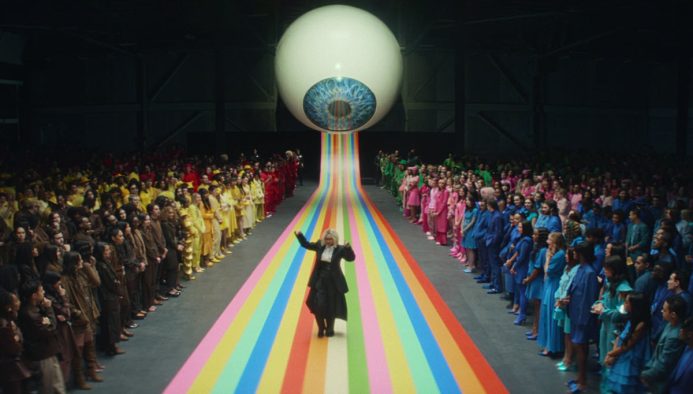
Boy, was I wrong. I can definitely see the continuity with Sorry to Bother You, but Boot Riley’s latest movie erupts to new levels of slapstick, satire, and showmanship, all worthy of the heartbreak and turmoil of the intervening years since 2108. The production design itself is so explosively and unashamedly joyous. The ladies — and a couple of gentlemen — dressing up in their crazy outfits and bold colors, the fantastic and nearly fantastical sets. But the fun doesn’t stop there. The “hi-hi-HEE-ho hi-hi” soundtrack ompa-loopa’ing and doodle-doo’ing merrily along. The use of miniatures — miniatures! — in the style of Terry Gilliam. Who does a car chase using miniatures? The baldly obvious stop-motion instead of CG. Who introduces stop motion so late in the game? But mostly — above all and unrelenting — the surprisingly sophisticated over-the-top humor that reminds me of Thomas Pynchon for its insight, breadth, and even nuance. Who tells jokes this way? Who can pull all this together in something as daunting as a major motion picture? Who does all this? Boots Riley, that’s who.
Also carried over from Sorry to Bother You, but considerably amplified, is the social satire. It’s one thing to indict late-stage capitalism, corporate excess, the gig economy, and the marginalization of labor. Been there, done that, got the T-shirt, chanted the slogan, and then paid Warner Bros my subscription fee for HBO. These days, real politics lives in memes, not movies anymore. But here comes Riley, having not gotten the memo, colorfully afire with passion for a marginalized cause carried forward from the 60s and 70s. Riley, born in 1971, still has his fist raised, not to strike — or even strike — but to keep rhythm to a dwindling chant. For a man making such ebulliently silly movies, Riley’s agenda is one of social realism, but from stage left, further left than Gilliam ever dared, swooping in from this unexpected flank. Here is a man determined to make Marxism fun again, writing hilarious technobabble about the dialectic, entirely minus the didactic. Preaching without being preachy, his slyly satirical sermon vivid, bold, colorful, spun out by a spirited band of lovely ladies having the time of their lives.
And I don’t just mean the three leads: Keke Palmer doing the hard work of playing the straight man in such a swervy slapstick comedy; Naomi Ackie doing the even harder work of playing the best friend (you can see her doing it just as well in Sorry Baby, a sexual assault polemic that would have suffered greatly without her); and the knee-weakeningly adorable Taylour Paige as the goofy air-headed comedic relief. Once Poppy Liu teleports into the action, I Love Boosters comfortably globalizes with its four leads. Oops, hold that thought, I guess we should also include Eiza Gonzales, who I had given up on after she flailed in the vanguard of Guy Ritchie’s latest sleepwalking attempt at an action movie. Here she deadpans deliciously the all the fun Marxist technobabble stoner dialogue. If you listen closely, there’s a point in there! I also have to include Demi Moore as the villain, last seen spraying the entertainment industry with gore at the end of Coralie Fargeat’s aggrieved The Substance. Here, Moore gets to have more fun with less mess. Industry will indeed be sprayed in I Love Boosters, but with glittery left-wing magic instead of angry slop. The climax of I Love Boosters isn’t just a social metaphor, it’s a metaphor for the movie itself, a tribute to the power of optimism, a blindingly colorful refutation of despair. Who does this in a major motion picture? Boots Riley, that’s who.
(There’s even some continuity here with another one of my favorite movies from 2026, Mother Mary. This is basically a two-person play by David Lowry, who last movie Green Knight ranged far and wide in the distant mists of Arthurian legend. Mother Mary is as intimate as Green Knight was epic. It’s a ghost story wrapped in a fashion experiment, expressed as a dialogue, told in lushly cinematic language, intercut with a concert movie. And like I Love Boosters, it’s very much about clothing, disguises, fashion as an expression instead of just an industry. It’s also a pair of fantastic performances: Anne Hathaway showing some impressive physicality, and Michaela Coel, who was all but wasted in Soderbergh’s disappointing heist movie The Christophers. Come for the David Lowry visuals, stay for the haunting interpersonal connection between Hathaway and Coel.)
