


You’re not just Sektori’s pilot, you’re also its architect
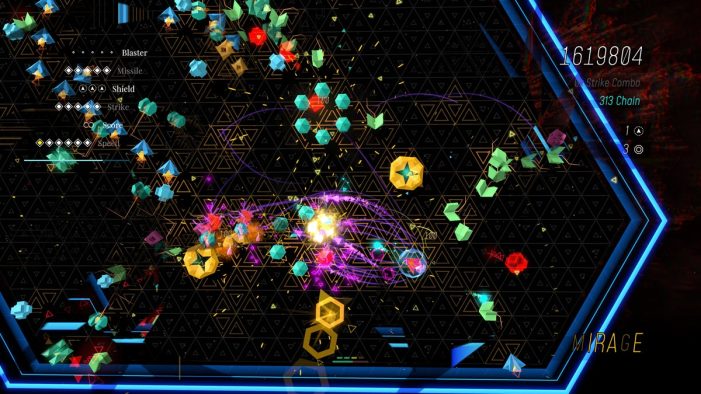
Twin-stick shooters like Sektori are a dime a dozen, and they’re especially cheap when they’re abstract. Arcade action without some sort of theming — ancient Greece, plucky spaceships rescuing dudes, giant bugs, ghost and goblins, swords and sorcery — isn’t just naked, it’s barely there. Unsexy when sexy can make all the difference. Quaker meeting houses to Catholic cathedrals, plain donuts to sprinkles and pink icing, greyscale resale value to cherry red with painted flames. So what’s a game like Sektori to do in the Geometry Wars postbellum?
No one’s going to pick up Sektori for its theming. The only theming is an occasional prose outburst with the arrival of end-stage bosses, announced as they arrive, like the declaration of some aristocracy as it strides into the expectantly paused chaos of a ballroom. “The Architect”, the valet announces. Or “Sacred Chains”. Or “The Serpent”. Sometimes “The Serpent Queen”, since there are escalating variants of each boss. The only other theming is a mission statement on the main screen:
Sektori is a place, a form of being, a method of transformation. Sektori is seeking, processing, shaping. Sektori is a specter of your zero state. Embark on a journey to reach your truest state of consciousness.
Sounds like some kind of Californian wanna-be-Buddhist guff to me. That’s the sum total of the work done in the Sektori writers’ room. No one wrote a plot, or cutscenes, or descriptions of the weapons. No artists drew animated figures or autocadded models or sculpted pixels. Sektori is a construction of unadultured gameplay, straight, no shooter, except the twin-stick variety, take it neat or not at all, stripped down as it is, playing close to ones and zeroes, free of narrative pretension to float in the bright neon purity of vector-graphics cyberspace. You’re in like Flynn. Kevin, not Errol.
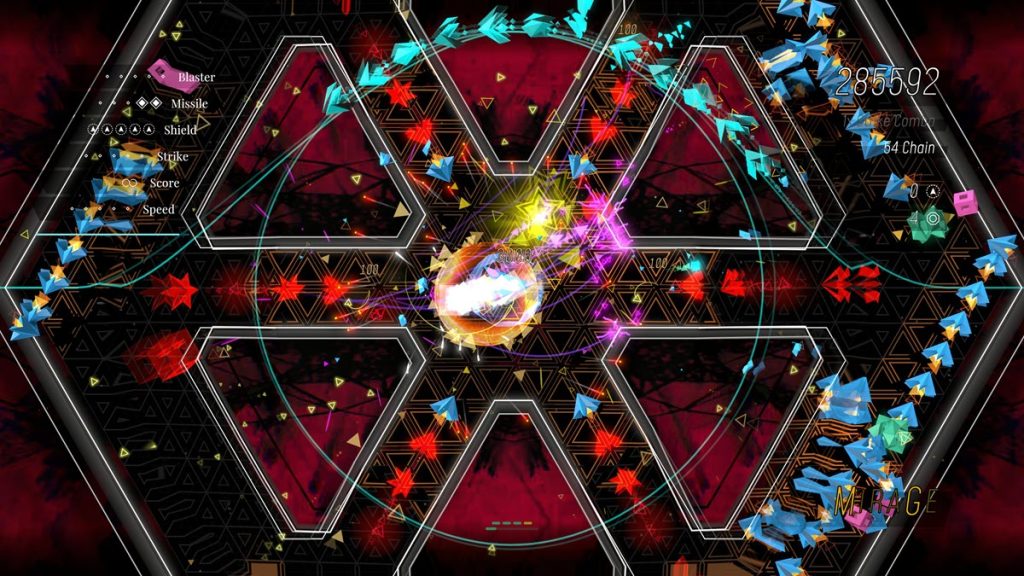
It’s a choice. Hades this ain’t. Okay, to be fair, it kind of is. Sektori and Hades share the vocabulary of aim, dodge, juke, thrust, and that indispensable sine qua non of twin-stickery, the strafe. Both games speak the same language, even if one is more fancy about it, even if Hades asks you to master the timing of the attack rather than giving you the instant gratification of Sektori’s spray-‘n-pray bullet spew.
But for the most part, Sektori is speaking the language of Hades, Dead Cells, and Binding of Isaac, using the grammar of upgrades arcade shooters have derived from deck-builders, ARPGs, and rogue-likes. This is an almost hard-and-fast rule of game design: if a player isn’t upgrading something, if he’s not selecting new powers or abilities, if he’s not turning 1s into 2s, then the design is static, stagnant, a glass of flat soda in a boarded up diner in a rundown part of the neighborhood. Progression, and preferably meta-progression, is the fundamental truth of modern game design, the barb in the hook. Entanglement, engagement, then enthralldom. And it’s all part of Sektori. The themelessness is just sheep’s clothing.
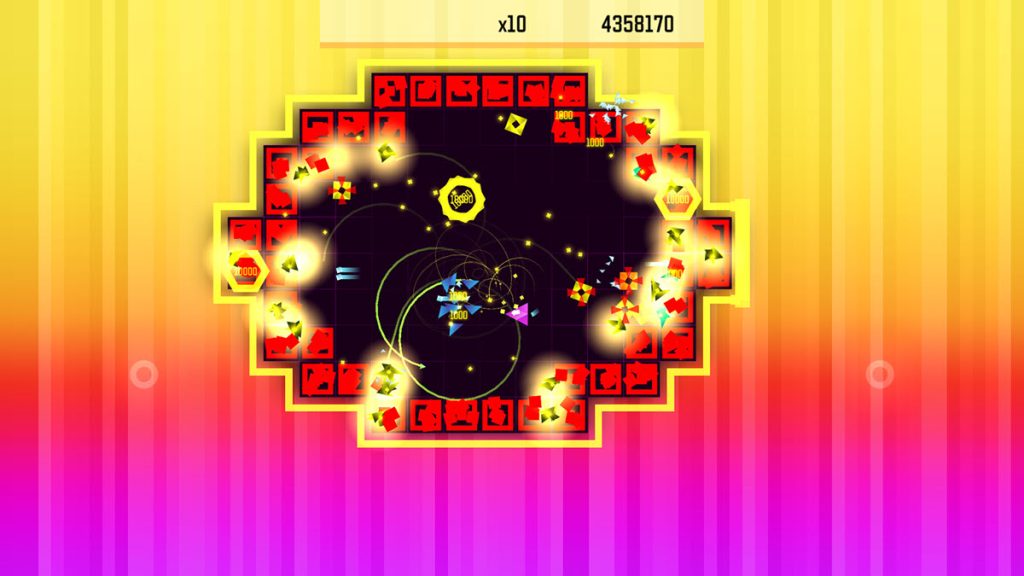
Kimmo Lahtinen is the author of this story about a triangle progressing its pew-pew to pew-pew-pew. Lahtinen was a programmer at Finnish studio Housemarque. He did programming for zombie twin-stick shooter Dead Nation, 2D platformer Outland, and the Defender-inspired and brilliantly modern/retro Resogun. After Resogun, he left Housemarque and released various one-man indie titles, including an artsy match-3 and a pun-based top-down army brawler. Sektori is his updated take on Trigonarium, his first post-Housemarque game, a twin-stick shooter he published on Steam in 2015. Here’s how that looked:
By iterating on Trigonarium, Lahtinen was planning on doing something relatively quick and easy. But he concedes he let Sektori get away from him. After 25 years practicing responsible and manageable design, as he put it in his animated designer’s commentary: “I thought that for once, I don’t care. Let’s go.” The ensuing attitude of “more everything” stretched the process out by several years, but it shows. Sektori is full of hidden features, careful tuning, shrewd design decisions so shrewd you might not even notice. It rewards exploration with discoveries that belie its appearance as a simple, accessible, themeless arcade shooter. Whether you call it “learning the game” or “discovering new things”, these discoveries are part of the thrill.
Allow me to slightly spoil that thrill by explaining some of what makes Sektori stand out from the dime-a-dozen crowd. The design is premised on player agency, a fundamental crux of everything from visual novels to open-world games, the ineffable question lurking in the word “game”, even in its absence. But Sektori is almost entirely about player agency, about the choices you make. You matter always.
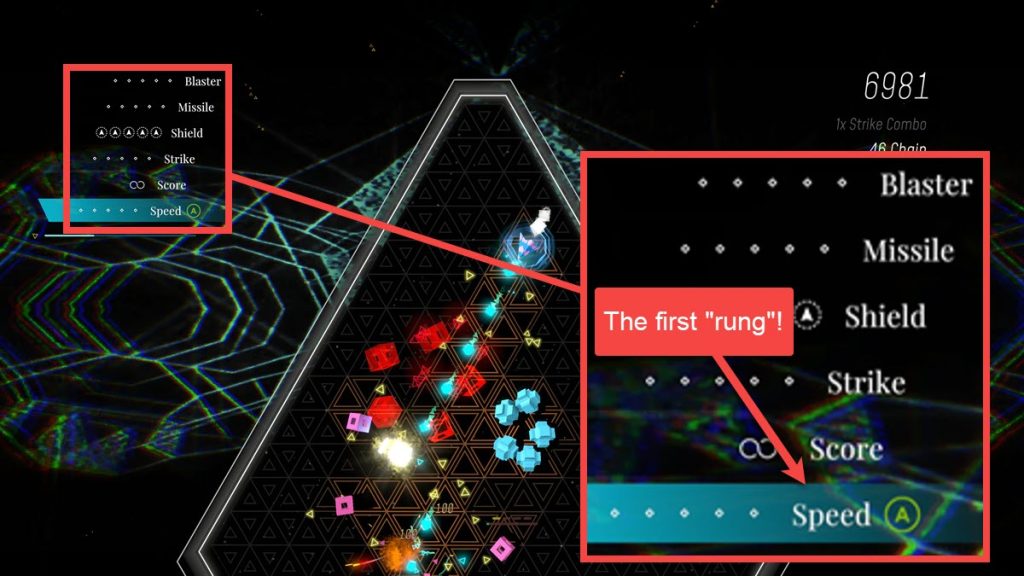
Unlike other similar games that rely on randomness — what will the gumball dispenser spit out this time? — you always choose your upgrades in Sektori. There are two kinds of upgrades: the inherent attributes of your triangle, and the myriad rules tweaks/violations. The first kind of upgrade is arranged in a ladder, from ship speed, to dash attacks, to homing missiles, to the number of shots your triangle fires. Each time you pick up a blue token, which spawns when you’ve collected the little detritus enemies drop when you kill them, you climb a rung on the ladder. Your position is indicated in a display on the side of the screen. Having picked up your first token and climbed to the “ship speed” rung, do you immediately cash it in to upgrade your ship’s speed? Or do you hold out for one of the later and arguably better upgrades higher up the ladder?
This spend-or-save dynamic is constant in Sektori and it means your innate attributes are entirely your choice for any given run. The feeling is one of “builds”, almost like in a real time strategy game. Speed or homing missiles? More shots or more frequent dashing? Some combination thereof? How heavily will you lean into any given upgrade? Homing missiles sure are nice, but at the cost of moving slowly? Extra shots are obviously preferable, but can you afford to hold out that long, to invest that many tokens? You’ll develop a preference. But then you’ll have to be flexible depending on how you’re doing, because partway up the ladder are extra lives. If you want to keep playing, you’ll have to figure out the trade-off between upgrades and extra lives along the way. How safe are you going to play it? And is extra power a sufficient substitute for extra safety? Sektori is about gambling as much as shooting.
The other kinds of upgrades are powered by deck-building. Don’t groan! It’s not what you’re thinking. Before any given run, you choose eight of Sektori’s 16 “decks”. Calling them decks is generous, since they each have only three cards. And half of them are locked when you first take up Sektori, so this isn’t something you’ll have to fuss with until you start unlocking stuff. But the eventual result is that you’re building a deck of 24 cards to bring into each run.
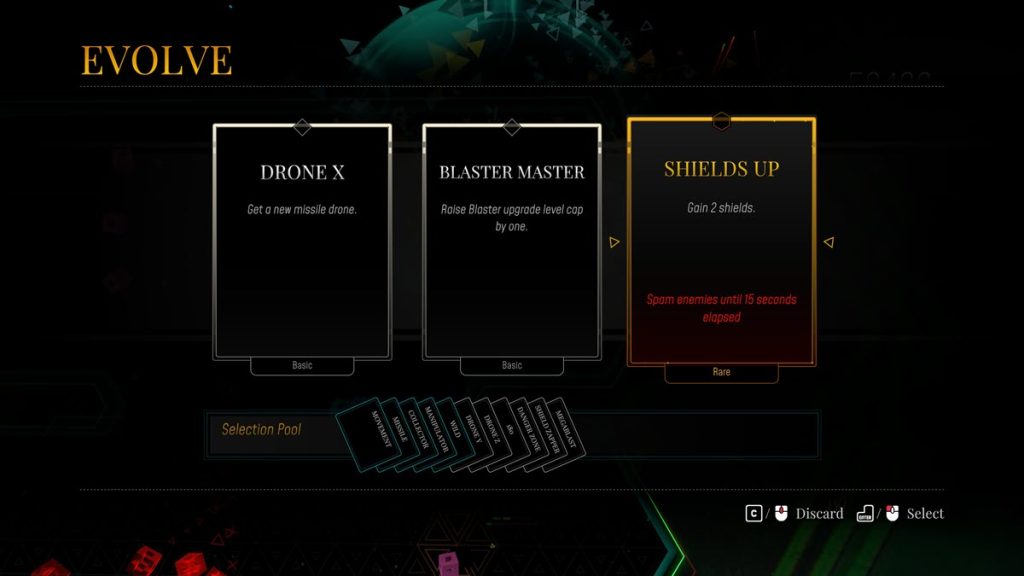
Whenever you pick up a golden token, you’ll get to choose from a random draw of three of these 24 cards. They’ll do things outside the purview of the more basic and reliable upgrades, things that can really change the way Sektori plays. This is the sizzle in Sektori’s otherwise plain steak, the sexy that makes all the difference. If your basic upgrades are your RTS opening build, these cards are your faction choice, the theming you’ll apply to your run, the part of Sektori’s design where the homely librarian whips off her glasses and shakes her tresses free. Your choice among those 16 decks is front-loaded, but it’s every bit as important as the ongoing risk/reward calculation of the innate upgrades.
The golden tokens that unlock a card are harder to come by, of course, but even that is entirely within your control. I’ve discovered three ways to get a golden token, and it’s never random (I believe there’s a fourth way to get a golden token but I’m not willing to go on record with this yet). The randomness comes from which three cards you’ll draw. If you’re lucky, you might even spawn a rare variant of any given card. These come with a curse — a timed negative buff — but you never have to take them. Like everything else in Sektori, it’s a calculation for you to make. It’s a risk with a reward and never an obvious A is better than B.
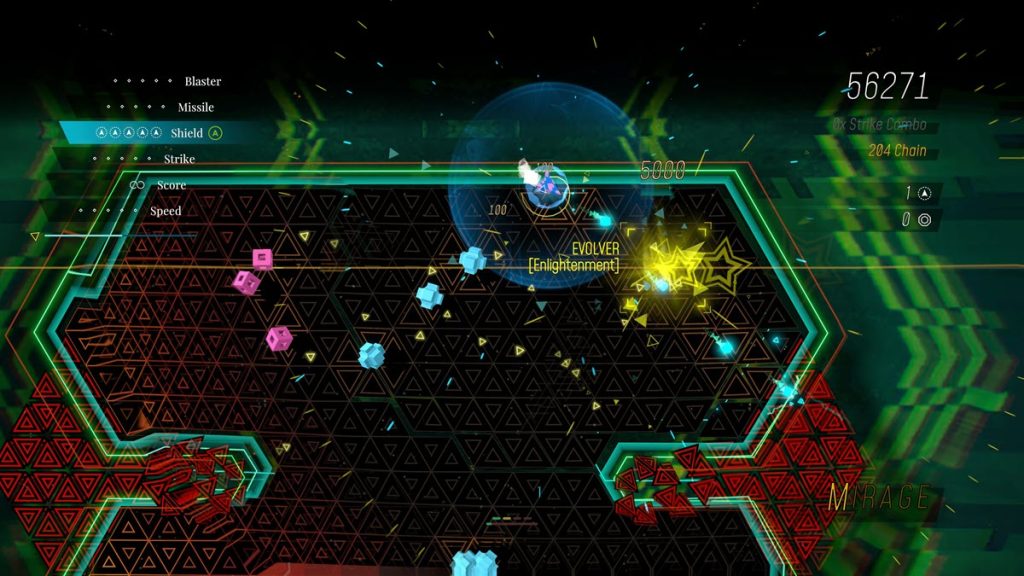
This upgrade system feels unique for how it’s always under your control, for how you’re never turning the crank on a gumball machine to see what will drop out, for how there’s no “gacha” or even “gotcha”. You’re always doing these upgrades to yourself. Even the random draw of three cards always comes from the deck of 24 you built before the game began. Sektori asks you to build just as equally as it asks you to drive. It’s player agency always and only. Although the moment-to-moment gameplay is that mind-voiding zen that goes with any good arcade shooter, you’re not asked to surrender any of it to vulgar randomness.
The bottom of the screen always shows how close you are to the end of any stage, at which point one of the game’s five bosses will be announced before the dancers clear and your regal nemesis strides into the ballroom. Their order is random, and the bosses begin as their most simple variants. But they get increasingly complex as you progress. As near as I can tell, the idea is to play through five worlds of five bosses each. Ha ha, as if. I can rarely get through the first set of five. Part of the learning curve is not wasting all your lives fighting a boss, which is where I’m currently becalmed. The five bosses are all right fuckers, unleashing fresh bullet hells as their variants get more advanced. I’ve done my best when I’ve built a potent combination of upgrades and powers, when I’ve intentionally managed what Sektori offers rather than merely persevered, when I’ve dredged for myself a comfortable zen groove and my physical body has all but melted into the controls. In like Flynn. Whoa, I know bullet hell.
Sektori makes it easy to achieve this Flynn state of consciousness by clearly, conveniently, and obviously showing you the things you need to know amid the chaos, where every digital jot and tittle jockeys furiously for your attention. It’s nearly a miracle of modern HUD how cleanly Sektori surfaces the most important information. You can see your dash recharge as a replenishing line around your ship with a distinct tone when it’s ready. The locations of dropped tokens, even all the way across the arena or offscreen are immediately and always obvious, with a rude sound effect when they’re in danger of expiring. (With such a thorough interface, it’s especially annoying that there’s no way to see what cards I’ve unlocked, especially when the cards I’ve yet to unlock are on display. Hey, Sektori, isn’t the more relevant information the cards that are actually in effect?)
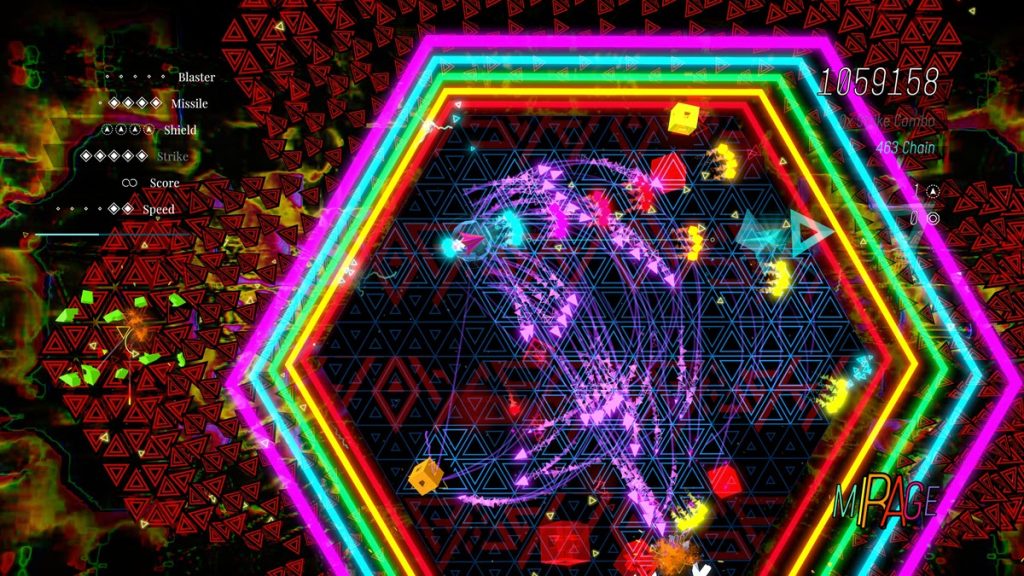
The rising action does something I don’t see in other games like this: a rich-get-richer snowballing in which the upgrades can make Sektori easier the further you get. Once you learn the game design, once you can manage tricks like the orgiastically glorious rainbow mode, once you learn that you’re entirely in control of the upgrade process and you’re comfortable taking control, each successive upgrade can make it easier for you to get additional upgrades, which in turn makes it easier to get additional upgrades, which makes it easier to get additional upgrades, and so on. In a lot of games like this, I’m hanging on for dear life as the difficulty ratchets up, eventually runs away from me, and inevitably leaves me blinking and bewildered in the dirt. In Sektori, I feel more like I’m breaking a wild horse, subduing it, taming it, wrangling it into submission and now in charge. This doesn’t always happen, but it has always happened when I’ve done well. Now, Sektori, witness the power of this fully operational triangle! Is that all you’ve got? Bring on the Serpent Queen!
Every game of Sektori starts from zero, but there is meta-progression in terms of unlocking stuff. However, none of it will make you more powerful. It mostly just gives you new ways to play, remixes, like the difference between a taco and a tostada. They’re categorized as “challenge modes”, whereas the campaign is the “main mode”. For me, challenge modes are ways to practice for the campaign. For instance, the boss rush lets me practice the bosses, learning not to waste all my lives because I choked during a boss fight. Similarly, crash mode is a great way to appreciate the power of dashing (called “strikes” in Sektori) by only letting you attack using dashes. The weaponless gameplay of gates mode is familiar to me from Geometry Wars, and it’s a perfect way to practice maneuvering finesse. A mode called classic, for some reason, lets you choose score or updates as you progress, which is a pretty mean thing to do. But this trade-off is arguably part of the campaign, since you can parley your upgrade tokens for score tokens if you’re chasing high scores on a leaderboard. Classic mode is also “hey, just fuck around and do whatever” mode, because you can toggle a whole mess of unlockable mutators to radically shuffle gameplay parameters. Mutators don’t allow you to register a score or unlock metaprogression because how would that be fair?
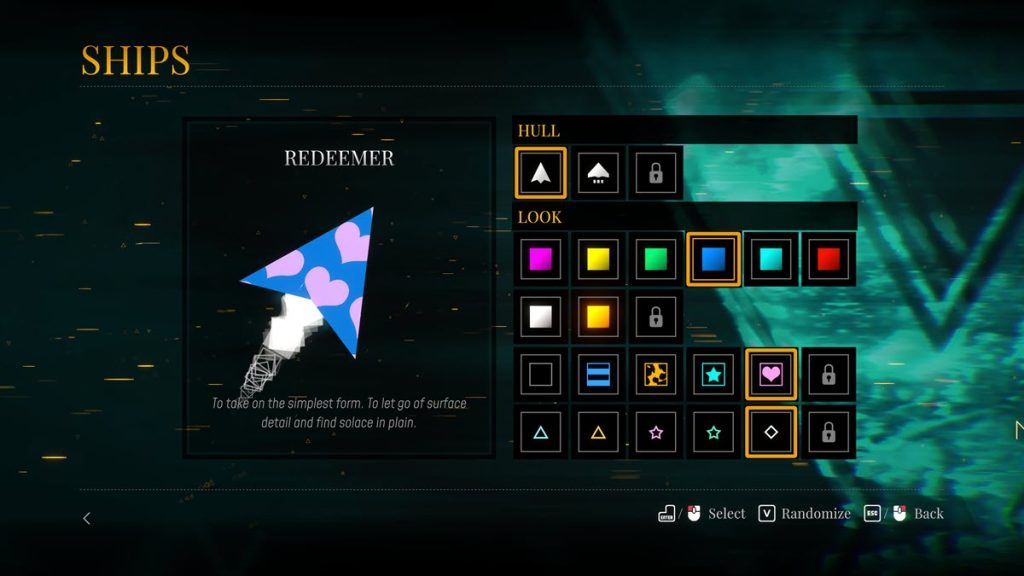
Also unlockable are cute little paint jobs for your triangle while he’s in the campaign. My triangle — let me show you it — is blue with little pink hearts. You can eventually unlock a squat triangle and something else, each with completely different base stats from the triangle, and therefore completely separate leaderboards. I cannot adjust my brain to the intricacies of the squat triangle and I can’t even see the something else yet. And don’t even get me started on the campaign’s three difficulty levels, also with their own leaderboards! I’m sure in the distant future of my eventual Sektori mastery, I’ll get to them. That’s when I will have melted into Sektori’s themelessness and achieved the “truest state of my consciousness”. In like Flynn!

Sektori
Rating:
PC
This is not your father's arcade shooter.
