Valve is disabling the ability to set pricing on mods. According to this official announcement, Valve is turning off the feature they rolled out on Friday that allowed modders to set pricing for their creations in the Steam Workshop. Even though modders have generated significant profit for Valve’s own Team Fortress 2, Counter-Strike: Global Offensive, and Dota 2, gamers voiced their displeasure at the new revenue sharing system as soon as it was launched. Negatives cited by detractors included copyright concerns, sketchy future support of broken mods, poor quality control, and modders getting too small of a cut.
We understand our own game’s communities pretty well, but stepping into an established, years old modding community in Skyrim was probably not the right place to start iterating. We think this made us miss the mark pretty badly, even though we believe there’s a useful feature somewhere here.
Earlier in the day, Bethesda had posted an explanation of their strategy on paid mods, but their reasoning did little to stem the arguments against the feature.
If you catch tonight’s episode of Better Call Saul, you’ll certainly remember the “Pimento” scene. But did you note the familiar voice or the vaguely familiar face? Steven Ogg, the voice actor and obvious visual inspiration for Trevor in Grand Theft Auto V, shows up in a small but memorable role, pretty much playing Trevor.
In the ongoing saga of Driveclub being a five-star racing game that was released two stars too early, it has finally gotten a replay feature. Now you can enjoy the truly gorgeous graphics without having to keep your eyes on the road. The replay mode lets you watch a race from a variety of camera views, with the option to enter a ridiculously detailed photo mode if you want to grab stills. It’s also a new way of looking at the tracks to learn how to drive them better.
The latest update also claims to make drift events less annoying. I’m not sure that’s possible, as I’ve yet to meet a drift mode in a videogame that wasn’t annoying. But with relaxed requirements for scoring drifts, at least it’s easier to get the stars you need to progress in the single-player tours.
Citybuilders are among the most information dense games you can play. Any citybuilder worth its salt is all about the whys and wherefores. Why is traffic bad here but fine there? Why did I suddenly run out of power? Why is the garbage not getting collected? Why is raw sewage backing up into houses? Why are people leaving? Why am I in an economic death spiral? Why don’t I just start over?
Cities: Skylines gives you pretty much all the stats, map overlays, and information displays you could want. Let me show you one in particular.
Failbetter’s Alexis Kennedy has a great post-mortem of Sunless Sea here. I particularly appreciate how he explains that some of his design decisions might not have resonated with a wider range of people, because he was staying true to a specific creative focus:
Ship speed is a good example. Sunless Sea is a stately game. You could reasonably call it a slow game. But we’ve resisted speeding up the ship, because it would reduce the tension, the sense of space and distance, and the menace of the dark. I think it’s quite possible that if the ship was 50% faster, the game would be more fun and less grindy – but I also think there’s an invisible line we’d cross, somewhere before that 50%, where the atmosphere was diminished without anyone quite knowing why. If we hadn’t had that iron creative focus from the beginning, I don’t think we’d have held our nerve, and Sunless Sea would have ended up a zippier, slighter experience.
Amen, brother. Some people have edited files to make the ship faster, which would be like fast-forwarding through the slow parts of a Stanley Kubrick movie. Sure, you could do it, but then you’re a philistine. I love how Kennedy tacitly concedes that game design doesn’t always have to worship at the altar of “fun”. If I want to have fun, I’d go outside and play tetherball. If I want a uniquely moving experience of exploring the unknown, I’ll play Sunless Sea.
Read the rest of the post-mortem for Kennedy’s confession that Sunless Sea is confused about it’s identity as a CRPG or a roguelike, how veteran players nearly ruined the early parts of the game, how early access saved us all from a terrible combat system (seriously, their first iteration at combat sounds godawful!), and how many bat skeletons Failbetter keeps in the office.
Move over Desmond, Tingle, everyone who’s ever sniped me in a first person shooter, and Tom Nook! There’s a new Worst Videogame Character of All Time in town. Literally.
After the jump, the only videogame character to drive me to a Twitter meltdown.Continue reading →
This tenacious member of a Rockstar crew called TeamPower AwesomeTeam uses Grand Theft Auto to demonstrate what a nightmare the already nightmarish Trials Fusion would be if it weren’t only in 2D.
If you love numbers and stats, a good action RPG like Diablo III will happily oblige you with more numbers and stats than you can shake an abacus at. But I didn’t have the foggiest notion about the game’s concept of distance until I saw The Escapist’s breakdown of just what “one yard” means in Tristramiam measurement.
In related news, here are some upcoming changes in the next patch. Hey, Blizzard, Diablo III is already good enough! Stop trying to make me want to keep playing!
Total War: Attila brings back family management to the series. Amongst Total War: Rome II’s many failings, Creative Assembly took out the dynasty drama that made such compelling stories in previous games. In the time since launch, the developers worked hard to bring Rome II up to snuff, (they’ve done a tremendous job at that) but the character bits unfortunately never made it back in. As you can see in the screenshot above, Total War: Attila corrects that. Here, one of the less careful members of the tribe have complicated the lines of succession, possibly bringing doom on themselves, or creating a future branch of royalty. It’s not quite up to Crusader Kings 2’s byzantine politics, but it’s a dash of flavor that’s missing from Rome II.
Well, you finally did it folks. All your pointless social media arguing and bluster regarding Anita Sarkeesian, Zoe Quinn, and everything else involved in the sorry GamerGate affair attracted the attention of NBC’s Law & Order: Special Victims Unit. The episode Intimidation Game handled the subject with all the subtlety and care of B.J. Blazkowicz redecorating a Nazi bunker. Mouzam Makkar, playing “Raina Punjabi” a feminist game designer, creates a video game called Amazonian Warriors. This spurs hardcore gamer fans of Kill or Be Slaughtered, a goofy take on shooters, to harass, kidnap, and torture her. The top moment of the episode was probably when master thespian, and real-life fan of Call of Duty, Ice-T described Amazonian Warriors to his fellow detectives.
I read on Kotaku that it’s better than Civ V with the ‘Brave New World’ expansion pack.
When someone says “Civilization” to a bunch of gamers, chances are that you’ll soon hear about a guy named Sid Meier, and phalanxes versus battleships, and the space race, and how the Mongols are so annoying. And certainly how many hundreds of games you all played, and how epic they were.
Mention it to gamers who started playing ten years earlier, and you’ll likely hear about a game from Avalon Hill by some guy named Francis Tresham, and calamities, and trade cards, and how the Cretans were so annoying. And how hard it was to find enough people willing to sit down and play a game that was pretty much guaranteed to last 12 hours. And there was no way anyone had played it hundreds of times. But it sure felt like it.
Pre-order incentives are nothing new. Putting money down on a game before launch may be a sucker’s bet because you don’t know how the game will actually turn out, but publishers love these programs because they lock customers into the purchase. The old reasoning given for preorders, that stores needed them to gauge demand for supply, has nothing to do with digital sales, yet the practice thrives. Sometimes, they’re fun little bonuses like a gold version of a weapon, or an extra mission crammed into a game with umpteen quests, but lately pre-order incentives have either become too convoluted to suss out or place a significant feature behind a paywall. Evolve goes for option 1.
Let’s figure out what we need to buy to get the full game after the jump!Continue reading →
Death isn’t death in fantasy games because it’s never permanent. Just make sure at least one of your party members survives the battle! Barring that, just reload. It’s particularly a non-issue in fantasy games because you can just cast a resurrection spell. You could never have a murder mystery in a fantasy game, because any ol’ cleric of sufficient level would be able to solve the crime by casting resurrection and going, “So, hey, who killed you?” And what’s the big deal with Aeris dying in Final Fantasy? Didn’t anyone have one of those Phoenix down things? Death in fantasy games isn’t death; it’s a nap.
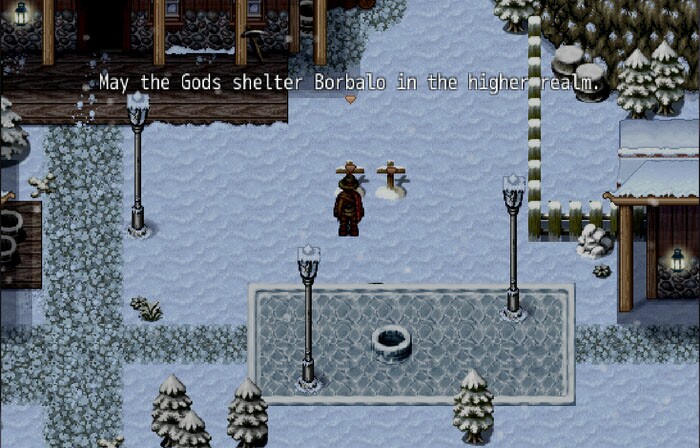
So I’m glad to see what looks like a retro 2D RPG being built entirely around the concept of death. Vidar — yet more evidence that all the good names for videogames have been taken — is based on the concept that the NPCs who are typically unkillable will die, moving the plot along an intricate web of if/then forks based on who’s alive and who’s dead. Each night in the town of Vidar, a beast comes out of a cave and kills one of the 24 townsfolk. You get a limited amount of time every night to work your way into the beast’s cave. Will you find and slay the beast before the last person dies on the 24th night? And how will the survivors who populate the town and offer you quests affect the storyline, not to mention your progress? Which of the various town events will you trigger?
It reminds me a bit of Guild Wars 2, where the dynamic events can result in all the NPCs in a town being wiped out and the town being lost. But that’s a bad example, since Guild Wars 2 is an MMO. The town is just going to be recovered and the townsfolk resurrected, easy peasy. A better example is the action RPG Din’s Curse, where the monsters in the dungeon can rise up and attack the town, killing vital NPCs and messing up your quests. It also reminds me of Westwood’s Blade Runner game from 1997, where a different suspects were replicants in any given playthrough.
Vidar creator Dean Razavi explains his game’s conceit in his Kickstarer video (note that the Kickstarter funds will go almost entirely to artwork). Power through the relatively generic trailer to hear Razavi explain how Vidar handles death and why it matters. You can also vote for Vidar on Steam Greenlight.
Battlefield 4’s recent Final Stand map pack release was the end of new content for the game, correct? Time to get ready for Battlefield: Hardline! Not so fast. According to Electronic Arts and DICE, the Final Stand, er, wasn’t so final after all.
With Battlefield 4 Final Stand released, we hope and believe that you will enjoy it together with the rest of the game for a long time. However, there is one thing we want to assure you: there is more content coming for Battlefield 4.
We will share details on exactly what this new content will be, and when it will arrive, in the near future. We understand that this may lead to even more questions about our plans, but rest assured that we’ll get back to you on the future of Battlefield 4 when the time is right.
The post then asks for players to vote on which past Battlefield maps they’d like to see “reimagined” for Battlefield 4. The survey lists possible candidates from Battlefield 2, Vietnam, 1942, Bad Company and 2142 as well as more modern installments in the series.
So in these early hours, I like The Crew a whole lot. But I can’t say for sure whether that’s because The Crew is a great game or because it’s part of a genre with too few games. Open-world caRPGs are few, far between, expensive to make, rarely as successful as they need to be, and exactly what I want to play when I play a driving game. It speaks volumes that the greatest open-world caRPG is still Midnight Club: Los Angeles, a 2008 game that understood the importance of personality as only Rockstar understands. Personality in the driving model (the fundamental gameplay of any driving game), and personality in the places you drive. There is no game that handles quite like Midnight Club: Los Angeles, and until Grand Theft Auto V, there was no open-world that presented Los Angeles with such ineffable Los Angelesness.
After the jump, we’re not just in Los Angeles anymore.Continue reading →