
I once held a tarantula. A friend of mine worked for an exotic animal company. He would load up his car with tupperware containers poked with airholes. Inside were snakes, skinks, hissing cockroaches, and spiders. He would bring them to children’s birthday parties and show them to the children. One day he dropped by my house on the way to returning the animals from a birthday party. He put the hissing cockroach on his nose. He showed us the snakes. The skinks sulked in their tupperware, not doing much of anything.
“Do you want to hold a tarantula?” he asked.
No. Of course not. No. Absolutely not. “Maybe?”
He took it out of the tupperware and held it cupped in his hand. It looked like it was thinking terrible spider things. It very slowly moved one leg and then another.
“Okay,” I said, my courage buoyed by the fact that he was holding it and not freaking out, “here’s the deal. I’m going to hold out my hand and look away. You put it on my hand, but get ready to take it off if I ask you. Okay?”
“Okay.”
He put it on my hand. I could barely feel it. It was eight almost imperceptible points of lightly furred contact with my palm, my wrist. One of the points delicately moved up and then down, then another. It was moving. A tarantula, barely heavier than the air, was moving on my arm. I didn’t turn my head to look at it. The feeling was quite enough.
Enemy is as unsettlingly effective as those imperceptible points of contact with the legs of a spider. It is subtle, insidious, creepy, working at a level deeper than what you’re seeing. It creates something sickly in the pit of my stomach. When it ended, I immediately watched it a second time because that’s the kind of movie it is. It is one of the most mind-blowing movies about one man’s relationship to women since Fellini’s 8 1/2. Enemy is also a welcome reminder of Jake Gyllenhaal’s range and depth as an actor. It wouldn’t work if long shots of Jake Gyllenhaal acting didn’t work.
Enemy is adapted from a novel called The Double by Jose Saramago, a Portuguese author I know from his novel Blindness (also adapted into a movie that’s haunting for very different reasons). Saramago’s absurdist story provides a foundation for Enemy, but Canadian director Denis Villeneuve films something that owes more to David Lynch and David Cronenberg, more existential than absurd. Villeneuve’s previous movie, Prisoners, was safely grim in that manipulative way of studio-approved movies about missing children that star Morgan Freeman. There’s nothing safe in Enemy, and nothing that an American studio would have approved, and it’s not merely grim, and there’s no villain or avuncular presence or a-ha twist. This is languid arthouse weirdness that sometimes resembles a horror movie with its discreet use of CG. It is a puzzle with a solution you might not like, or even care to solve, but the solution is in there. You just have to be willing to hold it in your hand and look at it.
Enemy is currently available for VOD. Support Qt3 and watch it at Amazon.com.

This week I talk with Metacritic founder and editor of videogames Marc Doyle about why on earth a site like this is listed on Metacritic. Join us for a discussion of aggregates, game reviews, and the state of the critical discussion about videogames. Apologies for lapsing into movie nerd talk near the end of the podcast, but bear with us and I guarantee you’ll come away with a few interesting recommendations.
Podcast (games): Play in new window | Download
Subscribe:

Look at that Russian ship. Stately, majestic, deadly. If Wargame: European Escalation can do such an awesome job adding planes (read the review of Wargame: Airland Battle here), imagine what they can do with ships. Only you don’t have to. You just have to play Wargame: Red Dragon.
Developer Eugen has gone this route from land to air to sea before. Their debut RTS, Act of War, was Command & Conquer with a new take on airpower. Rather than including airplanes on the map, taking off from the airports you build and then flitting a few screens over to bomb something, Eugen modeled airpower as an offmap asset controlled on a separate panel. It was one of the many ways Act of War was better than Command & Conquer for tuning Westwood’s trademark loosey-goosey gameplay. When Eugen added ships with an expansion, things got loosey-goosey all over again. The engine couldn’t quite handle the expanse of sea alongside the intimacy of a land-based tactical RTS. The ships did that standard RTS thing where they swiveled and banged into each other and jostled each other like a mob instead of a fleet, generally making a mess of a finely tuned game. Like the aliens in Signs, RTSs rarely survive contact with water. Naval combat tends to compromise an RTS, so don’t even think about hosting the game on a water map. In fact, I can think of only two games that did a good job of integrating ships into the overall game: Rise of Nations and Age of Empires III both had a really smart approach to what happens when an RTS goes to sea. And now that Wargame: Red Dragon is out, I can still think of only two games that did a good job of integrating ships into the overall game.
After the jump, sailing takes me away. Continue reading →

Victory Point Games’ blog details a few of the changes they’re making for the upcoming “gold banner” re-release of one my favorite games, Nemo’s War, which is a solitaire narrative shuffling of Jules Verne’s 20,000 Leagues under the Sea.
…the ship counters are larger (with more story detail and the occasional special ability); the Nautilus upgrades are more numerous (there are ten included), but only four are available at the start of each game. Nemo’s four motives (War!, Anti-Imperialism, Science, and Explore) have had their scoring functions streamlined considerably; the Uprisings, Rest, Refit, and Repair Actions all function smoothly now in the same manner as other “tests” in the game; there are many new cards with more adventures from the pages of 20,000 Leagues Under the Sea; there is no more weekly calendar to measure time — the deck is built during set up with three “Acts” and a “Finale” and you draw a card each game turn to measure time…
Nemo’s War is currently in playtesting. It’s also pending a visual upgrade from artist Ian O’Toole, whose work (pictured) looks like this.
To get a sense for how Nemo’s War played even before it got gold bannered, me and Bruce Geryk burbled fondly in this head-to-head competition that I’m convinced he won because he wasn’t playing right.

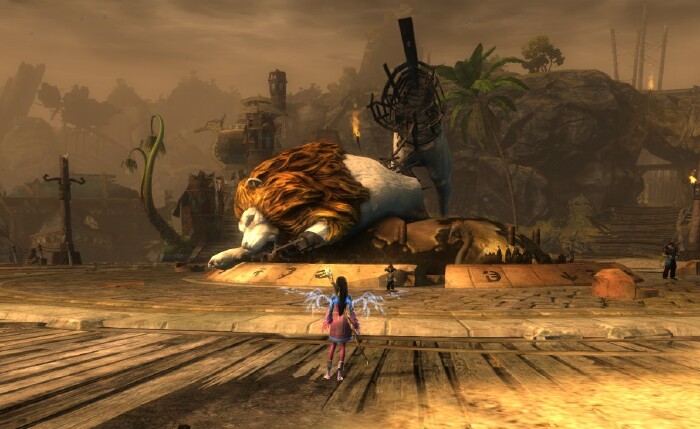
I’d like to apologize to any Guild Wars 2 players who were in Cair Shadowfane last night just trying to sell their junk, repair their armor, or study the map. All that chaos was my fault. I really didn’t think it was going to get so out of hand. My bad.
After the jump, Monday night’s all right for fighting. Continue reading →

This week we see something that Johnny Depp got paid $20 million to show up for. Then, at the 45-minute mark, we present our favorite presentations in movies for this week’s 3×3.
Next week: The Other Woman
Podcast (movies): Play in new window | Download
Subscribe:

“Mound Builders?” my friends ask, picking up the half-sized box. “What’s this?”
“It’s a solitaire game from Victory Point, the folks who published Nemo’s War, Dawn of the Zeds, and Ottoman Sunset,” I start to explain.
“What do you do in it? Build mounds?” My friends assume a mock heroic voice. “Hey, what should we build? A cathedral? A castle? No, I’ve got it! Let’s build a mound!”
They think that’s pretty funny. I guess it is, especially if the phrase “mound builders” doesn’t have any historical connotation for you. Mound builders were basically the native Americans more native than the Native Americans; the Indians before the Indians; the equivalent of the Precursors in a dopey sci-fi story. They made huge earthenwork structures in North America a thousand years before any pharaoh in Egypt had the bright idea to tell his slaves to stack a bunch of stones in the shape of a d4. When Europeans swept across North America, conquering tribes with now familiar names, they asked them, “So who built these enormous mounds? Was it you?”
The tribes with now familiar names just shrugged. “They were already here when we got here,” they said. Some of the Europeans concluded they must have been made by the giants briefly mentioned in the Bible. Other Europeans did some archaeology and eventually gave the earlier tribes the name Mound Builders. Great. Nice work, archaeologists. That’s the best you could come up with? My friends wouldn’t think it was so funny if you’d given them a cooler name. People of the Earthenwork Edifices? Tumulists? Was Barrow Lords taken?
“Is the game any good?” my friends ask after they’ve stopped laughing about mounds.
After the jump, I have some bad news. Continue reading →

Jay Gittings joins us this week with a report from PAX East! Find out what caught his eye at the show and what was far too popular to see. He also reveals the exact wrong way to enjoy certain games. Then join us for a conversation about Sentinels of the Multiverse, which we’re playing as part of our ongoing weekly series.
Podcast (games): Play in new window | Download
Subscribe:
You maniacs, you blew it up! Damn you! God damn you all to hell!

Oculus is perhaps the scariest movie about mirrors since Mirrors. Whatever the case, it’s no Absentia, which was director Mike Flanagan’s previous movie. At the 59-minute mark, we mount a discussion of our favorite framing devices in movies.
Podcast (movies): Play in new window | Download
Subscribe:

Caity Lotz had nearly enough gravitas to make the silly horror movie The Pact work. She was able to sell being panicked and straddling an old school motorcycle without it being simple cheesecake. Because, oh yeah, she was totally in her underwear for that scene. But she takes the movie seriously enough that it’s worth watching, even though it cast Casper Van Dien as a pudding eating cop.
So it’s a nice surprise to see her show up opposite proper actor Toby Stephens in The Machine. It’s not clear early on where The Machine is going, thanks to a merciful lack of exposition and very little techno-babble. So when Lotz arrives as the typical movie scientist — too young, too pretty, too effervescent — The Machine nearly falls apart. But it’s quite the accomplishment that she’s the one to bring it back together, to breathe life into it while Toby Stephens emotes sullenly, to shoulder what this movie is trying to deliver in the space between Robocop and Her. And oh my, what shoulders Lotz has got!
The other real star of The Machine is the production design and cinematography. I don’t recall seeing a credit for “colourist” in other movies, or even “colorist”, but it’s appropriate here. The Machine looks like Beyond The Black Rainbow, the 2010 incomprehensible love letter to the 80s, but with a budget. This is what Richard Stanley intended with all that garish color in Hardware. This is where Cameron would have ended up without CG and 3D and Titanic. This is the supersexy hard sci-fi movie Michael Mann never made, featuring wetly growling cyborgs, mostly sensible touchscreen computers, and a synth pulse soundtrack that would make Tangerine Dream proud. The Machine glows and throbs with the heart and sound of the 80s, but the production values of the 21st century.
The Machine is available on VOD now. Watch it on Amazon.com to support Qt3.

And we’re back after a Diablo-inflicted hiatus to discuss what we look for in an RPG, using Bravely Default, Diablo III, and Elder Scrolls Online to make our case. Brandon Cackowski-Schnell, Tom Chick, and Jason McMaster level up in the course of the discussion. Listen to find out who wins!
Podcast (games): Play in new window | Download
Subscribe:

Age of Wonders III is almost great. This fantasy strategy game has nearly everything a fantasy strategy game needs, including some things other fantasy strategy games don’t have. Clever combos of races and classes that make you want to keep starting new games. A broad tree of skills and spells that makes you want to keep starting new games again. Distinct and detailed armies that make battles a joy. Superb tactical combat that makes battles even more of a joy. A wonderfully competent AI. Let me repeat that one because it bears repeating: A wonderfully competent AI. Invaluable heroes who develop unique roles as a game progresses. A fantastic terrain model that provides beautiful evocative worlds with meaningful gameplay effects. A welcome flexibility in terms of how you can play. It’s nearly a complete package that rivals Warlock, Dominions 4, Fallen Enchantress: Legendary Heroes, and Eador for the superlative ways you can get your elf on.
But it’s missing one important thing.
After the jump, the ultimate feature. Continue reading →

This remake of an obscure Australian horror movie from the 70s is basically Carrie, but where the lead character is comatose instead of a high school girl. Interesting choice. The best thing going for it is its cast, which includes Sharni Vinson from You’re Next, Rachel Griffiths from Six Feet Under, and Charles Dance from everything Charles Dance has been in.
Unfortunately, the movie is a bit too taken with Sharni Vinson. As am I, to be sure. But you’re not going to pay $6.99 for a video-on-demand glimpse into my head. So Patrick’s greatest failing is not appreciating what it has with Griffiths and Dance, who lurk around in the background for far too long in favor of a couple of “belles among the brain dead”, including the lovely lively Peta Sergeant as Vinson’s sidekick nurse, toiling away in a creepy experimental institute for the braindead. But I’ll trade all the scenes of Vinson Googling “moving things with mind”, stumbling around in the dark, and having two too many relationships for one more shot of Dance sticking his head into a door and saying “Remember to tell me when he has a bowel movement, yes?” Is there anyone else channeling Peter Cushing half this well?
The old mansion, the traditional nursing uniforms, and the sometimes ponderous pace set Patrick apart from most modern horror movies. Although it leans too heavily on bad CG backdrops and effects, it offers an intriguing combination of Victorian horror and latter day technology. There are a few fascinating early fake-outs. An old timey phone rings. The camera cuts to a shot of Vinson’s iPhone. It’s her ringtone. Pretty sneaky. But despite occasional sly touches, Patrick goes from intriguing to borderline camp to downright risible, until it quite literally defenestrates itself.

It’s an epic 2 vs. 1 battle over Captain America: The Winter Soldier. Smartly directed Avengers follow-up or soggy comic book pulp? For this week’s 3×3, we propose a discussion of marriage proposals, starting at the 1:14 mark.
Next week: Oculus
Podcast (movies): Play in new window | Download
Subscribe:


