
ArenaNet announced the Heart of Thorns expansion for Guild Wars 2 today. I suppose I’m as excited as the next person about some of the new features, but I’m also disappointed. The new features are exactly what you’d expect in an expansion, but I can’t help but feel a bit of an “is that all there is?” sensation. I blame Guild Wars 2 itself. It can’t be easy to expand a game this generous, expansive, and varied. There are already so many ways to play, and the classes feel so different, and there are so many options for what would normally be considered endgame grind: dungeons, fractals, exploration, legendary weapons, completing skills, pet collecting, achievements. Furthermore, with the living world storyline, ArenaNet has done such a great job adding new content and new places. And I say that having barely played any of season two. So what’s left for an expansion to do?
After the jump, what specifically is being added in Heart of Thorns? Continue reading →

Paradox announces the next add-on for Europa Universalis IV will be called El Dorado.
This expansion’s historical focus on the Central American and South American theaters of exploration will challenge you with new decisions worthy of a king or conqueror. As the Aztecs, subject the Mexican plain to your rule but make sure you have enough vassal kings to sacrifice to your angry gods. As the Europeans, push deeper into the jungles of the Amazon, following rumors of lost cities and magical fountains.
I don’t recommend that latter course of action. You’ll just end up in charge of a raft full of monkeys. Also included in El Dorado will be the option to design your own custom nation and monarch. Because for some people, history isn’t enough.
El Dorado will be out in February.

It’s no surprise that 2K is bringing a Borderlands bundle to the Playstation 4 and Xbox One, consisting of Borderlands 2, the Pre-Sequel, and all the downloadable content released for each game to date. But what is a surprise is that the collection will have four-player splitscreen support! Move over, Diablo 3? You’ll even be able to import your characters and badass rank from your PS3 or Xbox 360.
Borderlands: The Handsome Collection comes out on March 24th.

This week, Chris Hemsworth is a supersmart hacker in a Michael Mann movie.
Next week: American Sniper
Podcast (movies): Play in new window | Download
Subscribe:
Death isn’t death in fantasy games because it’s never permanent. Just make sure at least one of your party members survives the battle! Barring that, just reload. It’s particularly a non-issue in fantasy games because you can just cast a resurrection spell. You could never have a murder mystery in a fantasy game, because any ol’ cleric of sufficient level would be able to solve the crime by casting resurrection and going, “So, hey, who killed you?” And what’s the big deal with Aeris dying in Final Fantasy? Didn’t anyone have one of those Phoenix down things? Death in fantasy games isn’t death; it’s a nap.
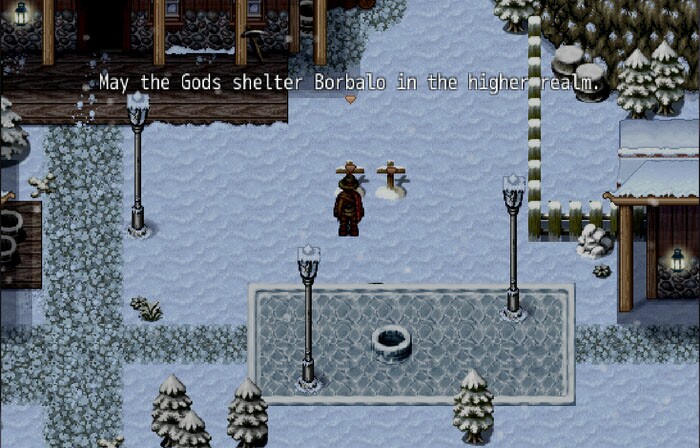
So I’m glad to see what looks like a retro 2D RPG being built entirely around the concept of death. Vidar — yet more evidence that all the good names for videogames have been taken — is based on the concept that the NPCs who are typically unkillable will die, moving the plot along an intricate web of if/then forks based on who’s alive and who’s dead. Each night in the town of Vidar, a beast comes out of a cave and kills one of the 24 townsfolk. You get a limited amount of time every night to work your way into the beast’s cave. Will you find and slay the beast before the last person dies on the 24th night? And how will the survivors who populate the town and offer you quests affect the storyline, not to mention your progress? Which of the various town events will you trigger?
It reminds me a bit of Guild Wars 2, where the dynamic events can result in all the NPCs in a town being wiped out and the town being lost. But that’s a bad example, since Guild Wars 2 is an MMO. The town is just going to be recovered and the townsfolk resurrected, easy peasy. A better example is the action RPG Din’s Curse, where the monsters in the dungeon can rise up and attack the town, killing vital NPCs and messing up your quests. It also reminds me of Westwood’s Blade Runner game from 1997, where a different suspects were replicants in any given playthrough.
Vidar creator Dean Razavi explains his game’s conceit in his Kickstarer video (note that the Kickstarter funds will go almost entirely to artwork). Power through the relatively generic trailer to hear Razavi explain how Vidar handles death and why it matters. You can also vote for Vidar on Steam Greenlight.

Trials Fusion, like the Trials games before it, is 100% accessible up to a certain point. Using its extremely simple “vocabulary” of only four verbs — lean forward or backward, accelerate or brake — you drive a motorcycle along 2D trails, trying to set the best time with the fewest wipeouts. Along the way, you can bail as many times as you want and you can take as long as you need to reach the end. But eventually, you’ll reach the end and you’ll finish the level and you’ll be free to move along to the next bit. You can try again to improve your performance and maybe beat your friends’ times. That, after all, is a big part of the Trials series. But these games aren’t going to throw any impassible trials or brick walls in your way.
Up to a certain point.
After the jump, reaching the end of the trial. Continue reading →

Okay, this category might be a bit of a stretch, but I like to end the yearly lists on a positive note. So this is a list of smaller games that deserve more recognition. But I’m not sure there’s a good metric for sufficient recognition, so consider this me just going, ‘Hey, have you heard of these games? If not, check them out because they’re really good!’
Plus, I didn’t get around to writing up full reviews for most of them, so this will have to do instead.
After the jump, ten games you probably overlooked in 2014. Continue reading →

Overrated is a loaded term. It looks good in a headline. It’s often used for no purpose other than to goad a reaction. But that doesn’t mean it isn’t useful. When I call a game overrated, I don’t mean it’s bad, that the reviews were wrong, that the people who liked it were dopes, or even that I didn’t like it. It just means I’m surprised more people weren’t more critical, that the conversation wasn’t more often about ways the game could have been better.
After the jump, the ten most overrated games of 2014. Continue reading →

So if the most disappointing category is a list of games that should have been better than they were, the most surprising category is the opposite. These are games that were better than they should have been. Just as disappointing is about falling short of expectations, these surprising games exceeded expectations and, in some cases, were among the best games of the year.
After the jump, the ten most surprising games of 2014. Continue reading →

We kick off 2015 with JC Chandor’s anti-crime thriller.
Next week: Blackhat
Podcast (movies): Play in new window | Download
Subscribe:

The worst thing about Preservation, the second horror movie from actor Christopher Denham, isn’t that it’s bad. This is a no-budget movie shot quick and cheap in parks around Los Angeles that are supposed to pass for the deep dark woods. The worst thing isn’t even that it’s insultingly implausible, with people doing typical stupid horror movie things and contrived set-ups for supposedly scary moments.
The worst thing about Preservation is that it is so shamelessly derivative. The set-up is that a troubled married couple and the husband’s troubled war veteran brother are all going hunting for the weekend. But as they’re unpacking their baggage — and I don’t mean their camping gear — something happens and the hunters become the hunted. You probably saw that coming. But what you didn’t see coming, the supposedly clever twist, is a blatant rip-off of a handful of actually clever movies: Eden Lake, El Rey de la Montana, and Ils, respectively English, Spanish, and French, all superlative horror movies. It’s as if Denham decided, hey, I’ll do an American version of those! And then proceeded to confuse “American” with “dumb”.
Preservation is available now for video on demand.

Calling a game disappointing arguably has more to do with me than the game itself. Disappointment isn’t an inherent quality. It can’t exist without some sort of expectation in the first place. In many cases, these games are sequels, or the creations of developers with proven track records, or entries in established genres, or games with promising beginnings. But for various reasons, the central fact about these games is that I had personally hoped they would be better.
After the jump, the ten most disappointing games of 2014. Continue reading →

The first waves of undead advanced on Farmingdale from the suburbs and the highway. We might have overcommitted to drive them back, because now those approaches are secured with barricades and defenders, but no zombies to hold back. All quiet on the southern front. Not so on the mountain and forest approaches to the north. Hordes of undead are pouring down out of the mountains and in through the forest. Both of the villages in these areas have been overrun, the civilian defenders have been slaughtered, and the refugees have been run down and eaten. Only 20 cards into this game of Dawn of the Zeds — the National Guard will arrive as one of the last 17 cards in a deck of 62 cards — and we’re going to be hard pressed to keep the zombies at bay. This is not an auspicious beginning.
After the jump, things you’ll only see in The Director’s Cut. Continue reading →

I don’t normally keep playing games after I’ve written about them. That’s just the nature of writing about games as a job. You experience them, you process them, you mostly move on. But as I look back over the games I played in 2014, I realize I spent an inordinate amount of time with games from 2013 and 2012. Guild Wars 2, Grand Theft Auto V, Diablo III, and Marvel Heroes were significant parts of 2014 for me. If they weren’t so obviously games from other years, they would most likely be on this list. In fact, one of them is, but I think it earned its place.
I spent a lot of 2014 with boardgames. I’m tempted to extend my fanatical platform agnosticism to include boardgames. But ultimately, I can’t reconcile the fact that boardgames are such a different type of experience, with unique advantages and disadvantages. I still intend to write about boardgames, but I’ve decided it’s proper to hang a curtain — not too thick a curtain, but a curtain nonetheless — between videogames and boardgames.
I fell out of love with the iOS as a gaming platform this year. Not to say it doesn’t have some exceptional offerings and a unique niche. But as I sampled various iOS games in 2014, time and again I felt that it’s not a gaming platform any more, but a business model. And I’m not interested in the business model it’s pushing.
Conversely, something really clicked with the Wii U this year, even alongside the sexy shiny newness of my new Playstation 4 and Xbox One. Three of my ten favorite games of 2014 are Wii U exclusives. On top of that, I was delighted with Star Wars Pinball (a standalone spin-off of Pinball FX) and Hyrule Warriors (a Zelda-fied Dynasty Warriors). Try as I might, I can’t resist that Nintendo magic.
Finally, I wish I had gotten the chance to play Thief, Wolfenstein: New Order, Infamous: Second Son, Batman: Arkham Origins, Elder Scrolls Online, The Evil Within, Hitman Go, Valiant Hearts, Tropico 5, Costume Quest 2, Lords of the Fallen, Little Big Planet 3, and Lego Batman 3. But onward to the games I did play!
After the jump, the top ten games of 2014. Continue reading →

And that’s a wrap on 2014. So it’s time for us to pick our top ten movies of the year, along with most surprising, most disappointing, and so forth.
Next week: A Most Violent Year
Podcast (movies): Play in new window | Download
Subscribe:


