
You know that part in a movie shootout when the bad guy runs out of bullets and he throws the gun at the good guy? Because why not? What else are you going to do with an empty gun? But it never works in the movies because the good guy tricks the bad guy by ducking.
Superhot, which is not the movies, will have none of this nonsense.
After the jump, what’s white and red and white all over? Continue reading →

The listeners have spoken and we have listened, so this week we watch The Goonies, the winner of the 2016 Make Us Watch Whatever You Want Fundraiser-palooza. Find out who stands with the Goonies and who stands against them! At the 1:41 mark, we hail a discussion of cab rides in movies.
Next week: Crouching Tiger, Hidden Dragon: Sword of Destiny
Podcast (movies): Play in new window | Download
Subscribe:

Bear with me as I proclaim the three most important commandments of boardgame design, because after that I’m going to sit down to talk to the designer of Clockwork Wars, one of my favorite recent boardgames.
Podcast (games): Play in new window | Download
Subscribe:
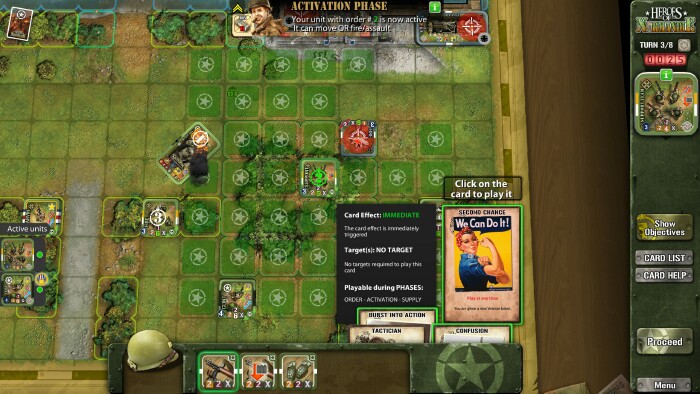
When Heroes of Normandie was released for the PC last October, it was supposedly a port of the lively boardgame. With its Nazi zombies, sexy spies, and over-the-top heroic G.I. Joes, the boardgame was a fanciful comic book version of Squad Leader, with just enough crunchy tactics to invoke Squad Leader but not enough brain-busting minutiae to invoke Squad Leader. Squad Leader for dummies who want big colorful tiles with their boardgames and artwork that wouldn’t look out of place on a Topps card.
Slitherine’s PC port added plenty of the stuff you’d expect in a good boardgame port. A clear above-the-board expression of the mechanics! Campaigns! High score lists! Support for online play! Unlockables! Even a rogue-like mode with an economy and persistent units! It looked great. But then you played it and realized something was missing.
The Heroes of Normandie boardgame includes cards that each player can use for unexpected gotchas, helpful boosts, and rules tweaks. Your hand of four cards is just as much a part of the gameplay as the dice, unit stats, and game board. But Sliterine’s port simply pretended the cards didn’t exist. Imagine Chess without the rooks. Monopoly without Park Place. Settlers of Catan without sheep. The Avengers without Iron Man. A fellowship of the Ring without Legolas. Two and a Half Men without Charlie Sheen. A Republican debate without Donald Trump. The Oscars without any black nominees. I can do this all night.
But it’s all moot as of today. The cards have finally been added. It’s technically a beta for now, but as near as I can tell, it works just fine. Which means this is finally a port of Heroes of Normandie and not just a halfway measure.

Ubisoft could do this in their sleep. Sometimes it feels like they have. Far Cry’s evolution over the last three games has been, uh, glacial. Far Cry 3, Far Cry 4, and Far Cry Primal consist of the same gameplay verbs applied to mostly different nouns. Upgrade your guns (bows and spears). Throw grenades (beehives). Clear out bases (bonfires) to capture fast travel points. Tag enemies with your camera (owl). Ride an elephant (woolly mammoth) into battle. Wreak havoc when you release wild animals (wild animals). Unlock the grappling hook (grappling hook).
After the jump, macaroni and skill trees Continue reading →

This week, we see some minor Coen (movie poster here). Then we dispense with a 3×3 about words of wisdom at the 59-minute mark. Then we determine the winner of the 2016 Make Us Watch Whatever You Want Fundraiserpalooza, which was hugely successful! Our heartfelt thanks to all of you. You’re awesome and a podcast couldn’t hope for more generous, enthusiastic, and supportive listeners.
Next week: well, listen to our drawing at the 1:45 mark to find out!
Podcast (movies): Play in new window | Download
Subscribe:

The Witch is not the stuff of horror movies; it is the stuff of folklore. Stolen children. Hovels in the woods. Familiars. Poison apples. Cursed wilderness. Here the civilizing influence of Christianity and American exceptionalism are no match for ancient pagan things in the woods. The Wicker Man meets The Exorcist meets The Crucible, but with nary a concession to a modern horror movie audience. Things don’t jump out of the shadows. There isn’t any of the usual gore. It’s not found footage. The actors even talk funny.
Most of first time director Robert Eggers’ experience is as a production designer, and it shows. The Witch is gorgeous with its rustic simplicity, sickly grey cinematography, and richly inhabited period costumes. But Eggers shows considerable skill as a director, telling his story with an unnerving slow burn, a harrowing score, and poetic dialogue. He relies heavily on his cast. His script expects a lot from them. Ralph Ineson’s stately basso profundo and the harshly austere lines of Kate Dickie’s face will be familiar to anyone who’s seen them on Game of Thrones. It’s no surprise these British veterans are fascinating to watch. They make an imposing couple. You’d think ancient pagan things in the woods don’t stand a chance.
But the foundation of The Witch is its child actors. Newcomers Anya Taylor-Joy and especially Harvey Scrimshaw, dwarfed by his father’s musket, manage difficult dialogue and difficult scenes that would have completely undermined the movie if they didn’t work. This is ultimately a horrific fable, a grim fairy tale, and it needs children. It’s hungry for them.
The Witch shares a superficial similarity to Poltergeist and The Exorcist. But because it’s set in a very different time, because it’s about people with deeply religious worldviews and a distinct way of talking, there’s a remote quality to it. This isn’t a horror movie you watch and think about what you would do. This isn’t It Follows or 28 Days Later. Instead, it plays out like someone else’s horror movie. It’s about the things they would be afraid of, how they would act, what they would feel, what they would do. But because it’s so effective, because Eggers and his cast sell the horror with such conviction, there’s no safety in its remoteness. Ultimately, The Witch would have us all.

Why is it horror February? Six reasons. Dying Light, Layers of Fear, Soul Axiom, Darkest Dungeon, The Flame in the Flood, and Jason McMaster’s performance in our online game of Arkham Horror designer Richard Launius’ latest boardgame, Legends of the American Frontier.
Podcast (games): Play in new window | Download
Subscribe:

In the original Tomb Raider — the most recent original Tomb Raider — our cast of characters is shipwrecked on a sinister island. Lara Croft becomes their unlikely savior. Well, of the ones that survive. Because the template isn’t pulp adventure; Tomb Raider is a horror story in which our heroine is transformed by violence and death. As she descends into increasingly nightmarish levels, the island’s mysterious background emerges and the members of the cast meet their various fates. It’s an exciting character-driven story about peril, heroism, and violence. Just describing it makes me want to play it again.
Rise of the Tomb Raider, on the other hand, is the typical ham-handed videogame story, clumsy, cringe-worthy, and aimless.
After the jump, other than that, it’s pretty good. Continue reading →

Bruce Geryk’s new podcast debuts here. It’s called Wild Weasel and Paulie Shore is not involved. Instead, it’s about wargaming. And it’s the sort of podcast where the host casually rolls out the phrase “French ironic lyricism”, but then says he hates the word “synergistic”. It’s also the kind of podcast where the host isn’t shy about telling you the five best wargames of all time. Of all time!

Layers of Fear tries to ask a few questions. Can a videogame play with the idea that you have no idea what reality has been constructed behind your back when you’re not looking? Can it violate the laws of physics? Can it ruthlessly deconstruct physical space? Can it do zero-G? Those are the questions it intends to ask. Of course, anybody who has ever played a videogame already knows the answers. But Layers of Fear asks anyway.
And then it jumps in your face and makes a loud noise.
After the jumpscare, another jumpscare, and another, and another, and another. Continue reading →

Three moderately comics savvy dorks going to see a Marvel superhero movie that killed at the box office? What could possibly go wrong? At the 1:12 mark, this week’s 3×3 is about that part in the movie when the movie says its own name. At the end of the podcast, we update the list of candidates for the 2016 Make Us Watch Whatever You Want Fund Raiser. You still have one week to make your mark on that list!
Also, be sure to check out these awesome Qt3 Movie Podcast posters created by our friend sinnick.
Next week: Hail, Caesar!
Podcast (movies): Play in new window | Download
Subscribe:

If you haven’t played Soma, I’m jealous that you get to experience it for the first time. I hope you didn’t read any reviews. Possibly including this one. All you should know going in is that it’s by indie horror developer Frictional Games and that it’s something about an underwater base. Oops. I wish you didn’t even know that second bit. But, really, there’s no avoiding it. Whether it’s the screenshots or the “set below the waves of the Atlantic ocean” in the product description, that particular cat is well and truly out of the bag.
After the jump– wait, should I even click past the jump? Continue reading →

It’s no surprise that the directors of the two strongest segments in V/H/S also provide the two strongest segments in Southbound, a new horror anthology. A collective of filmmakers who call themselves Radio Silence wrote, directed, and did the visual effects for the Halloween-party-gone-wrong effects-heavy rollercoaster finale of V/H/S. Their segment in Southbound, called The Way Out & The Way In, is also effects-heavy. It features a solid set of actors and unique creature design. It gives Southbound its structure and payoff.
But the highlight of Southbound is smack dab in the middle. David Bruckner’s segment, The Accident, consists entirely of the delightful Mather Zickel on the phone, splattered with gore and unsure what to do. It’s a one-man show about about the horror of helplessness in the face of grievous injury. It begins as a typical scenario that would fit snugly into any horror anthology. A driver on a remote road hits someone, panics, and flees the scene. Then he’s haunted and somehow punished. But Bruckner immediately swerves. Zickel, playing the driver, doesn’t flee. He tries desperately to do the right thing. He gives in to the calm guidance and soothing reassurance of the 911 dispatcher at the other end of the line. Or is it in his head? Is this authority, or is it conscience? Is this the Milgram experiment or Psycho?
In addition to gore, The Accident is dripping with the same delicious dark humor as Bruckner’s apocalypse party segment in The Signal (I didn’t care much for Signal co-director Jacob Gentry’s Synchronicity, recently released for VOD, but I was thrilled to see three of the actors from that apocalypse party back together again). Bruckner’s segment in V/H/S, Amateur Night, was also far and away better than the rest of that anthology, for its premise, execution, social relevance, and hugely gratifying payoff. With calling cards like these, I can’t comprehend why Bruckner, probably the most unsung horror director working today, has been unable to get a feature film going in Hollywood. That’s the real horror of Southbound.

This week I talk to the creator of Onirim, Castellon, and Sylvion, three unique jewels of solitaire boardgaming.
Podcast (games): Play in new window | Download
Subscribe:


