


How much nonsense can you take? Find out with this Peter Greenaway double-feature.
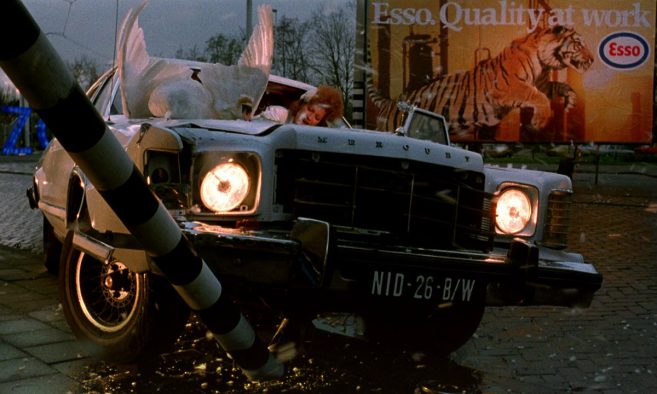
Why do some people love sausages and other people hate sausages? No fucking reason.
–Rubber, by Quentin Dupieux
Absurdism is the sausage made by feeding European flesh into the machinery of industrial slaughter. Before World War I, it had found expression among various high-falutin’ philosophers who explained that searching for meaning is futile. All is vanity, etc. But the horrors of World War I cultivated a global zeitgeist, kicking off the celebration of the non sequitur as a learned response to enormity. It was all the rage on French stages. The sort of thing you might learn in Paris, like drinking absinthe. Which is probably why I first encountered it doing student theater. You give a student a stage and some actors, and there’s no telling what kind of nonsense they’re going to make happen. Genet, Ionesco, Sartre. Then absinthe at cast parties.
One of my first plays was a production of something absurdist on the main stage of the American Repertory Theater in Cambridge. For the life of me, I couldn’t tell you the name of the play, or what it was about, or anything that happened in it. I just remember the director sounded awfully smart when he talked about it, and he had very definite ideas about where we should stand when we said our lines. As for what the lines meant, well, that was our business. So we just looked offstage, out over the audience, carefully angling our faces up into the light, and spoke gravely.
My character’s name was Baboon, which I remember because in another play my character’s name was Rabbit. That one was a Sam Shepherd play. I couldn’t tell you the name of that play either, or what it was about. But I do remember sitting in a high-backed swivel chair and spinning around so my back was to the audience. From that position, I surreptitiously applied green make-up to my face and put a pair of fake fangs over my teeth. Then, near the end of the play, I spun around to reveal — surprise! — that I had transformed into a monster.
When I moved back to Arkansas and did community theater, there was a lot less of this nonsense. In fact, almost none of it. But somehow, I ended up in an adaptation of something French and absurd, where the three characters were Mouth, Eye, and Ear. We wore huge papier-mache sculptures on our heads. From inside these masks, we had to holler the lines so the audience could hear us. I wore the eyeball. The lips were a redhead and the ear was my friend Natalie, who would later play the female lead in Sling Blade.
Our venue was the back room of some bar in Little Rock, and the director was smart enough to spice things up with a little song and dance. This mostly involved the three of us carefully arranging ourselves in a line, trying not to bump masks, and then thrusting our hips forward in unison and shouting, “Cornhole!” I don’t think it was actually in the script. I think the director added that part. But it made as much sense as anything that was in the script.
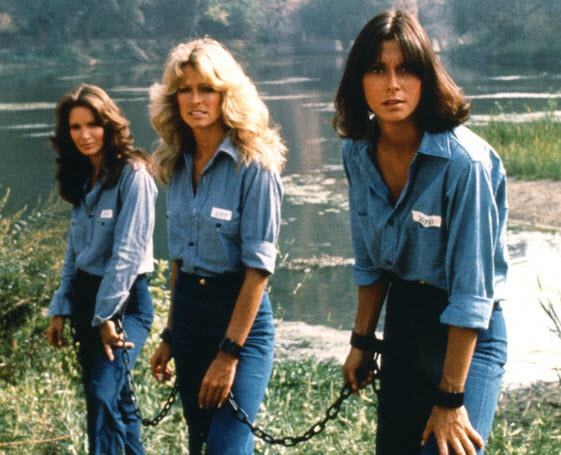
Of course, no one going to a bar in Little Rock is going to want to watch some absurdist French play, so the director billed it as a double-feature with an episode of Charlie’s Angels. The episode where the Angels go undercover into prison. She adapted it for stage with actual dialogue from the episode. I’m sure it violated various rules and copyrights and whatnot. But, like I said, the venue was the back room of some bar in Little Rock. Samuel French wasn’t likely to come after us.
The redhead and Natalie played two of the Angels and the director herself was the third Angel. In fact, I’m pretty sure the whole thing was just a boondoggle so she could be a Charlie’s Angel. I was Bosley, of course. Except for one night when the redhead couldn’t get a babysitter, so I had don a wig and a falsetto to fill in as Farrah Fawcett. The girl who did the lighting ran onstage between light cues to read the Bosley parts directly from the script.
In a way, the director was far smarter than the guy who did the play at the American Repertory Theater in Cambridge, because she knew no one sober wanted to see and hear a bunch of nonsense from France, and that furthermore, drunk people in Arkansas love Charlie’s Angels. So she found a way to pair French absurdism with something palatable. She really knew how to make the sausage.
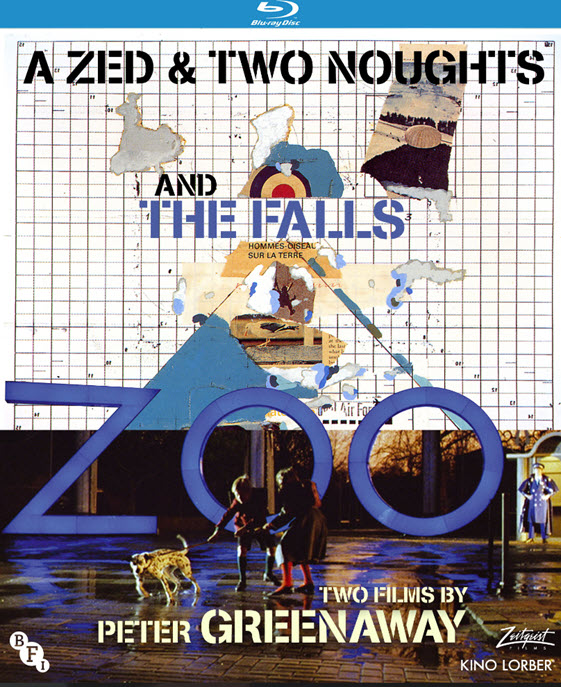
I can’t say the same for the folks at Kino Lorber, who have released a two-disk DVD double-feature with Peter Greenaway’s The Falls on one disk, and Peter Greenaway’s A Zed and Two Noughts on the other disk, which doesn’t strike me as the sort of thing to appeal to drunk people or sober people. However, the guy who directed that play at the American Repertory Theater would probably be into it.
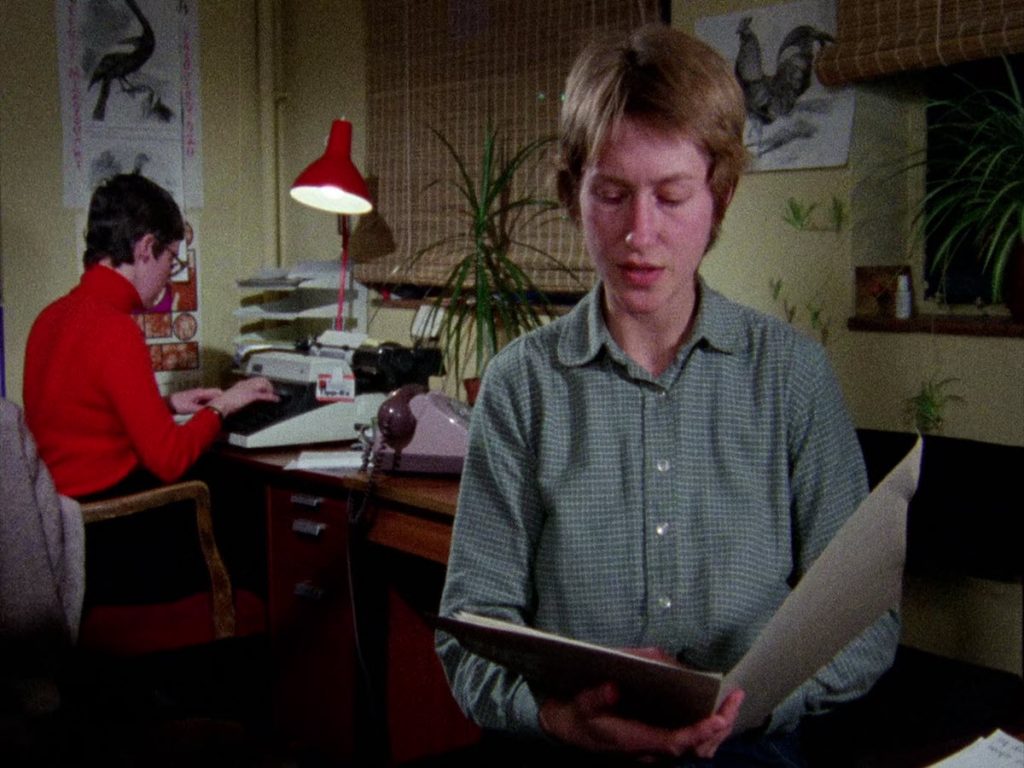
The Falls, from 1980 and proudly wearing the fashions of the 70s, is the more interesting of the two movies, which is saying something since it’s three hours of almost literally reading a phone book. This phone book is a directory of the 19 million people affected by something called the “Violent Unknown Event”, or V.U.E. Greenaway basically shoots a short film for each entry, but since it would take too long to do all 19 million, he only does the ones whose surnames begin with “Fall”. There are 92 of them, so this is 92 short films — sketches, really — related in alphabetical order, in the style of an absurdist mockumentary.
None of the names are even remotely real. I mean, can you think of someone whose surname begins with Fall? The subjects are people like Combayne Fallstoward and Tasida Fallaby. The V.U.E. has mutated these 92 people, each of whom is introduced with a title card and a sawing burst of music from composer Michael Nyman.
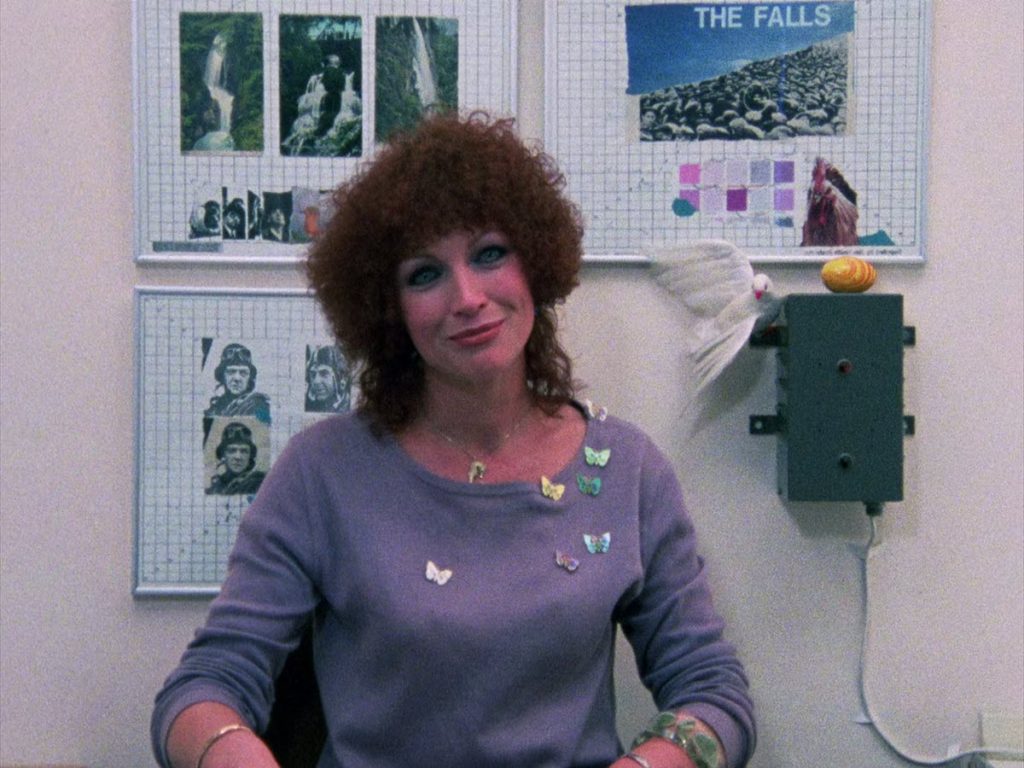
What makes The Falls fascinating is that these short films are worldbuilding for Greenaway’s absurdist D&D campaign, a Yaknapotawhpa County of nonsense: the deformities and mutations afflicting the survivors, including immortality and invented languages; a “Boulder Orchard” as the epicenter of the V.U.E.; the ensuing Theory of the Responsibility of Birds as an (unexplained) explanation; the shadowy Society for Ornithological Extermination, or FOX; someone named Tulse Luper who will find his way into other Greenaway works. All this is set to imagery such as people exhibiting their categorical knowledge of bird trivia, early footage of experimental aviation, plenty of scenery, plenty more stock footage of birds, and occasional vehicles driving in circles. As one of The Falls’ subjects says, “The imagery of birds is vast and unlimiting. You can take what you like.” Greenaway helps himself liberally.
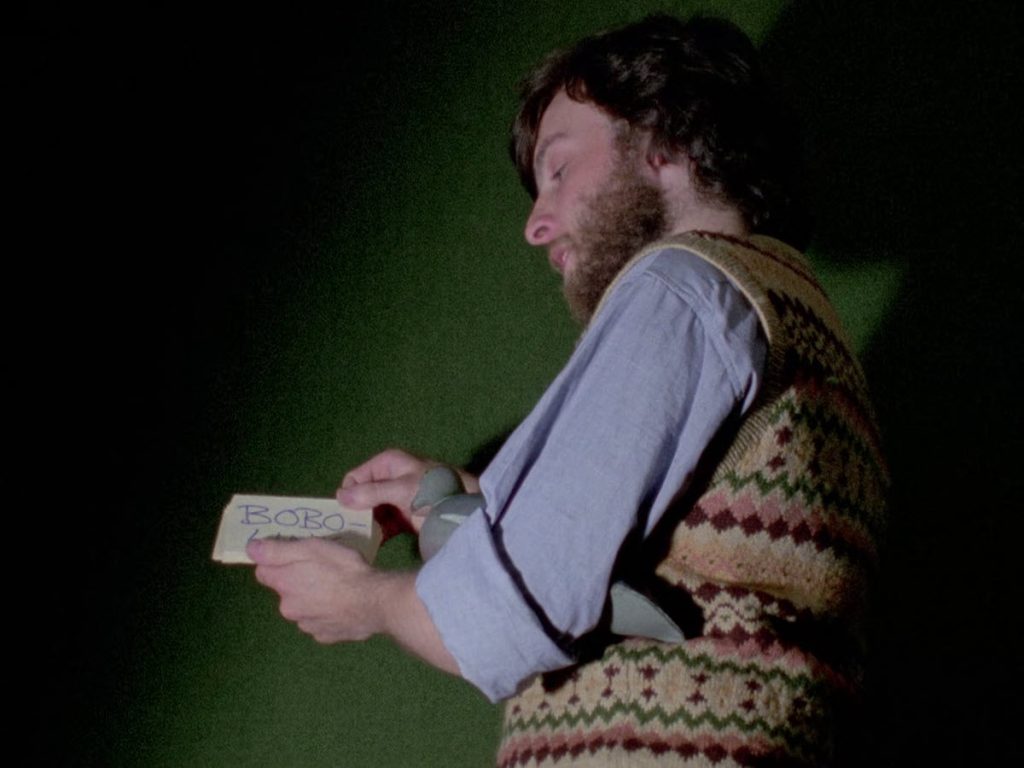
What makes The Falls tedious is everything else. All three hours of it. Unmitigated nonsense. Imagine Monty Python without the jokes. To be fair, it will occasionally stumble upon humor, as Englishly dry as unbuttered toast. For instance, when an avian disease wipes out all of Carlos Fallanty’s pet birds, the lone survivor is a turkey he adores.
Two veterinary officials came to make sure he had burnt or buried all the corpses. Insisting that the one remaining bird should be destroyed as well, the vet promised to compensate Carlos with at least a set of photographs. These are the photographs taken as the vet stalked the bird with his camera, whilst the vet’s assistant stalked the bird with a shotgun. Carlos was not happy with the photographs. He is now awaiting trial for shooting the vet.
Another subject of The Falls forms a theory on the cause of the V.U.E.
When her thesis was published…Agostina was pilloried, and on a number of different levels. Her landlady sought a court order to get her removed from her flat in Torquay, the paperboy burned her newspapers, a local grocer accused her of stealing egg powder, and her publisher withheld her royalties. Agostina took to driving her Land Rover in circles on the beach at Torquay until that, too, was forbidden her by the police, who impounded the vehicle to search it for pornography.
Another subject adopts “rewriting of Victorian novels with the benefits of hindsight” as a hobby. These bits are funny, but they can hardly sustain the three-hour running time. For the most part, The Falls is an exhausting exercise in the excesses of absurdism.
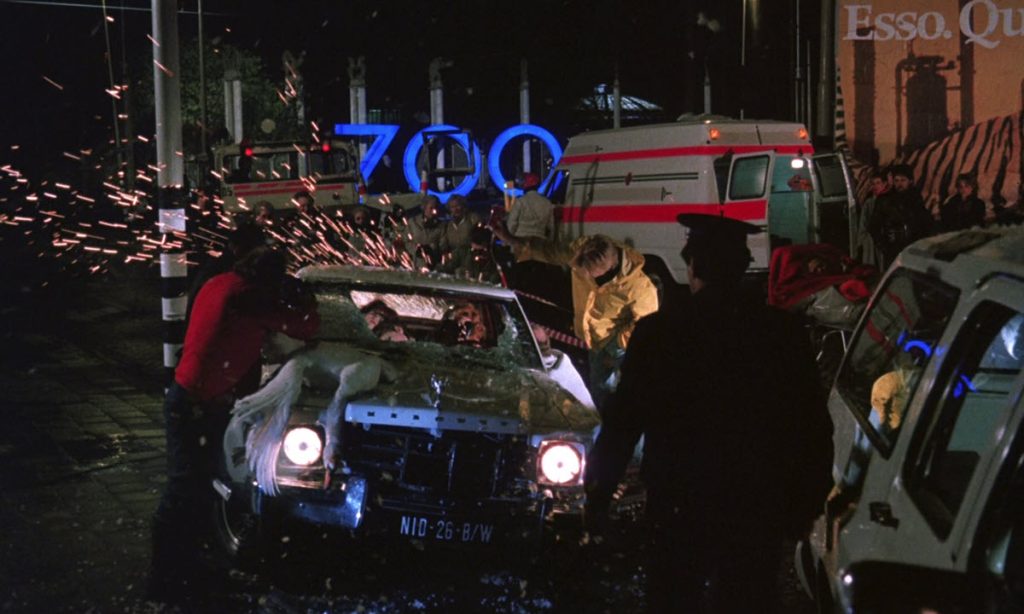
Then there’s A Zed and Two Noughts, which is only two hours long. But whereas The Falls changes things up every few minutes by moving on to a new subject, Zed and Two Noughts offers no such relief. It is only and always about twin widowers who work at a zoo, are sleeping with an unintelligibly French double amputee, and are obsessed with snails and decomposing animals. It’s as funny and entertaining as it sounds.
To Zed and Two Noughts’ credit, the Michael Nyman music is exquisite. Also, this is the movie where Greenaway started working with cinematographer Sacha Vierny. The differences between Fall’s prosaic mockumentary look and this movie’s aesthetic is stark. Consider shots like this:
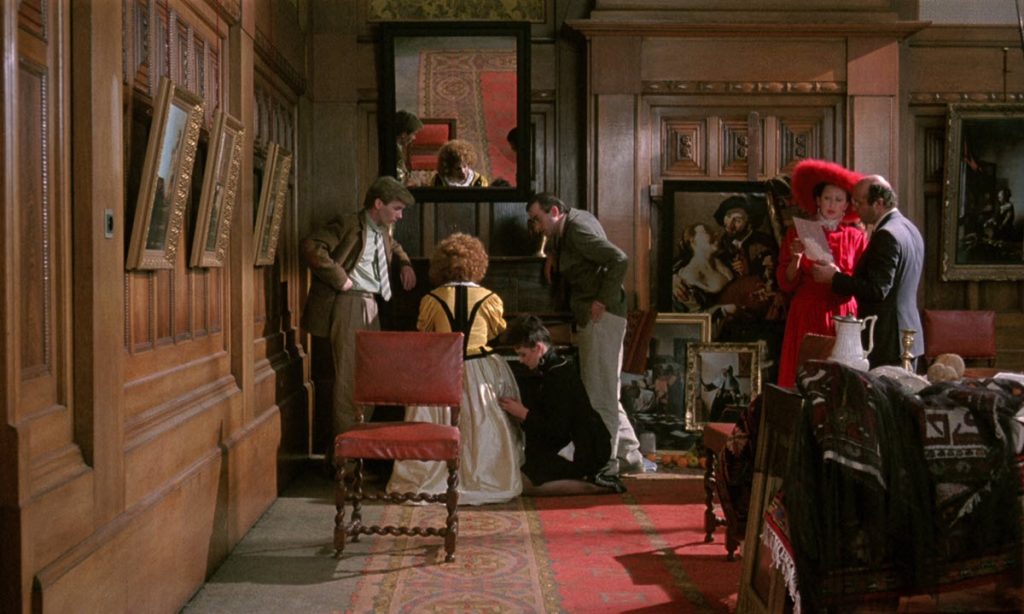
And this:
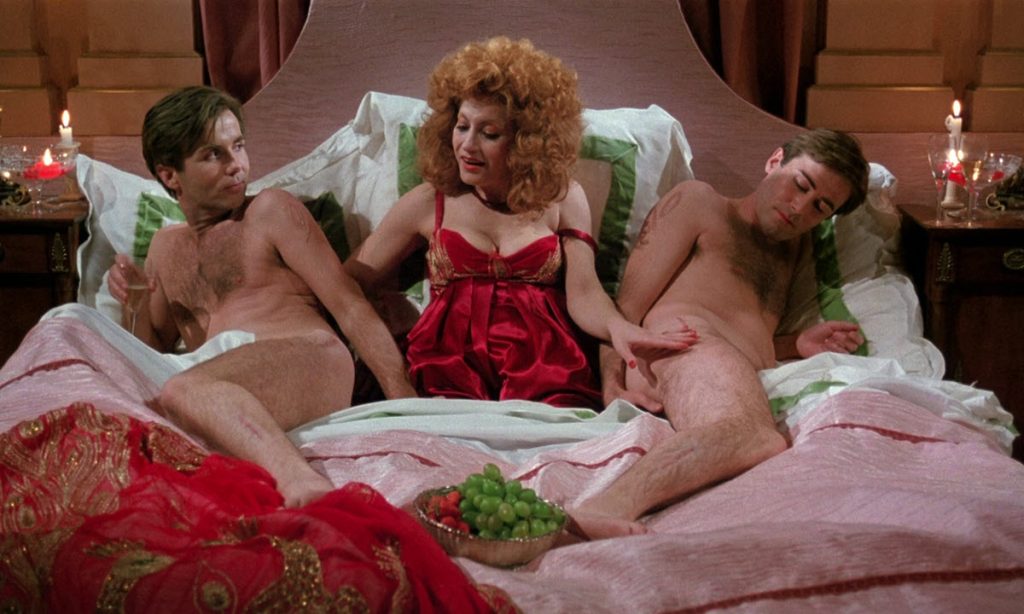
And, of course, this:
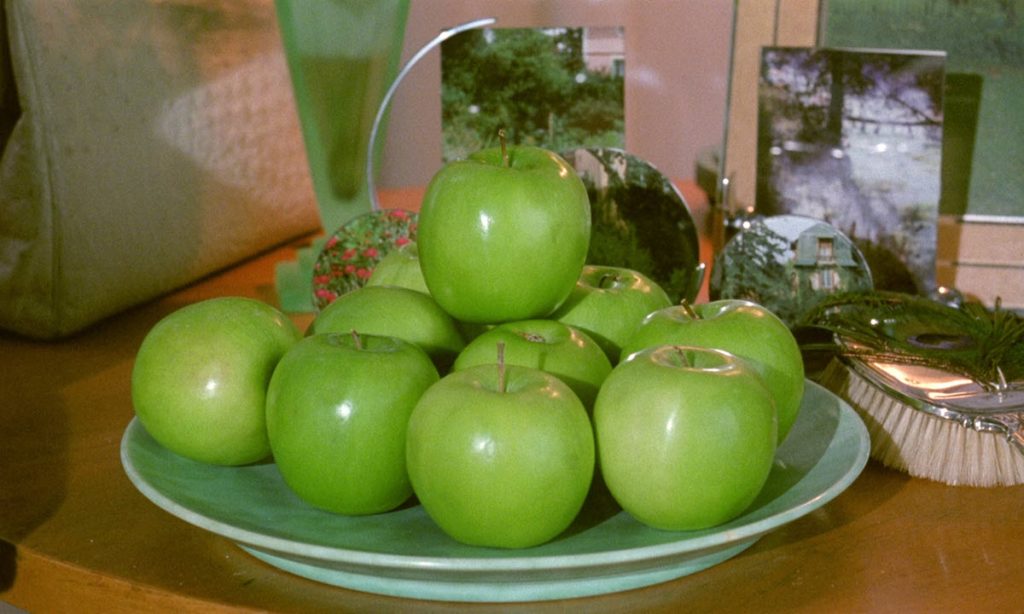
Greenaway was a painter before he was a filmmaker, which explains a lot of what you see in Zed and Two Noughts, as well as some of what happens. It seems Vierny was instrumental in translating Greenaway’s vision into cinematic compositions. A few short years later, for example:
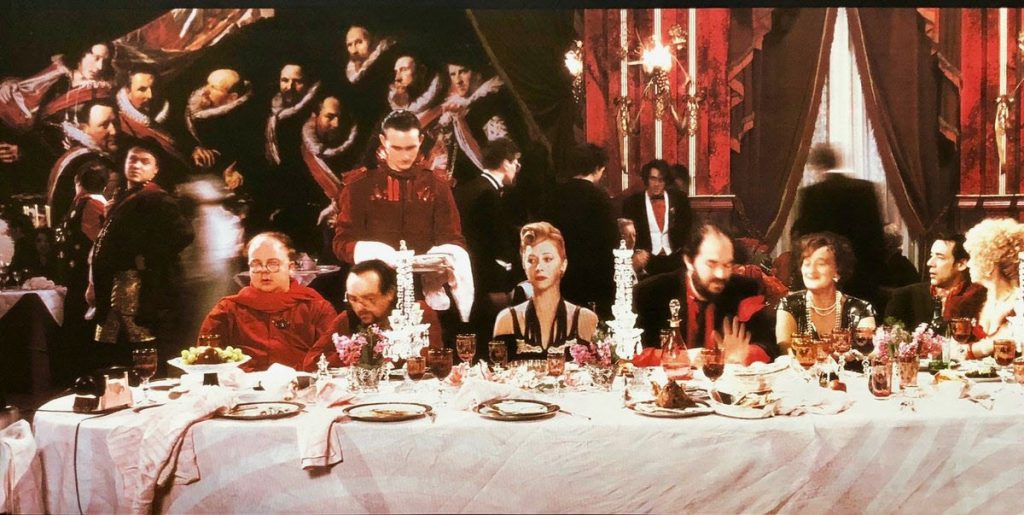
In 1989, Peter Greenaway will make the movie I knew him from before I watched this double-feature. The Cook, the Thief, his Wife, and her Lover is gorgeous, theatrical, grotesque, and indulgent, but it has only the lightest touches of absurdism. It’s mostly a straight-up Jacobean revenge play, which was a whole genre in the olden days. In a Jacobean revenge play, someone does something terrible, and gets his just desserts when something terrible happens to him. No need for a lot of moral complexity, since Jacobeans love moral order in the universe, which is the opposite of absurdism. It’s why The Cook, the Thief, his Wife, and Her Lover is probably Greenaway’s most accessible — and least Greenaway? — movie. It makes sense.
I don’t mean to imply that I don’t like absurdism, or that I don’t accept meaninglessness. On the contrary, it’s the burden you bear when you adopt a secular worldview. We’ve got to deal with it somehow, and if we can’t appreciate French nonsense, well, there are other options.
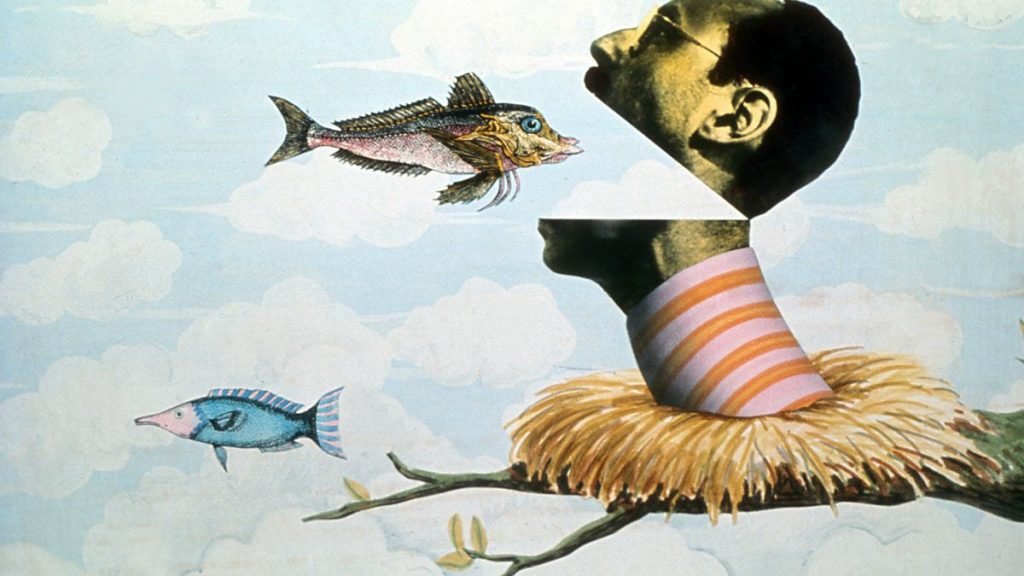
The easiest is comedy, which accounts for Monty Python’s success. Would people quote them so often if they weren’t funny? Their pre-parody stuff is arguably absurdist, but with jokes and Terry Gilliam animating the intermissions. The English were right there in the trenches alongside the French in World War I, but they have their own relationship with the absurd, their own expression of meaninglessness, delivered with the kind of toast-dry humor that comes from maintaining stiff upper lips and doomed empires. Plus, you don’t have to know French to fully appreciate it. My favorite English absurdist humor is less silly than Monty Python and it has fewer actors. It’s a BBC Three series called Snuff Box, with Brit Matt Berry and an American named Rich Fulcher. Estragon and Vladimir by way of The Muppet Show. Here’s an example of Snuff Box at it’s darkest, weirdest, and most nonsensical.
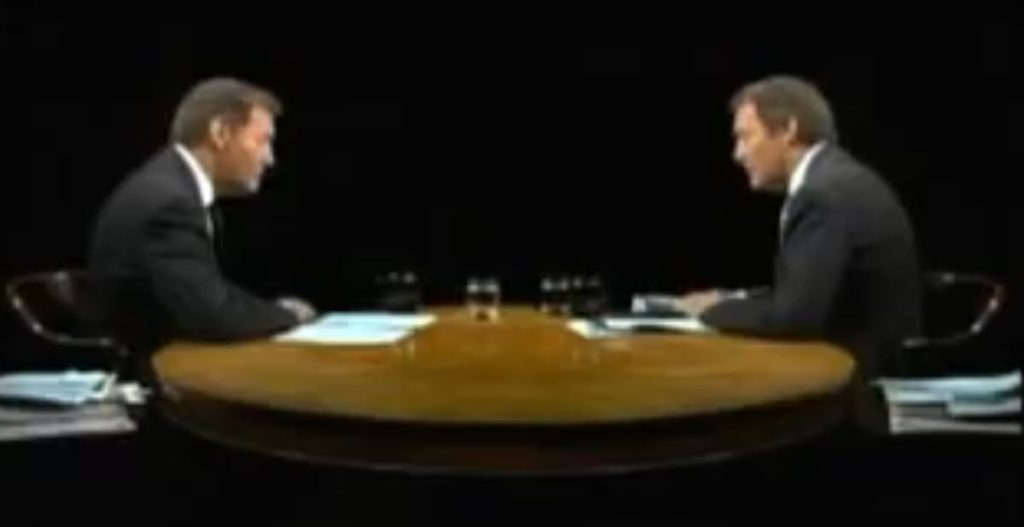
Another way to deal with absurdism is to take it in short bursts rather than sitting through multiple acts of the stuff. In 2008, Andrew Fillipone Jr. posted ‘”Charlie Rose” by Samuel Beckett’ on YouTube. He describes it as follows:
Something has happened to PBS favorite “Charlie Rose.” The erudite conversations and sober intellectualism have been replaced by an absurd world where illogic, inane dialogues, and open hostility rule.
Fillipone turned out to be your garden variety documentarian, but not before this absurdist experiment in creative editing went viral. I grew up watching late-night TV when we were subject to whatever was being broadcast, and I remember well the night being so late there was nothing to watch but Charlie Rose. It was like being forced to hang out with your dad long after you’re too cool to hang out with your dad, but when you’re still too young to appreciate him.
So there’s something in me that resonates with Fillipone’s nonsense, with how it casts Rose in a tragic role. Fillipone’s edit creates something like a performance. Not just the spoken lines, but the beats, the pauses, the inarticulate stutters, the intentional silences. It teases sinister inferences from dead air. The editing conjures a performance where there had only been talk show blandishment. It dances a verbal ballet around inane words like google, yahoo, blog, and radiohead, under the looming presence of someone named Steve. “What’s gonna happen?” Charlie Rose asks himself sincerely. They stare at each other, helpless, defused, defeated. The lights fade and the credits play. Productions of Waiting for Godot run about two hours. This was no longer than your average music video or comedy sketch.
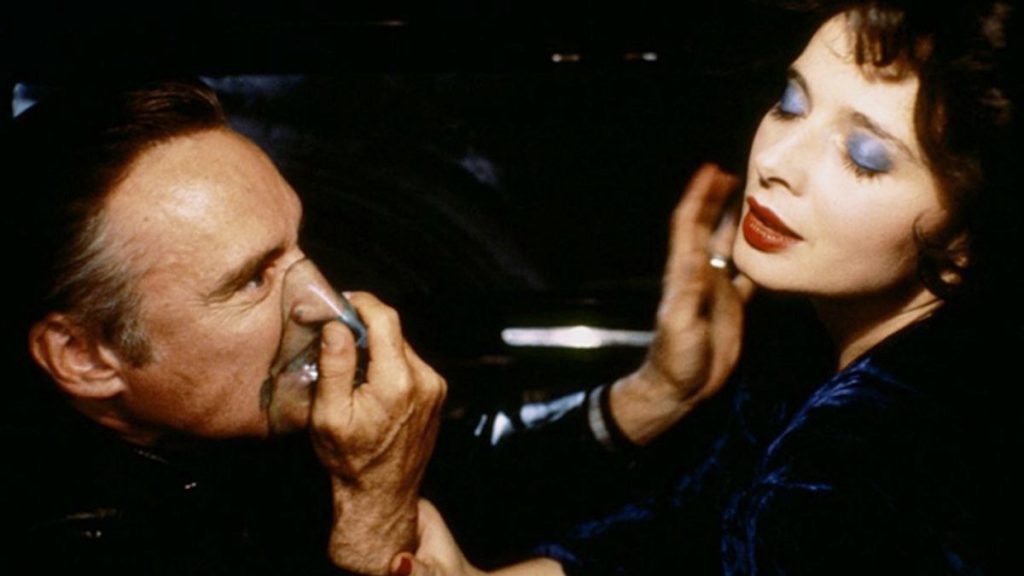
But for the most part, America doesn’t really do absurdism. I credit this to her abusive relationship with meaning; she simply can’t leave it, no matter how badly it treats her. Sure, we’ll always have weirdo David Lynch when he’s not doing heartwarming dramas about old men riding lawnmowers. But consider Greek filmmaker Yorgos Lanthimos. The more American his movies get, the less absurd they are. The point of Dogtooth, his first and very Greek movie, was the audience’s inability to understand it. Dogtooth aggressively deconstructs meaning. But the only ones confused by Bugonia, Lanthimos’ latest and very Emma Stone movie, were those of us expecting it to make a politically relevant point.
A third option for absurdism is what we did in Little Rock: pair the absurdism with something familiar. Make it more palatable. Give it the kind of resonance I experienced with ‘”Charlie Rose” by Samuel Becket’. This might be why Quentin Dupieux works so well for me.
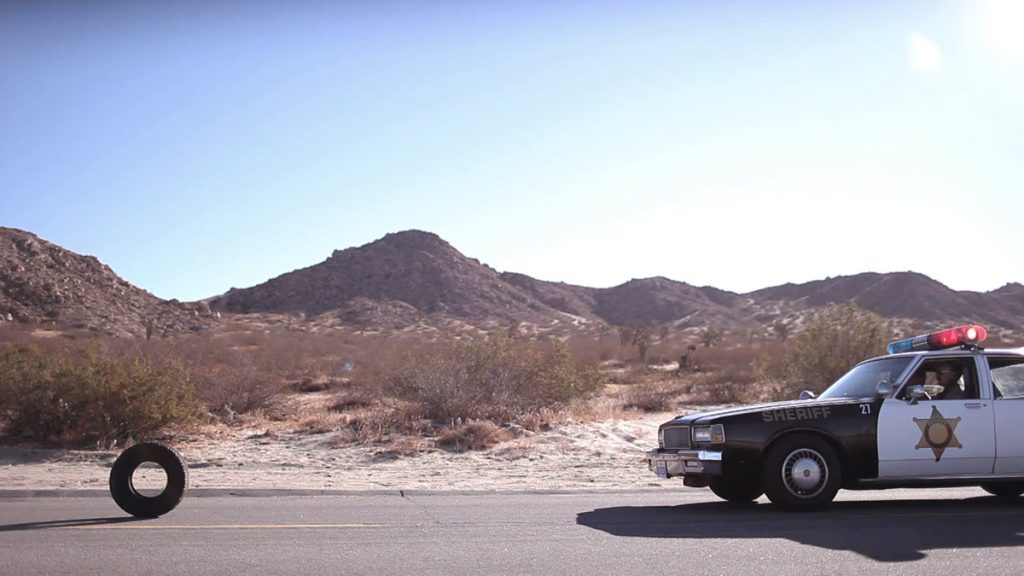
Whereas Greenaway’s original canvas was canvas, Dupieux began as a house musician, electronically remixing and sampling from other sources. The musical equivalent of what Fillipone did to Charlie Rose’s talk show. Dupieux’s filmmaking is hip to the short controlled bursts of absurdism you might find in music videos. But when he began doing longer-form cinema, he hitched his absurdist nonsense to the coattails of other genres, remixing tropes the way he might have remixed beats and sampled sound sources. 2010’s Rubber riffs on horror movies. 2013’s Wrong Cops is a ride-along with America’s love of police, however bad they may be. After that, Dupieux departed Hollywood and the English language, but his best French movies continue the tradition, slotting into familiar categories while gleefully making no sense. 2018’s Keep an Eye Out is a murder mystery. 2019’s Deerskin is a serial killer romance. 2021’s Mandibles is part ET, part creature feature. 2022’s Incredible but True is a time travel yarn.
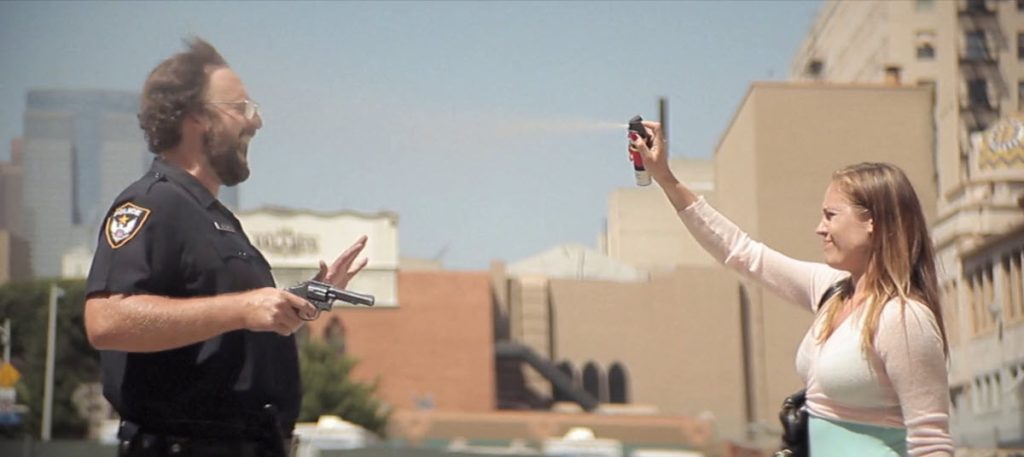
Furthermore, many of Dupieux’s movies have a rich layer of metanarrative, whether it’s the literal theatricality of Keep an Eye Out, the found footage element of Deerskin, the social media commentary in The Piano Accident, or the murder of his own Greek chorus in Rubber. Dupieux opens Rubber — indeed, his entire cinematic career, given that this was his first success — with a credo, committing himself to meaninglessness in cinema:
In the Steven Spielberg movie ET, why is the alien brown? No reason. In Love Story, why do the two characters fall madly in love with each other? No reason. In Oliver Stone’s JFK, why is the President suddenly assassinated by some stranger? No reason. In the excellent Chainsaw Massacre by Tobe Hooper, why don’t we ever see the characters go to the bathroom or wash their hands like people do in real life? Absolutely no reason. Worse, in The Pianist by Polanski, how come this guy has to hide and live like a bum when he plays the piano so well? Once again the answer is no reason.
I could go on for hours with more examples. The list is endless. You probably never gave it a thought, but all great films, without exception, contain an important element of no reason. And you know why? Because life itself is filled with no reason. Why can’t we see the air all around us? No reason. Why are we always thinking? No reason. Why do some people love sausages and other people hate sausages? No fucking reason…Ladies, gentlemen, the film you are about to see today is an homage to the no reason, that most powerful element of style.
Peter Greenaway’s equivalent credo is buried partway through The Falls. The case of Erhaus Bewler Falluper shows a sly bit of self-awareness on Greenaway’s part.
Whilst acknowledging his output, Falluper’s detractors accused him of manufacturing fictions and deliberately confusing identities. He was also accused of not knowing the difference between a good joke and a bad one. Falluper’s supporters were certain that the accusations were often true, but they believed Falluper’s half-fictions were effervescent by-products of his compulsion to draw up maps, index disasters, and break chaos into small pieces that he might rearrange these pieces in a different way, perhaps alphabetically.
I don’t intend to dismiss an entire literary movement by being dismissive of Peter Greenaway artful and artsy absurdism, and I’ve only seen three of his movies. But what does it say about me that the only Greenaway I can stomach is a simple Jacobean tragedy? And that my favorite absurdist, Quentin Dupieux, is basically a music video director homaging the movies he and I grew up with?
To me, it says pure absurdism is an acquired taste, if not outright madness. Even lack of meaning has to be relatable. Humans crave patterns, order, sense. We create stories, mythologies, entire religions to that end. Without the fundamental ingredients — patterns, order, sense, resonance, familiarity — we’re left with randomness, chaos, futility, like trying to make sausage without meat. And five hours of lard sausage is more than enough for me.
(Why the holy hell am I writing this wanna-be intellectual hoo-ha about absurdism? Because the Patreon review request made me subject myself to an excess of Peter Greenaway when it won the double-feature drawing! You, too, can enjoy the opportunity to subject me to this sort of thing, or pretty much anything you like, if you support my Patreon campaign for $10 or more.)
