


Pynchon & Mason & Dixon: absurd, funny, historically reverent, and uniquely American
My first encounter with Thomas Pynchon was indirect, though the filter of a filmmaker whose latest movie felt suddenly weird, unfamiliar, a little ill at ease, perhaps even “off”, as if he’d come under a strange new influence, or was maybe just drunk. Paul Thomas Anderson’s Inherent Vice didn’t feel like any other Paul Thomas Anderson movie. When I first saw it, I was confused. What on earth had happened to this movie? Why was it so conspicuously and bizarrely different from his other movies, so unlike the Paul Thomas Anderson I remembered? What was this raucous audacity, this untidy shimmer as if it were shot through a distorted lens? What was this strange aftertaste, like some spice from a distant land surreptitiously stirred into the mix? What were these shifts in tone, these ludicrous outbursts, the slithering vulgar undercurrents of eroticism? Why the sensually indulgent voiceover from a fortune teller, invisible to most of the other characters, in an ethereal performance from a folk harpist named Joanna Newsom? Why does Martin Short abruptly show up, as ridiculously out of place as a talking dog? It wasn’t just detective fiction, it was detective fiction by way of something else.
The something else was, of course, Thomas Pynchon, from whose novel Inherent Vice was adapted. I didn’t quite appreciate this until I’d seen the movie multiple times, my perspective shifting from confusion to fascination. Anderson was indeed under a spell. He was in thrall to another voice, one coming from beyond the language of cinema. It would be even more obvious in One Battle After Another, adapted from another Pynchon novel, which curdles as Anderson clumsily attempts to make it modern and politically relevant. That was my second encounter with Pynchon.
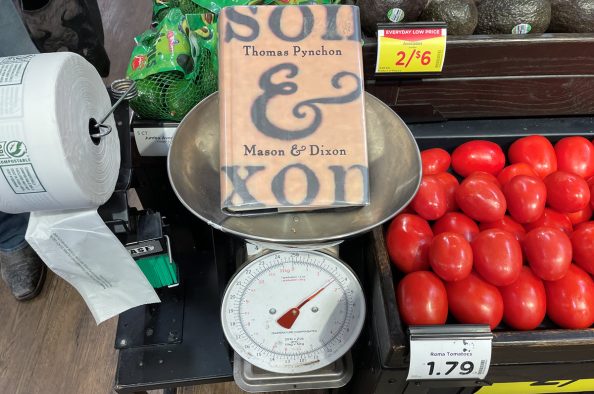
My third encounter with Pynchon was Mason & Dixon, historical fiction from the era and area of the American Revolution. It is the writer’s fifth novel out of nine, published in 1997 in a hefty tome weighing in at three pounds. Paperback reprints in 2004 and 2006 will be lighter, but something this substantial should be grasped in a format equally as substantial. It’s not enough to simply pick up a book by Thomas Pynchon; it should be lifted.
Although it’s mostly light-hearted and even airy, Mason & Dixon is not a work to be approached lightly. You should not expect to fold the cover back and read it at the pool while keeping an eye on your splashing children in case they begin to drown. Don’t plan on getting through it crepuscularly, a few paragraphs at a time, by the light of a bedside lamp as you drop off to sleep every night. Do not pick it up at the airport for a flight from Los Angeles to St. Louis, or even New York. Give yourself at least a trip to Sydney and back.
Some prose is simply skating. Glide along the words, ground down and equally smooth, penned for frictionless passage, written to be moved beyond, more paving than lit-TRA-chure. Other prose can be tangled, wild with knots and intent and implication, broken into uneven swathes and upthrust heaves of textured terrain and unexpected elevation, occasionally impossible to comprehend without backing up, attempting another course, marking the way and finding a pass through its verby wilderness. Hold, hold, I’ve stumbled again and lost my way. Search out the verb. Aye, there, I’ve found it, the Rosetta stone, a gem at the heart of these mountains. Now suss out the subject…good, good…and then the object. Just so…three points from which I can map the rest of the way. Now I unravel the clauses…so many of them!…I isolate the adjectives, I note the thorny little adverbs. The punctuation my trusty landmarks whereby I divide this work. Behold, I have read a paragraph of Pynchon’s Mason & Dixon! I have mapped the prose, much the way its heroes mapped America.
With well-written prose, exploration is no chore. It’s part of the process. Indulge me a moment, and try this lovely passage:
It breaks slowly upon the Astronomers, that with no time available for gazing at anything, this people’s Indifference to the Night, and the Stars, must work no less decisively than their devotion to the Day, and the Earth for whose sake something far short of the Sky must ever claim them, a stove, a child, a hen-house predator, a deer upwind, the price of Corn, a thrown shoe, an early Freeze.
It’s a knot, to be sure. But it’s worth reading several times over. It’s worth saying out loud. Perhaps even committing to memory. This is not a book in which you read a paragraph and simply move on to the next, one following the other like pinched beads on a rosary, each equally comfortable pellets in a predictable litany. This is a sometimes uneven journey among oases, a soaring voyage with shrewdly observed vistas and carnival layovers. Often you will be arrested, whether gobsmacked or merely intrigued, whether to untangle or marvel in iteration. Ride ’round once more the summits, plunges, and corkscrews of a wondrous wordway wrought from there to here. A paragraph of Pynchon is not just text; it’s a park.
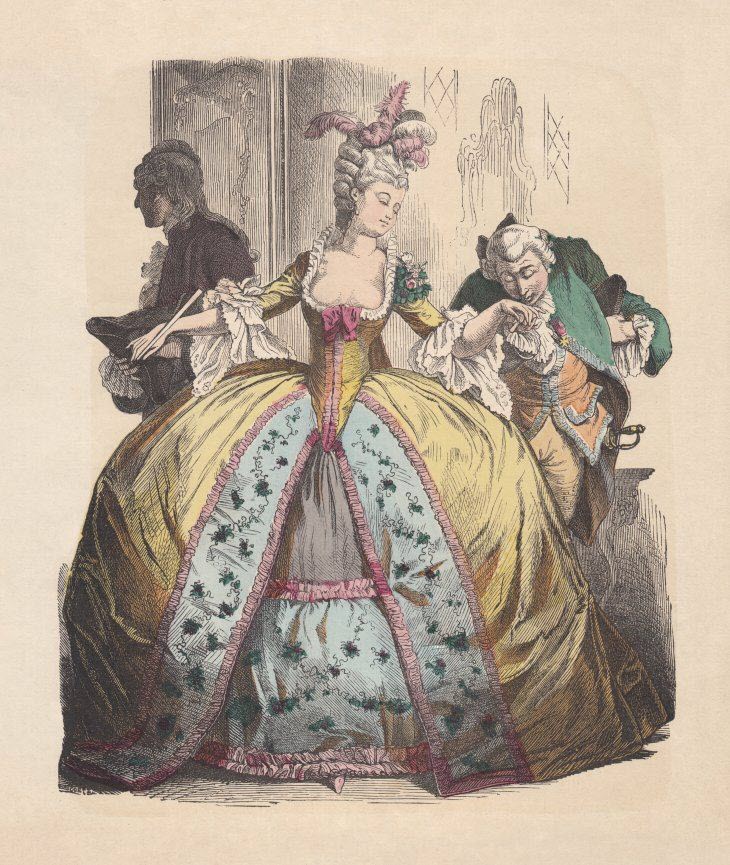
I cannot help myself; one more example. Allow me to set the stage. Lord and Lady Lepton are disgraced nobles who’ve fled to America, where they’ve built a fantastical casino. In this scene, they’re speaking with Captain Dasp, a French spy. The narrator, from 20 years in the future, relates their conversation.
It is difficult, in these days of closer-fitting Attire, to imagine the enormous volumes of unoccupied Space that once lay between a Skirt’s outer envelope, and the woman’s body far within. “Why, there may be anything!” Capt. Dasp as if genuinely alarmed, “stash’d in there,– contraband Tea, the fruits of Espionage, the coded fates of Nations, a moderate-sized Lover, a Bomb.”
“Yet the present-day Bodice,” remarks Lady Lepton, “can conceal secrets only with difficulty. A single key, perhaps, or the briefest of love-notes. Indeed, ’tis but an ephemeral Surface, rising out of the Spaces that billow ambiguously below the waist, till above melting…here, into bare decolletage, producing an effect, do you mark, of someone trying to ascend into her natural undrap’d State, out of a Chrysalis spun of the same invisible Silk as the Social Web, kept from emerging into her true wing’d Self,– perhaps then to fly away,– by the gravity of her gown.”
“Oh, pishtush,” comments her Husband, “Pshaw. Bodices are for ripping, and there is an end upon it.”
Are women’s clothes a prelude to a thrill and likely misadventure? Are they a prison? Or are they the discardable wrapper around a treat? Three perspectives, three characters, one brief exchange. Lady Lepton’s contribution requires some effort, rendered as it is in Pynchon’s sometimes labored and eminently worthy prose. But it’s carefully laden with imagery and cultural commentary, well worth unpacking. And it’s situated between two quick, easy, and funny observations. Throughout Mason & Dixon you will find mediations on death as a gender, on the divine emptiness of bread, on the difference between coffee and tea, on ley lines and flying magicians and pockets of missing time. Here are marvels, musing, observations to be discovered, parsed, admired, smitten by or sometimes even laid low by, as if by a blow.
But enough about style! What, exactly, will the prospective Mason & Dixon reader encounter in its 773 pages, divided into 78 chapters, further divided into two parts, with a brief epilogue as its third part?
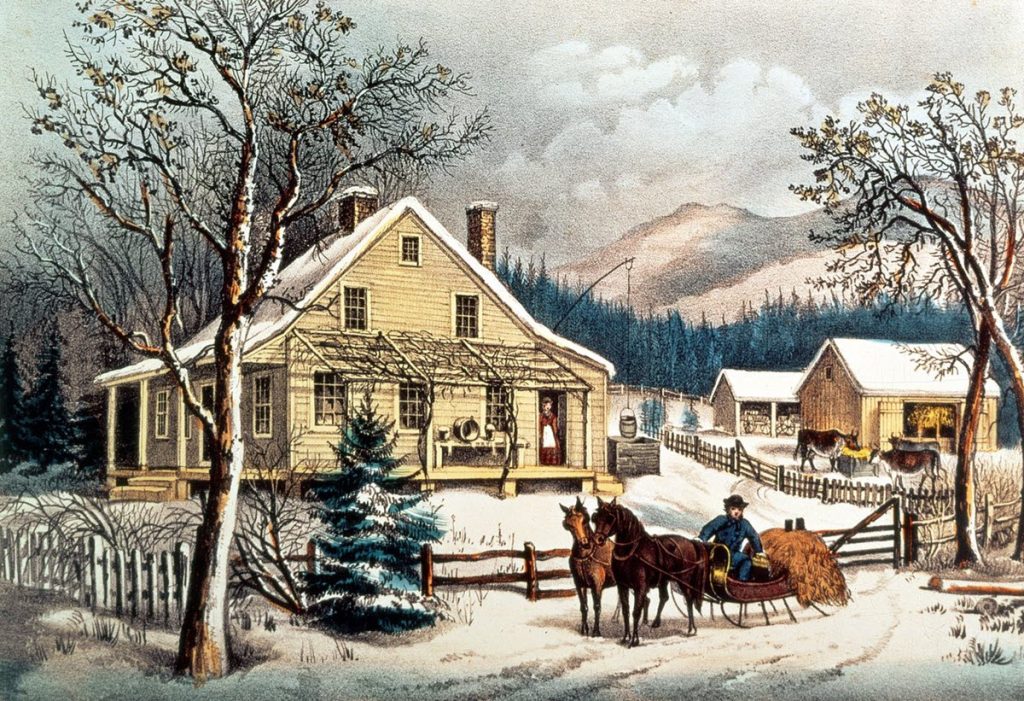
The framing device is set in 1786 America, “with the War settl’d and the Nation bickering itself into Fragments”. It takes place over the course of a single wintry night, in a snugly idyllic Currier-and-Ives homestead. The reverend Wicks Cherrycoke — Pynchon’s names are nothing if not playful — has come to America to attend the funeral of a friend, and he’s staying with his brother’s expansive family. By way of earning his keep, he entertains them with tales of the adventures of a surveying party 20 years ago, for which he had been appointed chaplain. Their task in 1765 was to precisely mark the border between Pennsylvania and Maryland, at that time separate charters under the auspices of the British Empire. The men who led the party were an astronomer named Charles Mason and a surveyor named Jeremiah Dixon.
But Reverend Cherrycoke’s account begins at the beginning, going back to the two men’s first mission together, in 1761. The Royal Society sent them to Borneo to mark the precise time when Venus passes between the earth and the sun. These times would be collected from observation points around the globe — one of the benefits of an empire on which the sun never sets — to determine astronomical stuff you can only determine through trigonometry. This is the first part of the novel, with the second part being Mason and Dixon’s more famous assignment in America, drawing a line that will result in more upheaval than it resolves, a cultural watershed for centuries to come. As a Chinese adventurer tells them:
…nothing will produce Bad History more directly nor brutally, than drawing a Line, in particular a Right Line, the very Shape of Contempt, through the midst of a People,– to create thus a Distinction betwixt ’em,– ’tis the first stroke.– All else will follow as if predestin’d, unto War and Devastation.
Throughout their adventures, and likewise throughout Reverend Cherrycoke’s tale-telling, there are frequent discursions. The narrative unmoors from place, time, tone, and even genre, jumping backwards, forwards, dramatically sideways, and even into other literary works. Chapters 53 and 54 veer parlously off the beaten path, without so much as a “meanwhile”. Did an editor fall asleep? Did someone rip out some pages? This is a novel full of secret passages and trap doors and even musical numbers. Come for the story within a story, stay for the burlesque of the horny Quebecois nuns!
Although the eponymous line is famously a north/south divider in the United States, Mason and Dixon aren’t major historical figures. They were minor functionaries in a larger empire, never wealthy, never particularly famous, men that will do to swell a progress, start a scene or two, advise the prince, as it were. They never had their paintings done. Search Google images as deep as you like and you’ll only ever find this illustration of two faceless men, which appeared in a history textbook in 1910.
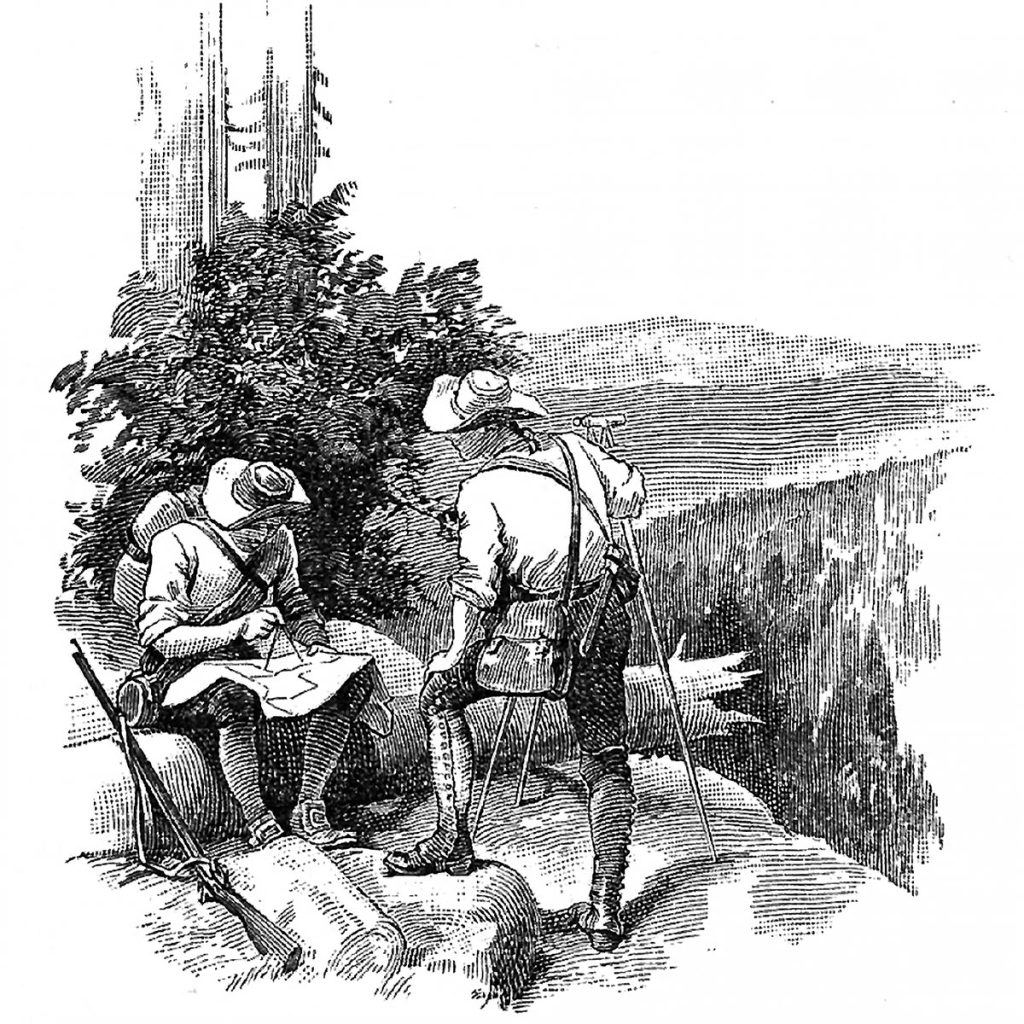
We know the basics, of course. As you’d expect an astronomer and surveyor on assignment in the British Empire, they kept records of what they did. But we know comparatively little about who they were, which gives Pynchon the freedom to create them himself. As a story, Mason & Dixon is a rollicking buddy comedy, a Colonial era road trip around the globe where two men meetcute with apprehension, then work together long enough to become friends and foils for life.
Mason is a proper English gentleman, the son of a baker, yet apprenticed to an astronomer. When the story begins, he is a recent and chronically afflicted widower, with one foot in the afterlife and an eye to the Heavens, as Gothickally depressive as Dixon is Westeringly manic. Dixon is an erstwhile Quaker (“his Conscience early brought awake and not yet entirely fallen back to sleep”), a hearty carouser to Mason’s melancholic. “I am a Northern Brit, a semi-Scot, a Gnomes’ Intimate,” he says, raised among superstitious coal miners, more down to earth than Mason, with appetites more worldly. Their meetcute is in Portsmouth, from which they’re eastward bound for Borneo. After each of them flubs an attempt at opening with a joke…
The two are staring, one at the other, each with a greatly mistaken impression, — likewise in some Uncertainty as to how the power may come to be sorted out betwixt ’em. Dixon is a couple of inches taller, sloping more than towering, wearing a red coat of military cut… He will be the first to catch the average Eye, often causing future strangers to remember them as Dixon and Mason.
Surveyor Dixon says to astronomer Mason:
“Takes an odd bird to stay up peering at Stars all night in the first place, doesn’t it…? On the other hand, Surveyors are runnin’ about numerous as Bed-bugs, and twice as cheap, with work enough for all certainly in Durham at present, Enclosures all over the Country, and North Yorkshire,– eeh! Fences, Hedges, Ditches ordinary and Ha-Ha Style, all to be laid out…I could have stay’d home and had m’self a fine Living…?”
“They did mention a Background in Land-Surveying,” Mason in some Surprize, “but, but that’s it? Hedges? Ha-Has?”
“Well, actually the Durham Ha-Ha boom subsided a bit after Lord Lambton fell into his, curs’d it, had it fill’d in with coal-spoil. Why, did you think I was another Lens-fellow? O Lord no,– I mean I’ve been taught the lot, Celestial Mechanics, all the weighty lads, Laplace and Kepler, Aristarchus, the other fellow what’s his name,– but that’s all Trigonometry, isn’t it…?”
Mason, having expected some shambling wild Country Fool, remains amiably puzzl’d before the tidied Dixon here presented,– who, for his own part…is amus’d at Mason’s nearly invisible Turn-out, all in Snuffs and Buffs and Grays.
Their contrasts in clothing, speech, manners, disposition, and punctuation continue for another 700 pages, each and every one of them brimming with keen historical detail about empires and colonies, about the people who lived in them, about their daily lives, and about a looming and unborn America.
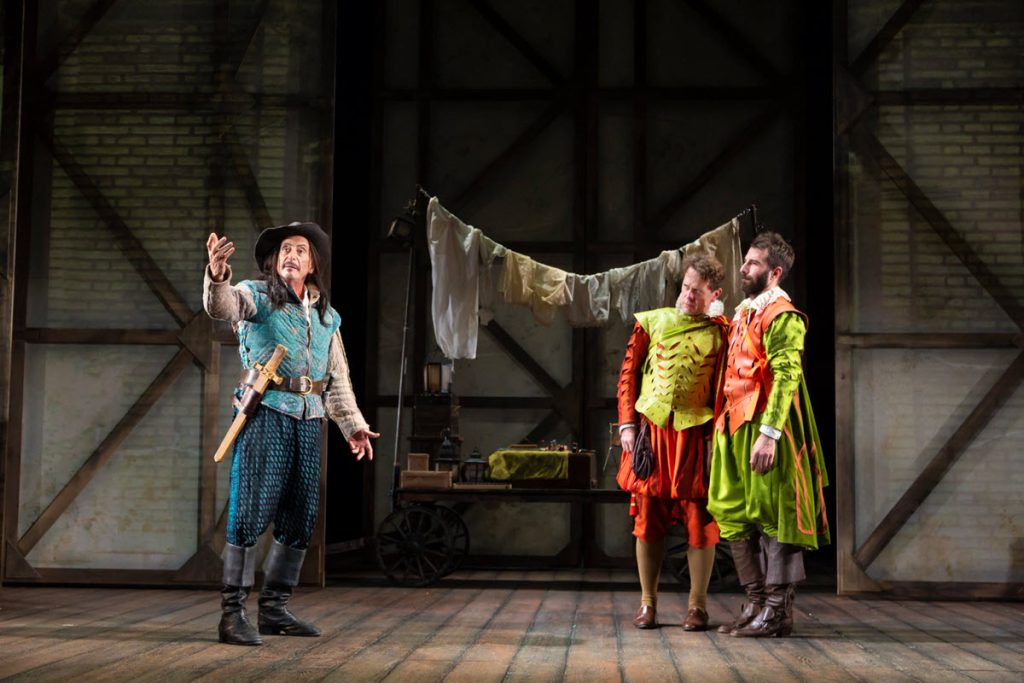
When talking about Mason & Dixon, I can’t help but think of Tom Stoppard’s Rosencrantz and Guildenstern are Dead. These are airily existential and absurdist buddy comedies, set against the backdrop of something bigger than their unwitting protagonists. The main characters are peripheral players in a familiar drama, Hamlet on one hand, America on the other. These intimate friendships play out in the shadow of a cultural enormity, each story a wistful metaphor for the human condition, where we’re at the mercy of forces we can neither see nor comprehend. But whereas Stoppard’s play is a play, written as an outline into which productions and their actors will breathe life, Mason & Dixon is a gloriously realized novel, sprung fully formed from Pynchon’s remarkable forehead.
Rosencrantz and Guildenstern ends on the ship carrying them to their doom. Mason and Dixon find themselves in a similar predicament early in their story, when the English frigate taking them to Borneo is set upon by a French warship. They spend the battle blind and terrified in the hold of the Seahorse, called a “jackass” frigate for being “a couple of guns shy”. The Seahorse loses egregiously and this is where the adventures of Mason and Dixon might surely end. But once the French discover the frigate’s mission is merely to transport an astronomer, they let it limp back to England, gloating that “France is not at war with the sciences”.
Mason tries to make sense of it while they sit shellshocked in Portsmouth. He ponders to Dixon:
“Was there a mistake in the Plan of the Day? Did we get a piece of someone else’s History, a fragment spall’d off of some Great Moment…such as now and then may fly into the ev’ryday paths of lives less dramatic? And there we are, with Wigs askew.”
And what they cannot speak, some of it not yet, some of it never, resumes breathless Sovereignty in the wax-lit Rooms.
By way of comparison, here’s the last scene of Rosencrantz and Guildenstern Are Dead:.
Ros That’s it, then, is it? The sun’s going down. Or the earth’s coming up, as the fashionable theory has it. Not that it makes any difference. What was it all about? When did it begin? Couldn’t we just stay put? I mean no one is going to come on and drag us off…. They’ll just have to wait. We’re still young … fit… we’ve got years…All right, then. I don’t care. I’ve had enough. To tell you the truth, I’m relieved.
And he disappears from view. GUILDENSTERN does not notice.
Guil Our names shouted in a certain dawn … a message … a summons… there must have been a moment, at the beginning, where we could have said — no. But somehow we missed it.
And disappears.
…the play fades, overtaken by dark and music.
Later, Mason and Dixon recall that they might have died on the Seahorse: “As if we’re Lodgers inside someone else’s Fate, whilst belonging quite someplace else…?” In the wilds of America, when they come to crossroads that must be charted, they split apart, each heading blindly in a different direction, agreeing to turn back and retrieve the other as soon as they encounter civilization. As Dixon sets out along his unknown path:
He has certainly, and more than once, too, dreamt himself upon a dark Mission whose details he can never quite remember, feeling in the grip of Forces no one will tell him of, serving Interests invisible. He wakes more indignant than afraid. Hasn’t he been doing what he contracted to do,– nothing more? Yet, happen this is exactly what they wanted,– and his Sin is not to’ve refused the Work from the outset.–
There must have been a moment, at the beginning, where they could have said no, their sin being that they didn’t refuse the work from the outset.
Unlike Hamlet’s erstwhile schoolmates, Mason and Dixon do not meet their doom in this story. Pynchon’s novel isn’t as darkly concise a tale as Stoppard’s play. Yet it’s got the same sense of being swept into the future by some uncaring conveyance, whether it’s a letter edited by Hamlet, an order from the Royal Society, or something darker and less tangible.
“What Machine is it…that bears us along so relentlessly? We go rattling thro’ another Day,– another Year,– as thro’ an empty Town without a Name, in the Midnight…we have but Memories of some Pause at the Pleasure-Spas of our younger Day, the Maidens, the Cards, the Claret,– we seek to extend our stay, but now a silent Functionary in dark Livery indicates it is time to re-board the Coach, and resume the Journey. Long before the Destination, moreover, shall this Machine come abruptly to a Stop…gather’d dense with Fear, shall we open the Door to confer with the Driver, to discover that there is no Driver,…no Horses,…only the Machine, fading as we stand, and a Prairie of desperate Immensity….”
Not to imply that Mason & Dixon is relentlessly morose, or even terribly existential. It’s mostly sly, historically insightful and keenly written, sometimes even sexy, with dense and arresting prose to make you work until your heart soars with the genius of it all. But really, the humor’s the thing. I’d call it a comedy above all, remarkably light for a three-pound tome, progressing from the English empire into the American Revolution, and then deeper into the wilds, dissipating into the stuff of myth.
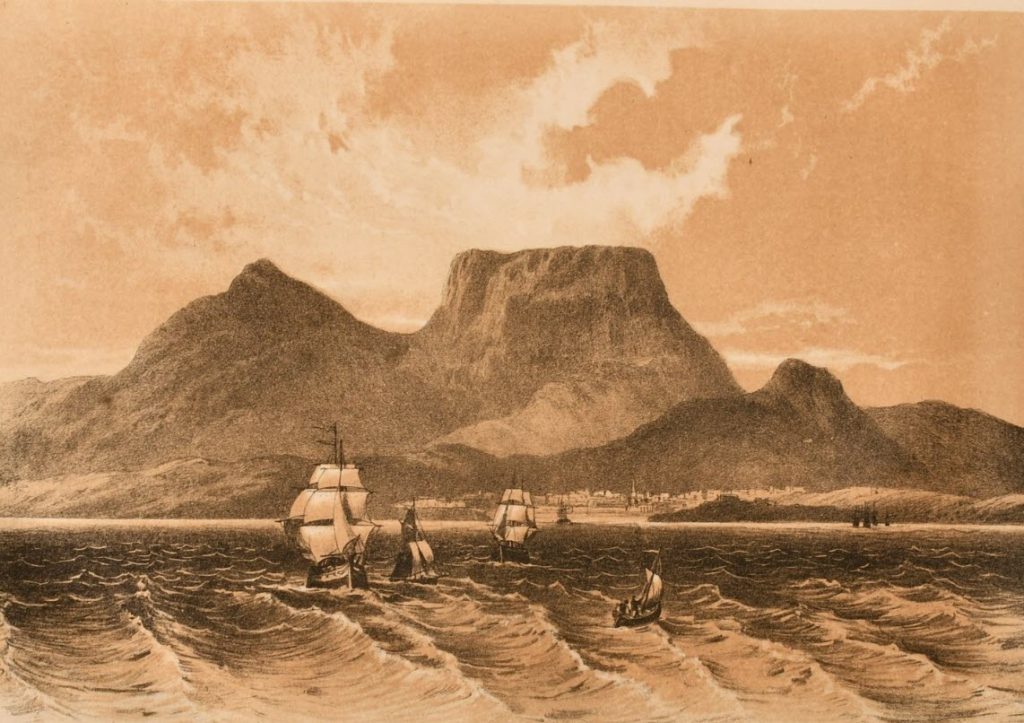
After their French drubbing, for their second attempt at Borneo, the pair fails to round the Cape of Good Hope and ends up in Capetown. Here they will note the relevant positions of Venus from the site of farmer’s daughter misadventures in the Vroom household.
A “Cape delicacy”, Mrs Vroom tells Mason of some new concoction on the table, “Our Malays called it ketjap.” Mason and Dixon are having dinner with the Vrooms: Cornelius Vroom, his wife, and “what seems like seven, and is probably closer to three, blond, nubile Daughters. Mealtimes are a strange combination of unredeemably wretched food and exuberantly charming Company. Under the Table-cloth in a separate spatial domain such as Elves are said to inhabit, feet stray, organs receive sudden inrushes of Blood…Blood, clearly rushing throughout Dixon, is detectable as well in faces and at bosoms and throats in this Jethro’s Tent they’ve had the luck to stumble into.”
Vroom’s daughters are Jet, Greet, and Els. They lend the Capetown episode a playfully winking bawdiness (you’ll find the same sensibility peppered throughout the novel in the most unlikely places).
Dixon meanwhile is struggling with the very Chinese Concoction, or rather with its slender Bottle, out of whose long neck he finds he has trouble getting the stuff to flow. “Strike her upon the bottom,” whispers Els, “and perhaps she will behave.”
I have no idea how or whether it’s historical to invoke catsup in 18th century South Africa, but I’m pretty sure a similarly silly episode involving werewolves and pizza in Yorkshire is entirely fanciful. Yes, werewolves and pizza, on the same page. That’s Pynchon for you. Before he’s done, he’ll even chuck a were-beaver into the mix (Zepho Beck’s woodchopping contest against the Swedish axeman reads like the stuff of American myth, even if it’s actually not).
The Capetown episode, and the madness of a windblown Atlantic naval outpost called St. Helena, are the first part of the book. As worldbuilding, it plumbs the eastward spread of empire and all that implies, where Capetown is “a town with a precarious Hold upon the Continent, planted as upon another World”. It’s a Dutch colony, described by Pynchon as a “…European settlement so precarious, facing an unknown Interior with the sea at their backs, forced, step after step, by the steadfast Gravity of all Africa, down into it at last…It is another way of living where the Sea is ever higher than one’s Head, and kept out only provisionally.”
Here is their initial encounter with the specter of slavery. The literal specter.
Men of Reason will define a Ghost as nothing more than a wrong unrighted…which like an uneasy spirit cannot move on…But here is a Collective Ghost of more than household Scale,– the Wrongs committed Daily against the Slaves, petty and grave ones alike, going unrecorded, charm’d invisible to history, invisible yet possessing Mass, and Velocity, able not only to rattle Chains but break them as well.
Mason & Dixon is littered with acute historical observations, realized in achingly good prose. Although this being Pynchon, they’re routinely punctuated by jokes. Bored with Capetown’s colonial mutton for dinner, the two men venture out to try local cuisine. During a conversation, as Mason holds forth about his own woes back in England, a native chef asks, “Have the Dutch conquer’d your land, too?”
“Oh, dear me, no,–” Mason prim’d to chuckle in condescension till Dixon, infernally a-beam, says, “William of Orange, what about him? Tha wouldn’t style tha’ a Conquest?”
Please tell me you got that one. Here’s an easier one. During the actual readings of the transit of Venus, the members of their host family “speed about in unaccustom’d Bustle, compared to the Astronomers, who seem unnaturally calm.”
“Dutch Ado about nothing,” Mason remarks.
The book is full of such slyly erudite and sometimes playfully anachronistic asides. And even not so sly. In New York, Mason is accosted by a young woman who spies for the rebels:
Amy is dress’d from Boots to Bonnet all in different Articles of black, a curious choice of color for a milkmaid, it seems to Mason, tho’, as he has been instructed ever to remind himself, this is New-York, where other Customs prevail. “Oh, aye, at home they’re on at me about it without Mercy,” she tells him, “I’m, as, ‘But I like Black,’– yet my Uncle, he’s, as, ‘Strangers will take you for I don’t know what,’ hey,– I don’t know what, either. Do you?”
“How should I– “
“You’re a stranger, aren’t you? Well? What would you take me for?”
Days later, riding back to Brandywine through the Jerseys, he will rehearse endlessly whether she said “would you take me,” or “do you take me,” and ways he might have improved upon “Um…,” his actual Reply. She does glance back with an Expression he’d noted often in his life from Women, tho’ never sure what it means.
Mason flummoxed by women is funny enough and easy to enjoy. The “as” gag confused me at first, but I got it quickly enough. Bless his impish heart and pen, but Pynchon is too restless to stay in the 18th century.
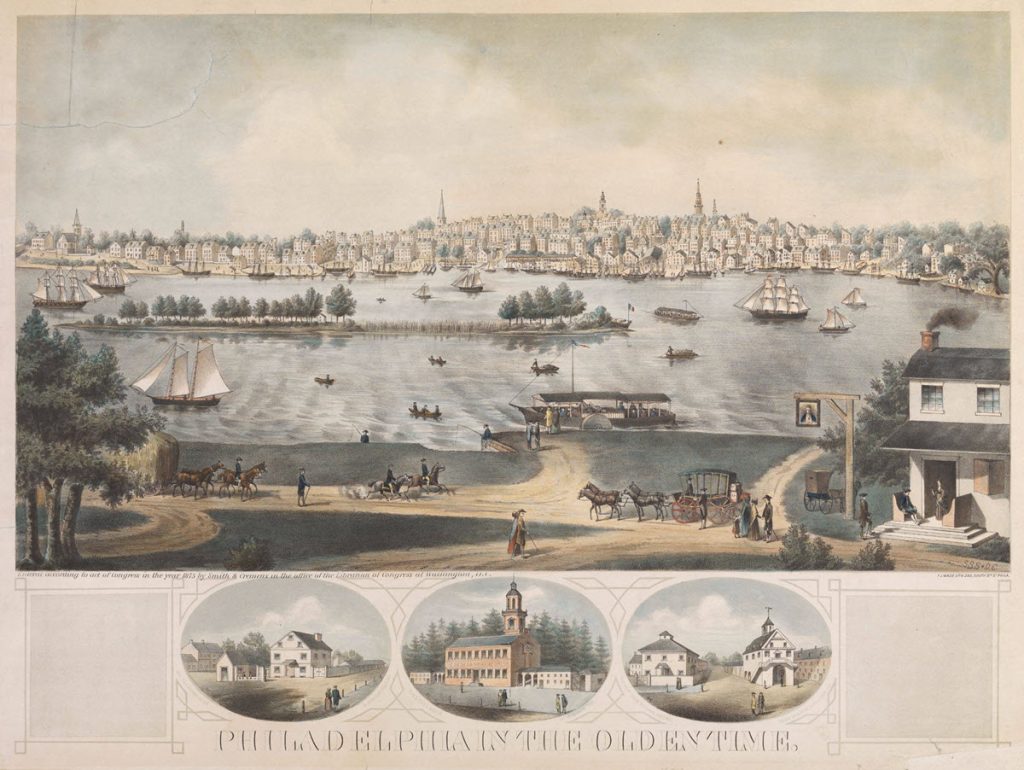
The second half of the novel explores the westward counterpart of the British Empire, soon to be known as the United States of America. Here Mason and Dixon pierce the civilized crust of the Atlantic coast a-buzz with its coming Revolution, as we read in this description of Philadelphia:
…there’s a distinct feeling in the Rooms, of Afternoon. Maps have been brought and spread, Pigeons bearing Messages dispatch’d from under the Roof-peaks by expert Belgians, resident here, to as far away as Lancaster County. Boys old enough to handle a Rifle are drilling out in Back. Younger brothers are active at the next Order of Minitude, with long Sticks, whilst down at the next, the Dogs run obsessively to and fro, all ’round the Edges, faces a-twist with Efforts to understand. Down the Street ’round the Corner, into the City at large, the Sailors grumble in their candle-less Ale-Hovels, the devout Man of Business looks ahead to an hour dedicated again to the Daily Question, the Child trembles at the turn in the Day when the ghosts shift about behind the Doors, and out of the Gust-beaten wilderness come the Paxton Boys…
(The Paxton Boys were men who had massacred the residents of an Indian settlement, and later descended in a mob on Philadelphia to continue their work. They are among the early examples of what the novel calls “the Catastrophick Resolution of Inter-Populational Cross-Purposes”.)
Here Mason and Dixon will humorously hobnob with the likes of sensational celebrity Ben Franklin, George Washington and his sidekick jester slave, and even this guy:
Virginians young and old are standing to toast the King’s Confoundment. When it’s his own turn to, Dixon chooses rather to honor what has ever imported to him,– raising his ale-can, “To the pursuit of Happiness.”
“Hey, Sir,– that is excellent!” exclaims a tall red-headed youth at the next table. “And ain’t it oh so true…. You don’t mind if I use the Phrase sometime?”
But overall, the coming revolution barely registers for them. Pynchon seems less interested in the event than he is the setting, which is its own kind of insight. Because the American Revolution was neither. It was an English civil war, through and through. No revolution at all and not much of a war either. France will demonstrate shortly, and Russia ultimately, what revolution truly means. This much ballyhoo’ed kerfuffle was but a squabble between businessmen and parliamentarians over the finer points of mercantilism. A king looked on haplessly, sitting an ocean away. Lawyers roused rabble and wrote loftily about rights. Men were inspired. Women sewed and spun. Thugs took to the streets. Soldiers contracted diseases and died, and occasionally fought a battle.
Almost all of them were English, concerned with what it meant to be English. America wouldn’t be truly discovered until she won Her own Civil War and lost the Reconstruction, born at last in a spasm of redemption from disgrace then fallen back into disgrace. The spasm would be repeated in the Civil Rights movement and the rise of the modern Republican party. Look for America in 1776 and you will only find her obliviously nattering English father. Her mother waits west, her birth deferred until another century.
As surveyors, Mason and Dixon’s initial task was sorting out the tangle of borders among Pennsylvania, New Jersey, Delaware, and Maryland. The quad-colony area was a mess, legally and geographically, so the English King royally decreed an expedition to bind the earth to the heavens, with a surveyor and an astronomer to bring their respective spheres into accord. Once that was done, they were to surgically and decisively separate Pennsylvania from Maryland, drawing a line that would theoretically extend to the Pacific. It would be a far more important template than anyone realized at the time.
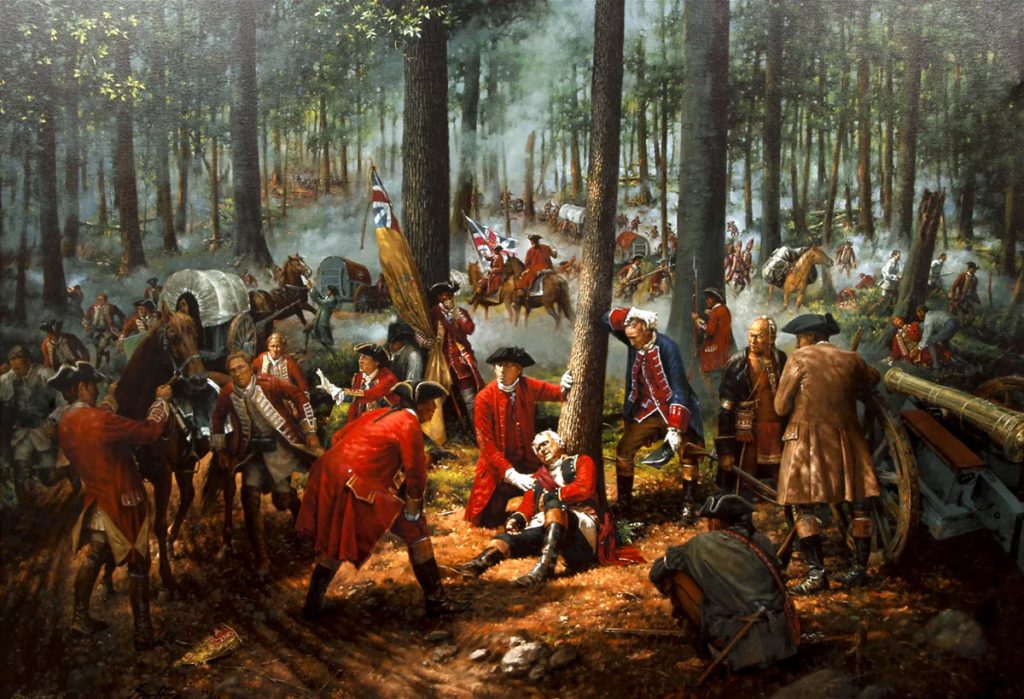
From the head of the Chesapeake Bay, Mason and Dixon plunge westward into the wilderness America will roll over and subsume on its way to manifesting Her destiny. Yet they barely kiss what will become known as “Ohio”. Back then, it was the Northwest. It was wild, untamed, dim, teeming with savages. In Mason & Dixon, it’s even more fantastical than that. George Washington, who nearly died out there with Braddock, warns them: “you cannot know what will be waiting among the Trees…”

To give you a sense of where Pynchon is willing to go as our heroes depart the civilized murmur of the coming American Revolution for rural and native America, he early on introduces a talking dog. While Mason and Dixon are still in England, as far only as chapter three, they meet a Norfolk Terrier named the Learned English Dog. It is as abrupt, ridiculous, and earnest as later episodes of clocks talking to each other, of a Brazilian electric eel in a pilfered bear-claw bathtub, of an invisible and amorous mechanical duck, or of secret Jesuit telecommunications harnessing the Aurora Borealis. Pynchon will pull your leg, early, often, and insistently, but the L.E.D. explains it all well in advance:
I may be praeternatural, but I am not supernatural. ‘Tis the Age of Reason, rrrf? There is ever an Explanation at hand, and no such thing as a Talking Dog — Talking Dogs belong with Dragons and Unicorns. What there are, however, are Provisions for Survival in a World less fantastick.
As they pierce deeper into America, Mason and Dixon discover even more of these provisions for survival. The novel goes from a tale of empire, to a whiff of revolution, and into a dimming wilderness of legend and folklore, which is where the mythology of the American Revolution will take hold, flourish, gestate. The geography progresses, tightens, constrains from open-seas adventure, to bustling city intrigue, to tangled uncertain wilds. The tone dissolves from history into possibility, from chronicle to myth, from youth and possibility to posterity and reminiscence. Rosencrantz and Guildenstern are killed untimely after a couple of hours onstage; Mason and Dixon live to ripe old ages and their story dissolves in timeless mists. In the end, an American Revolution hardly even registers. The novel fades, overtaken by dark and music.
It…was…fun,
While it lasted,
And it lasted,
Quite a while,–
[Dixon] For the bleary-eyed lad from the coal pits,
[Mason] And the ‘Gazer with the big-city Style,–
[Both] We came, we peep’d, we shouted with surprize,
Tho’ half the time we couldn’t tell the falsehoods from the lies,
[M] I say! is that a– [D] No, it ain’t! [M] I do apologize,–|
[Both] This Astronomer’s Life, say,
Pure as a Fife, hey,
Quick as Knife, in
The Da-a-ark![M] Oh, we went,–
Out to Cape Town, [D] Phila-
Del-phia too,
[Both] Tho’ we didn’t quite get to Ohi-o,
There were Marvels a-plenty to view…
Those Trees! Those Hills! Those Vegetables so high!
The Cataracts and Caverns,
And the Spectres in the Sky,
[M] I say, was that– [D] I hope not! [M] Who
The Deuce said that? [D] Not I!
It’s a wonderful place, ho,
Nothing but Space, go
Off on a chase in the Dark…
Life is too short to have never read Thomas Pynchon. It’s furthermore too precious to have never read Mason & Dixon.
(This article is courtesy of the Patreon review request drawing. If you’d like to participate, or if you’d just like to support me writing pieces like this, please considering contribuing to my Patreon campaign. This site remains ad-free and active thanks to its generous Patreon supporters.)
