


The staggering ingenuity — and surprising intimacy — of Strange Jigsaws
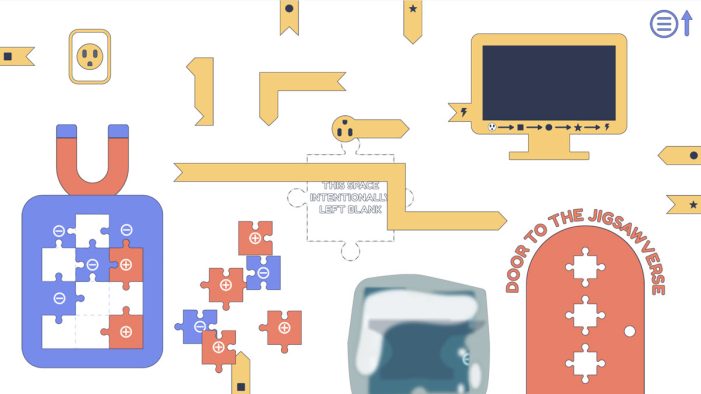
Strange Jigsaws is an apt enough title. Most of these puzzles are iterations on jigsaws, and many of them are nothing if not strange. But this is not a jigsaw puzzle. The average window shopper might mistake it for a lo-fi Glass Masquerade, that series of digital jigsaw puzzles with a luminous stained glass window aesthetic. But the Glass Masquerades live in the category of time-wasters, games you power down your brain to play, much like doing an actual tabletop jigsaw puzzle. Strange Jigsaws is more active, more brain food than mind bath, something you grind and process and digest rather than soak in.
I kind of wish Strange Jigsaws were called something else, because it’s only tangentially linked to jigsaw puzzling, and it’s more than just a set of puzzles. It’s got a narrative thrust, and it eventually reveals itself as a journey. It’s a guided tour through the mind of a man who doesn’t just make puzzles, but who cannot resist tinkering. Strange Jigsaws is his inner monologue turned outward, the diary of someone who looked at a jigsaw puzzle one day and simply couldn’t keep his hands off it, who couldn’t resist turning jigsaw puzzles into, well, something else entirely.
There’s a kind of alchemy here that turns puzzles into something more than puzzles. They bleed out into the structure of the game itself, they absorb it and transform. Nothing you see is untouched or unaffected. Everything gets sucked into the puzzling narrative. Each puzzle is just a point — sometimes wave, sometimes particle — along the journey to the final cutscene. That final instance of conclusion and contraction, a charming salute and send-off, well worth reaching.
I’m probably getting too grandiose. Strange Jigsaws isn’t some grand experiment like The Witness, the island Jonathan Blow constructed as his theme park for puzzles, his airy open-world that will leave you to wonder, agog, at the the statuary and monuments and canals and caverns, swallowed by its breadth, flummoxed by its impossibility, and ultimately frustrated by its pointlessness. The Witness, like Jurassic Park, is an exercise in hubris. But Strange Jigsaws, which is just as smart as The Witness for how it teaches you to play it, is a smaller place, trading expanse for intricacy. It is an exercise in intimacy.
What might seem at first like modest production values — clearly this is a one-man project — belies the ambition of the puzzles. The designer simply can’t keep his hands off anything. He refuses to color inside the lines. He will take you with him outside the normal boundaries, violating and redefining the concept of a “set of puzzles”. By way of example, an early puzzle asks you to do something that takes three pieces. But the field only offers two of them. There is clearly one too few available. What you must figure out is that the instructions, where the designer explains what the pieces are, are also part of the playing field. That last piece you need is the piece from the instructions identifying what it is. This is an early and important moment in Strange Jigsaws. Here you realize how the designer thinks, how he can’t resist bringing everything into play, including more than you expect from places you don’t expect.
It’s staggeringly smart and sometimes confoundingly subversive. But it’s not prohibitively difficult, and I say that as someone who’s easily frustrated by puzzles. Granted, there were plenty of times I simply quit playing because I didn’t know what to do…only to come back a few days later just to look at the puzzle again. Ah, so that’s it! A little time, a bit of distance, a fresh perspective, another real quick try. The solution was there all along. For some people, this might be a short game. I’m sure there are hardcore puzzle hounds who can finish this in an evening. But for me, and I suspect for many who will enjoy it in the spirit it’s intended, this is a game that can take literally months.
The designer has posted a hint system here, which is the first hit if you Google “strange jigsaws hints”. I confess I turned to these hints for two of the puzzles. I mostly regret it, because I’m almost sure I would have been able to figure them out in time. There’s an especially fiendish puzzle called Blue Temple — it’s just a field of blue — that’s all the more clever for its fiendishness. But I simply couldn’t resolve the final step, even after learning its intent. By the time I threw in the towel and looked up the solution, I discovered I had been on the verge of figuring it out. I had noticed exactly what I was supposed to notice, and sure enough, that had been the key to the solution. I had been on the threshold of a truly fantastic “a-ha” moment, but I lost faith. On a similar note, I knew what I needed to do for one of the last puzzles, but because I was impatient to write this review, I looked up the solution instead of working through it myself. I feel cheap, but I did it for you. (He tells himself.)
But all this fails to express what’s perhaps most striking about Strange Jigsaws. As with many puzzles, you have to adjust your perspective, think outside the box, leave behind your usual thought process. You have to step outside yourself to figure out what the designer wants you to do. That’s just puzzle solving 101. But in Strange Jigsaws, the designer isn’t hiding behind any sort of rationale, plot, or moon logic. Instead, he’s very much present, with you, guiding you, even encouraging you. Strange Jigsaws deliberately creates the sense of meeting him through his own thought process, through the unfolding successive reveals of how he designs puzzles, how he shifts the mutual understandings between creator and player, how he manipulates the boundaries. It’s not nearly as high-falutin’ as I might make it sound, although I’m sure someone could easily do a GDC presentation.
Instead, it feels like sitting in a corner booth in a quiet diner, watching him sketch out the puzzles on the back of a napkin and then slide it over to you. At one point, he even brings his daughter over to shyly say hello. It’s wonderfully personal, even touching. There’s a puzzle called The Million Piece Jigsaw Puzzle, which is quite literally a jigsaw puzzle with a million pieces. But it’s also a poignant meditation on the creative process, for better and worse and eventually better.
The designer never fully introduces himself — he doesn’t even bother to mention himself on the credits page! — but I guess I can be sympathetic to his reasons (The Million Piece Jigsaw Puzzle might actually explain some of that). He goes by the name “FLEB” (caps his), and he’s done a couple of earlier puzzle games. One of his linked social media accounts lists him as living in “The Carolinas”. I’m guessing by his neighborly lilt that it’s North Carolina, and he’s probably gainfully employed doing something smart people do in the Research Triangle, which might also be why he declines to name himself. But after playing through Strange Jigsaws, after sheepishly giving up on Blue Temple, after having shared that quiet booth in a diner for several months, I feel less like I just beat a bunch of puzzles. Instead, I feel like I just met a really smart and cool guy who showed me how his mind works.
Strange Jigsaws
Rating:
PC
No mere jigsaw puzzle, but a mind-blowing and surprisingly intimate meditation on the art of puzzles
