
So I got to play Skyrim. Actually play it. Jump in and run around and do whatever I want and stuff. I can’t verify anything about dragons, but I can assure you “here there be giants”.
Read all about it here.

Return in Red is, by nearly any metric, a bad movie. Bad. Director Tyler Tharpe is inordinately pleased with the simple act of moving the camera on a dolly without any regard for why or whether he should do it, much less how to cut around it. The lighting is alternately soupy, harsh, or tacky. It has no meaningful production values, shot mostly in people’s houses in Indiana. A barn set up with a couple of power tools stands in for a factory. The best thing you can say about the actors is that they’re occasionally relaxed. There is scarcely a frame of Retun in Red that doesn’t announce itself as an amateur production.
That said, I really liked Return in Red. It’s a textbook example of tension, suspense, and fear without resorting to the usual tropes. It has a canny sense for quiet menace. The opening narration is right out of the 70s, consisting of a simple quote about a program to study the effects of sound waves as a weapon. From here, we’re introduced to a small rural community, stalked by a strange white van with what looks like a satellite dish sticking out the side. Return in Red belongs in the tradition of The Crazies, or a far better version of The Crazies called Impulse, or an Alan Rudolph movie called Endangered Species, in which Dan Ulrich, JoBeth Willams, and Paul Dooley investigate UFO cattle mutilations.
And even though it’s bad, the amateurish quality gives it that raw grimy feel of 70s horror movies, especially when it starts to roll out the special effects. Like George Romero, Wes Craven, and Tobe Hooper before him, Tharpe is states and states away from from Hollywood, hundreds of miles from any movie studio, surrounded by and therefore working with actual people. As such, he has to come up with his own tricks. His desperate no-budget affection shows in every bleak and poorly lit frame he shoots. He’s like Mark Borchardt, but with a sense for subtlty.
I’m tempted to say Return in Red should have been a half hour shorter, maybe because I actually fell asleep a couple of times while watching it. Which isn’t the movie’s fault. My hours were messed up because of a time zone shift. In fact, my falling asleep complemented the occasionally hazy narrative. But ultimately, I don’t think you could trim anything from this slow and sometimes wet burn. The time it takes to breathe and meander makes the weird finale more effective. It gives the fate of the characters more weight, especially since they don’t seem like characters so much as people persuaded by Tharpe to wander into the frame from time to time.
But again, let me remind you that Return in Red is bad. I know that. I warned you right off the bat. But sometimes there’s more to a movie than being good or bad. Return in Red, available on Netflix’s instant watch, is one such movie.

I don’t make games; I just play them. Which is too bad for you, because if I made games, I would make the perfect real time strategy game. Not that I have anything against turn-based games, but the perfect one of those has already been made. Several times, in fact. Brian Reynold’s Sid Meier’s Alpha Centauri, Imperialism II, and Civilization IV, for instance.
Fortunately, most of the hard work for the perfect real-time strategy game has already been done. It just hasn’t been done in the same game. All I have to do is clump together bits from other games, do some quick testing to make sure it doesn’t crash, and, voila! The perfect RTS!
Read Of Hydralisks and Phalanxes here.

At QuakeCon, during one of the panels, Matt Hooper from id mentioned the Kinect. A very vocal young fellow seated behind me barked, “Lag!” This guy in the audience had been saying things very loudly and very inappropriately, so for a brief moment, I thought he’d called Hooper “fag”. I think — no joke — he might have had Tourrette’s Syndrome. When someone mentioned Zelda, he declared, “Navi!” as if it were the answer to an unspoken quiz show challenge (i.e. “name the sidekick in the following videogame franchises…”). At a reference to Half-Life, he hollered, “Oh yeah!”, almost exactly matching the intonation of the Kool-Aid pitcher busting in through a brick wall.
But when the Kinect was mentioned, he announced, “Lag!”. That one word, that one syllable, is the chief characteristic of the Kinect for many of us. And now, this week, here is the Kinect resorting to a port of the iPhone game Fruit Ninja. Here it is, hoping to insinuate itself among better games in XBLA’s Summer of Arcade series, like NBC sticking episodes of The Michael Richards Show between Frasier and Friends. But the truth of the matter is that no matter how responsive Kinect becomes, the greater issue is that it’s solving problems that don’t exist. If I want to play a casual colorful finger slider like Fruit Ninja — I don’t, actually, but if I did — I’ll play it on the iPhone instead of waving my entire arms around in the living room.
So, anyway, not much of a wallet threat this week.

Violet Sundown is a goofy mishmash of a community level. It’s good. It works well and is sufficiently challenging. The music is nifty. There’s absolutely nothing wrong with it. It just feels like a mishmash of styles and gameplay. Which is fine, especially when it delivers one particularly fine element.
Epiphany.
This may be an incidental benefit, but while playing Violet Sundown I became aware of how well I’m getting to know this game. It was a simple moment when I couldn’t quite make a jump and realized that I needed a grappling hook. Duh. Somehow in hurrying my sackboy along I’d missed picking up a grappling hook. Not an easy thing to miss. I ran back and there it was. I’d missed it. The simple realization that I was so quickly aware that I’d missed it pleased me. I know this game. This is pleasing.
As it turns out, not knowing is pleasing too…
After the jump, the best thing I played this week Continue reading →
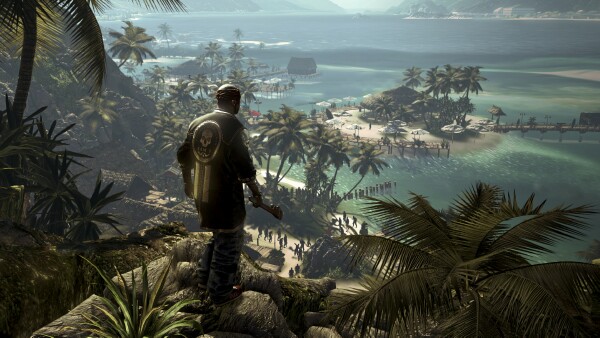
Jason McMaster recounts his ongoing series of vacations on Dead Island, each cut short after an hour. And Tom Chick gets in the wayback machine and parties like it’s 1999. Then — spoiler! — a Wii exercise game makes a surprise appearance.
Podcast (games): Play in new window | Download
Subscribe:

OK, so, Star Wars: The Old Republic is on its way this year and I’m trying to work myself into a MMO frenzy by starving myself of social interaction. For instance, before our podcasts, I only speak to Tom through grunts and clicks. My wife, Sarah, and I communicate through a psychic link. (The psychic channel we use is the one I usually reserve for REALLY wanting Doritos, which has reduced my nacho cheese intake to close to zilch.) The idea being that I’m so starved for human contact that playing a new MMO will be a “rad social experience.” The downside is that now I have to wait for it to come out.
Or do I? Find out after the jump… Continue reading →

Uday Hussein would not approve of our take on Devil’s Double. Neither would his double Latif Yahia, whose life is the subject of the movie. Dominic Cooper, who plays him, might not even approve. If you don’t want Devil’s Double spoiled, fast forward to this week’s 3×3 at the 52-minute mark. We have a catch-up session in which we plug this year’s movies into earlier 3x3s.
Podcast (movies): Play in new window | Download
Subscribe:


